Beko BCFD450 Manuale utente

Frost Free Combi Built-In
Fridge / Freezer
User instructions
BCFD450
EN

Please read these instructions first before using your appliance
Thank you for choosing a Beko appliance.
Please take some time to read this user manual before using your appliance, to
ensure you know how to safely operate the controls and functions.
Carefully follow all unpacking and installation instructions to ensure the
appliance is correctly connected and fitted prior to use.
Please write your product model and serial number on the last page of this user
manual, and store in a safe location close to the appliance for easy future reference.
This user manual may also be applicable for several other models.
Differences between models will be listed.
If you have any questions or concerns, please call our Customer Service Team
or find help and information online at www.beko.co.uk.
Explanation of symbols used throughout this User Manual
- The terminal in the plug is marked with the symbol.
- The freezer compartment is marked with the symbol.
-Important information or useful usage tips.
C
WARNING!
In order to ensure a normal operation of your refrigerating appliance, which
uses a completely environmentally friendly refrigerant the R600a (flammable
only under certain conditions) you must observe the following rules:
•
•
•
•
Do not hinder the free circulation of the air around the appliance.
Do not use mechanical devices in order to accelerate the defrosting, others
than the ones recommended by the manufacturer.
Do not destroy the refrigerating circuit.
Do not use electric appliances inside the food keeping compartment, other
than those that might have been recommended by the manufacturer.
- Symbol for waste electrical and electronic equipment.
SUPPLIER’S NAME MODEL IDENTIFIER
A
A
(*)
SUPPLIER’S NAME MODEL IDENTIFIER
A
A
(*)
Information
The model’s technical information can be retrieved by scanning the QR code on the Energy label and
proceeding to the website entering the model identifier.

Contents
Introduction & safety warnings...........................................................................2
Electrical requirements......................................................................................3
Transportation instructions.................................................................................4
Important installation instructions ......................................................................5
Getting to know your fridge / freezer..................................................................6
Suggested arrangement of food in the fridge / freezer......................................7
Temperature control and adjustment.................................................................8
Starting...............................................................................................................9
Storing frozen food.............................................................................................9
Freezing fresh food.............................................................................................9
Making ice cubes................................................................................................9
Defrosting.........................................................................................................10
Cleaning and care............................................................................................11
Replacing the interior light bulb........................................................................11
Do's and don'ts.................................................................................................12
Energy saving tips............................................................................................11
Problem solving ...............................................................................................11
Reversing the doors.........................................................................................13
Standard manufacturer guarantee terms and conditions..................................18
How to obtain service for your appliance..........................................................21
Please keep this handbook for future reference, or for
anyone else who may use the appliance.
Installation of high levelling foot........................................................................15
Built-in appliances guarantee terms and conditions......................
....................19
Parts guarantee terms and conditions ..........................................
....................20

Congratulations on your choice of a quality Appliance which has been designed to give you service for
many years.
WARNING!
IMPORTANT!
DO NOT connect your appliance to the electricity supply until all packing and transit protectors have been
removed.
•Leave to stand for at least 4hours before switching on to allow compressor oil to settle if transported
horizontally. r, disable the lock/latch,
ensure that it is left in a safe condition to prevent the entrapment of young children.
•This fridge/freezer must only be used for its intended purpose i.e.the storing and freezing of edible
an ongoing commitment. This appliance which is among the latest range introduced is particularly
environment friendly. Your appliance contains non CFC / HFC natural substances in the cooling
transpor
ignition source and immediately ventilate the room where the appliance is situated.
•We suggest you contact your local authority for disposal information and facilities available
•See Installation Instructions on page 5for information on suitable location.
•To obtain the best possible performance and trouble free operation from your appliance it is very
important to carefully read these instructions.
•On delivery, check to make sure that the product is not damaged and that all the parts and accessories
are in perfect condition.
•Ensure that the plug remains readily accessible. Do not use a multiple adapter bar or extension cable.
•Failure to observe these instructions may invalidate your right to free service during the guarantee
period.
WARNING- Keep ventilation openings, in the appliance enclosure or in the built-in structure, clear of
obstruction.
WARNING- Do not use mechanical devices or other means to accelerate the defrosting process, other than
those recommended by the manufacturer.
WARNING- Do not damage the refrigerant circuit.
WARNING- Do not use electrical appliances inside the food storage compartments of the appliance,
unless they are of the type recommended by the manufacturer.
•We suggest you keep these instructions in a safe place for easy reference.
•This appliance is not intended for use by persons (including children) with reduced physical, sensory or
mental capabilities, or lack of experience and knowledge, unless they have been given supervision or
instruction concerning use of the appliance by a person responsible for their safety.
• Children should be supervised to ensure that they do not play with the appliance.
•If there is a blue light on the refrigerator, do not look at the blue light with optical tools.
This product is equipped with a lighting source of the "G"
energy class. The lighting source in this product shall only
be replaced by professional repairers.
5HF\FOLQJThis product bears the selective sorting symbol for waste electrical and electronic
equipment (WEEE).
This means that this product must be handled pursuant to European Directive (8
in order to be recycled or dismantled to minimize its impact on the environment.
For further information, please contact your local or regional authorities.
Electronic products not included in the selective sorting process are potentiallydangerous
for the environment and human health due to the presence of hazardoussubstances.

ELECTRICAL REQUIREMENTS
Before you insert the plug into the wall socket make sure that the voltage and the
frequency shown in the rating plate inside the appliance corresponds to your
electricity supply.
Rating label is on the left hand side of fridge inner liner.
We recommend that this appliance is connected to the mains supply via a
suitable switched and fused socket in a readily accessible position.
WARNING: When positioning the appliance ensure the supply cord is not trapped
or damaged.
Should the mains lead of the appliance become damaged or should it need
replacing at any time, it must be replaced by a special purpose made mains lead
which can only be obtained from a Beko Authorised Service Agent.
WARNING! THIS APPLIANCE MUST BE EARTHED
If the fitted moulded plug is not suitable for your socket, then the plug should be cut
off and an appropriate plug fitted. Destroy the old plug which is cut off as a plug with
bared cord could cause a shock hazard if inserted into a socket elsewhere in the
house.
The moulded plug on this appliance incorporates a 13 A fuse. Should the fuse need
to be replaced an ASTABEAB approved BS 1362 fuse of the same rating must be
used. Do not forget to refit the fuse cover. In the event of losing the fuse cover the
plug must not be used until a replacement fuse cover has been fitted. Colour of the
replacement fuse cover must be the same colour as that visible on the pin face of
the plug. Fuse covers can be obtained from an authorised service agent.
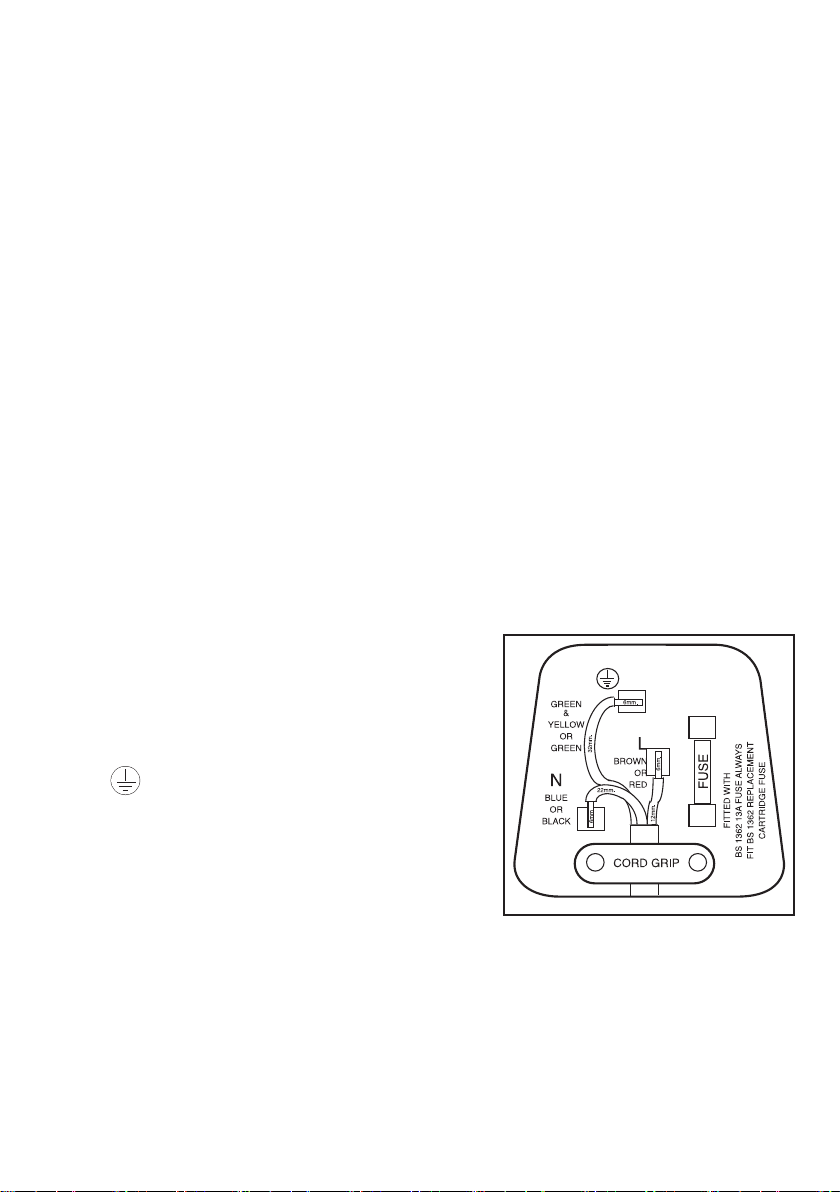
IMPORTANT! FITTING A DIFFERENT PLUG
As the colours of the wires in the mains lead of this
appliance may not correspond with the coloured
markings identifying the terminals in your plug
proceed as follows (see diagram):
1. Connect the green-yellow or green (Earth) wire
to the terminal in the plug marked 'E' or with the
symbol or coloured green and yellow or green.
2. Connect the blue (Neutral) wire to the terminal
in the plug marked 'N' or coloured black.
3. Connect the brown (Live) wire to the terminal in
the plug marked 'L' or coloured red.
With alternative plugs a 13 A fuse must be
fitted either in the plug or adaptor or in the main fuse
box. If in doubt contact a qualified electrician.
WARNING: Do not locate extension sockets or charging transformers/power
supplies or Lithium-Iron battery operated products adjacent to the compressor as
they could overheat.

TRANSPORTATION INSTRUCTIONS
1. The appliance should be transported only in a vertical upright position. The packing
as supplied must be intact during transportation.
2. If transported horizontally, leave to stand upright for at least 4 hours before
switching on, to allow compressor oil to settle.
3. Failure to comply with the above instructions could result in damage occurring to
the appliance. The manufacturer will not be held responsible if these instructions are
disregarded.
4. The appliance must be protected against rain, moisture and other atmospheric
influences.
5. When positioning your appliance take care not to damage your flooring, kitchen
furniture, related parts and doors, pipes, wall coverings etc. Do not move the
appliance by pulling by the door.
6. Empty any water in the drain tray before moving. See section ‘Defrosting’ and
‘Cleaning and care’ for further information.
7. Make sure that the defrost water pipe at the back of the product is fixed to the
plastic evaporating pan on the top of the compressor, to avoid defrost water spillage
on the floor.
IMPORTANT: Care must be taken while cleaning / carrying the appliance to avoid
touching the bottom of the condenser metal wires at the back of the appliance as you
might injure your fingers and hands.
Do not attempt to sit or stand on top of your appliance as it is not designed for such
use. You could injure yourself or damage the appliance.
IMPORTANT: Make sure that mains cable is not caught under the appliance during
and after carrying / moving the appliance, to avoid the mains cable becoming cut or
damaged.
Do not allow children to play with the appliance or tamper with the controls.
Beko plc declines to accept any liability should the instructions not be followed.

From Cookers
From Radiators
From Freezers
IMPORTANT
INSTALLATION INSTRUCTIONS
1. The space in the room where the appliance is installed must not be smaller than 10
cubic metres.
2. See pages 13 to 14 for detailed instructions regarding reversing door opening
direction.
3. This appliance has been designed to operate in ambient temperatures up to 38
degrees C (100 degrees F) and is equipped with Freezer Guard technology which
ensures that even if the ambient temperature falls to -15°C, frozen food in the
freezer does not thaw thanks to this. So, you may then install your appliance in a
garage or an unheated room without having to worry about frozen food in the freezer
being spoilt. However, at low ambient temperatures mentioned above, fridge contents
are likely to freeze, so check and consume food in the fridge accordingly. When the
ambient temperature returns to normal, you may change the temperature setting to
suit your needs.
If the ambient temperature is below 0°C, the food in the fridge compartment will
freeze. So, we recommend you don’t use the fridge compartment in such low ambient
conditions. You can continue using the freezer compartment as usual.
4. Do not place the appliance near cookers, radiators or in direct sunlight as this will
cause your appliance to work harder. If installed next to a source of heat or freezer,
maintain the following minimum side clearances:
5. Refer to cleaning and care section to prepare your appliance for use.
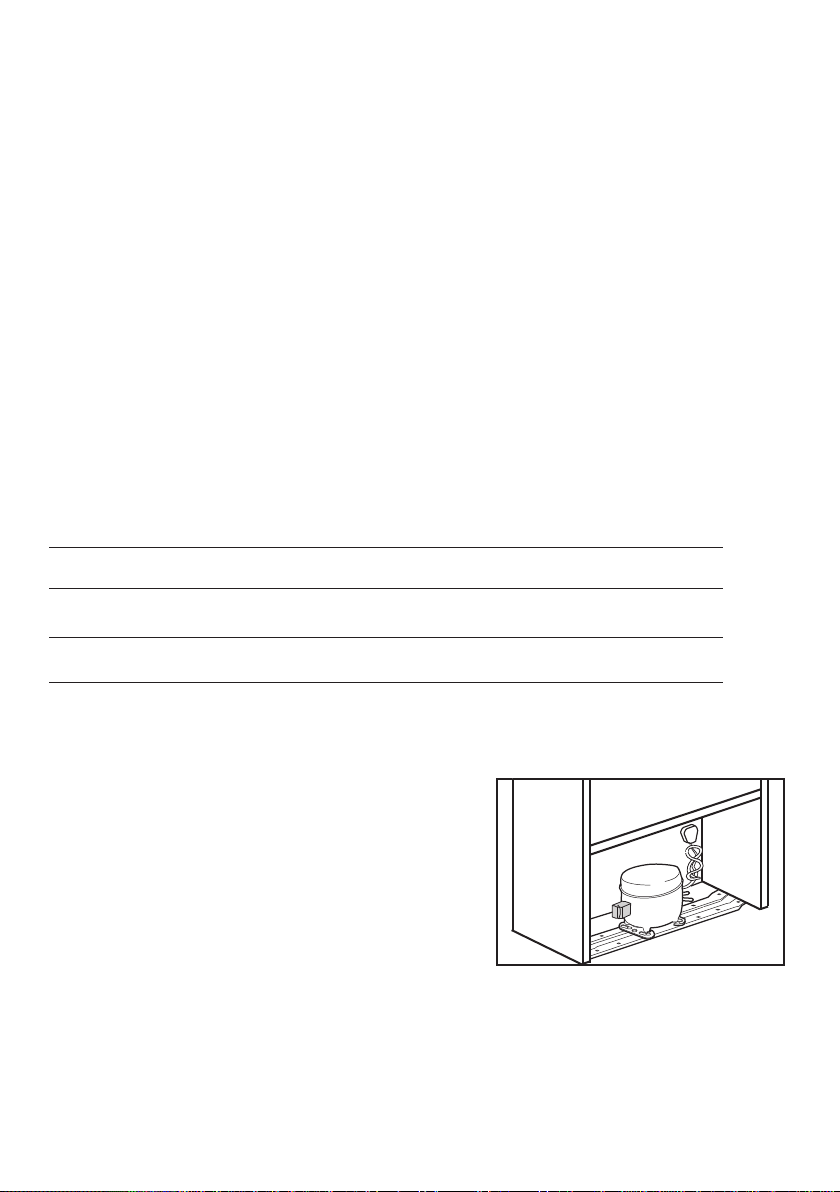
6. A special receptacle is supplied to store the
mains plug during transit.
The receptacle is fixed at the back of the
cabinet, on the side of the compressor (see
diagram). Gently remove the plug from the
receptacle. Never pull the mains cord, you may
damage the appliance. In the case of
transportation, ensure you locate the plug in the
receptacle provided to avoid transit damage.
50 mm (2")
300 mm (12")
25 mm (1")

GETTING TO KNOW YOUR COMBI T FRIDGE / FREEZER
CFigures that take place in this instruction manual are schematic and may not
correspond exactly with your product. If the subject parts are not included
in the product you have purchased, then it is valid for other models.
DEFROST WATER
COLLECTION
CHANNEL
EGG TRAY
FAST FREEZE
COMPARTMENT
FROZEN FOOD
STORAGE DRAWERS
TEMPERATURE SETTING
KNOB
INTERIOR LIGHT
BOTTLE
SHELF
DOOR
SHELF
DOOR
SHELF
SALAD
CRISPER
FREEZER
FAN
CABINET SHELVES
CABINET SHELVES

1. Baked, chilled cooked food,
dairy products, cans.
2. Meat, sausages, cold cuts.
3. Fresh fruit and vegetables.
4. Frozen food and freezing of
fresh food.
5. Frozen food.
6. Small bottles, cans, tubes.
7. Eggs.
8. Tall, large bottles, beverages.
8
4
5
5
5
SUGGESTED ARRANGEMENT OF
FOOD IN THE FRIDGE/FREEZER
Arrangement examples (see diagram)
The following guidelines and recommendations are suggested to obtain the best results
and storage hygiene.
1. The fridge compartment is for the short term storage of fresh food and drinks.
2. The freezer compartment is rated and suitable for the freezing and storage of
pre frozen food. The recommendation for storage as stated on the food
packaging should be observed at all times.
3. Cooked dishes must be stored in airtight covered containers.
4. Fresh wrapped produce can be placed on the shelf. Fresh fruit and vegetables should
be cleaned and stored in the crisper bins.
5. Bottles can be placed in the door section.
6. To store raw meat, wrap in polythene bags and place on the lowest shelf. Do not allow
to come into contact with cooked food to avoid contamination. For safety, only store raw
meat for two to three days.
7. Keep the food packed wrapped or covered. Allow hot food and beverages to cool
before placing them in the fridge. Do not store explosive substances. High proof alcohol
must be stored upright in sealed containers. Left over canned food should not be stored
in the can.
8. Fizzy drinks should not be frozen and products such as flavoured water ices should
not be consumed too cold.
9. Some fruit and vegetables suffer damage if kept at temperatures near 0°C. Therefore
wrap pineapples, melons, cucumbers, tomatoes and similar produce in polythene bags.
10. Place chilled cooked food and similar food near the rear of the fridge inner liner
where the cold wall is located.
11. Shelves, racks, crisper bins, drawers, flaps, bottle grippers are all removable.
12. Do not leave frozen food at room temperature to thaw; the best way to defrost food is
to put it in the fridge to thaw slowly. Make sure you avoid defrosting food or food juices
drip onto other food.
13. For hygiene reasons, always wrap food using a suitable packaging material before
storing in your appliance to avoid contact with the appliance surface.
14. Maximum frozen food storage volume can be achieved without using the upper shelf
cover located in the freezer. Energy consumption of your appliance is declared while the
freezer compartment is fully loaded without the use of upper shelf cover.
2
3
7
6
6

TEMPERATURE CONTROL AND ADJUSTMENT
Operating temperatures are controlled by the thermostat knob (see diagram) located
on the ceiling of fridge compartment. Settings may be made from MIN to MAX , MAX
being the coldest position.
When the appliance is switched on for the first time, the thermostat should be
adjusted so that after 24 hours, the average fridge temperature is no higher than
+5°C (+41°F). We recommend you set the thermostat half way between the MIN and
MAX setting and monitor to obtain the desired temperature i.e. towards MAX you will
obtain a colder fridge temperature and vice versa. Some sections of the fridge may
be cooler or warmer (such as the salad crisper and the top part of the cabinet) which
is quite normal. The normal storage temperature of the freezer should be
-18°C (0°F). Lower temperatures may be obtained by adjusting thermostat knob
towards MAX position.
We recommend that you check the temperature with an accurate thermometer to
ensure that the storage compartments are kept to the desired temperature.
Remember you must take your reading very quickly since the thermometer
temperature will rise very rapidly after you remove it from the freezer. Please
remember each time the door is opened cold air escapes and the internal
temperature rises. Therefore never leave the door open and ensure it is closed
immediately after food is put in or removed.
In case of a temporary ice build up in the fridge compartment, reduce the
thermostat setting to 1, monitoring at the same time that the fridge temperature is
maximum +5 degrees C [41 degrees F]. Once the ice build up disappears and the
appliance starts auto defrosting again as normal, then you may increase the
thermostat setting, if required. If the ambient (room or garage) temperature is
between 0°C and -15°C, we recommend you adjust the knob to setting 4 to reach
-18°C in the freezer compartment. Lower temperatures may be obtained by
adjusting setting knob towards MAX position.
Indice
Altri manuali Beko Frigorifero

Beko
Beko GNE V320 S Manuale utente

Beko
Beko DN 142103T Manuale utente

Beko
Beko FSE 1072 X Manuale utente

Beko
Beko DSA240K21W Manuale utente

Beko
Beko GNE60530X Manuale utente

Beko
Beko RCHE430K20S Manuale utente

Beko
Beko RDNE700E41XB IL Manuale utente

Beko
Beko Voltas RBM363 Series Manuale utente

Beko
Beko NDU 9950 Manuale utente

Beko
Beko CSA21032 Manuale utente

Beko
Beko BU 1153 Manuale utente

Beko
Beko CS 234020 Manuale utente

Beko
Beko DN 159120 Manuale utente

Beko
Beko RDSA240K30S Manuale utente

Beko
Beko RCNA365E30ZX Manuale utente

Beko
Beko FGA 943 Manuale utente

Beko
Beko TS190210 S Manuale utente

Beko
Beko GNE V322 S Manuale utente

Beko
Beko LNE415E20 Manuale utente

Beko
Beko GN1416240ZXN Manuale utente