Best CC34ISB Manuale utente

Model CC34ISB
ENGLISH.....................................2
FRANÇAIS.................................14
ESPAÑOL.................................. 28
In USA - BEST Hartford, Wisconsin
In CANADA - BEST Drummondville, QC, Canada
REGISTER YOUR PRODUCT ONLINE AT : www.BestRangeHoods.com/register
For additional Information visit www.BestRangeHoods.com

- 2 -
READ AND SAVE THESE INSTRUCTIONS
WARNING
TO REDUCE THE RISK OF FIRE, ELECTRIC SHOCK, OR INJURY TO PERSONS, OBSERVE
THE FOLLOWING:
1. Use this unit only in the manner intended by the manufacturer. If you have questions, contact
the manufacturer at the address or telephone number listed in the warranty.
2. Before servicing or cleaning unit, switch power off at service panel and lock service panel to
prevent power from being switched on accidentally. When the service disconnecting means can-
not be locked, securely fasten a prominent warning device, such as a tag, to the service panel.
3. Installation work and electrical wiring must be done by a qualified person(s) in accordance with
all applicable codes and standards, including fire-rated construction codes and standards.
4. Sufficient air is needed for proper combustion and exhausting of gases through the flue (chimney)
of fuel burning equipment to prevent backdrafting. Follow the heating equipment manufacturer’s
guidelines and safety standards such as those published by the National Fire Protection Associa-
tion (NFPA), and the American Society for Heating, Refrigeration and Air Conditioning Engineers
(ASHRAE), and the local code authorities.
5. When cutting or drilling into wall or ceiling, do not damage electrical wiring and other hidden
utilities.
6. Ducted fans must always be vented to the outdoors.
7. Do not use this unit with any separate solid-state speed control device.
8. To reduce the risk of fire, use only metal ductwork.
9. This unit must be grounded.
!
INTENDED FOR DOMESTIC COOKING ONLY
!
TO REDUCE THE RISK OF A RANGE TOP GREASE FIRE:
A. Never leave surface units unattended at high settings. Boilovers cause smoking and greasy
spillovers that may ignite. Heat oils slowly on low or medium settings.
B. Always turn hood ON when cooking at high heat or when flambeing food (i.e. Crepes Suzette,
Cherries Jubilee, Peppercorn Beef Flambe’).
C. Clean ventilating fans frequently. Grease should not be allowed to accumulate on fan or filter.
D. Use proper pan size. Always use cookware appropriate for the size of the surface element.
TO REDUCE THE RISK OF INJURY TO PERSONS IN THE EVENT OF A RANGE TOP GREASE
FIRE, OBSERVE THE FOLLOWING:*
1. SMOTHER FLAMES with a close-fitting lid, cookie sheet, or metal tray, then turn off the burner.
BE CAREFUL TO PREVENT BURNS. If the flames do not go out immediately, EVACUATE AND
CALL THE FIRE DEPARTMENT.
2. NEVER PICK UP A FLAMING PAN - You may be burned.
3. DO NOT USE WATER, including wet dishcloths or towels - violent steam explosion will result.
4. Use an extinguisher ONLY if:
A. You know you have a Class ABC extinguisher and you already know how to operate it.
B. The fire is small and contained in the area where it started.
C. The fire department is being called.
D. You can fight the fire with your back to an exit.
* Based on “Kitchen Fire Safety Tips” published by NFPA.

- 3 -
!
CAUTION
1. For indoor use only.
2. To reduce risk of fire and to properly exhaust air, be sure to duct air outside. Do not vent exhaust
air into spaces within walls or ceilings or into attics, crawl spaces, or garages.
3. Take care when using cleaning agents or detergents.
4. Avoid using food products that produce flames under the Range Hood.
5. For general ventilating use only. Do not use to exhaust hazardous or explosive materials and
vapors.
6. To avoid motor bearing damage and noisy and/or unbalanced impellers, keep drywall spray,
construction dust, etc. off power unit.
7. Your hood motor has a thermal overload which will automatically shut off the motor if it becomes
overheated. The motor will restart when it cools down. If the motor continues to shut off and
restart, have the hood serviced.
8. For best capture of cooking impurities, the bottom of the hood should be a minimum of 48”
and a maximum of 72” above the cooking surface. See “Install Mounting Bracket” section for
mounting restrictions.
9. Two installers are recommended because of the large size and weight of this hood.
10. The light source is designed for this specific application and can overheat if serviced by untrained
personnel. If any servicing is required, the product should be returned to an authorized service
facility for examination or repair.
11. Please read specification label on product for further information and requirements.

- 4 -
OPERATION
Controls (Fig. 1)
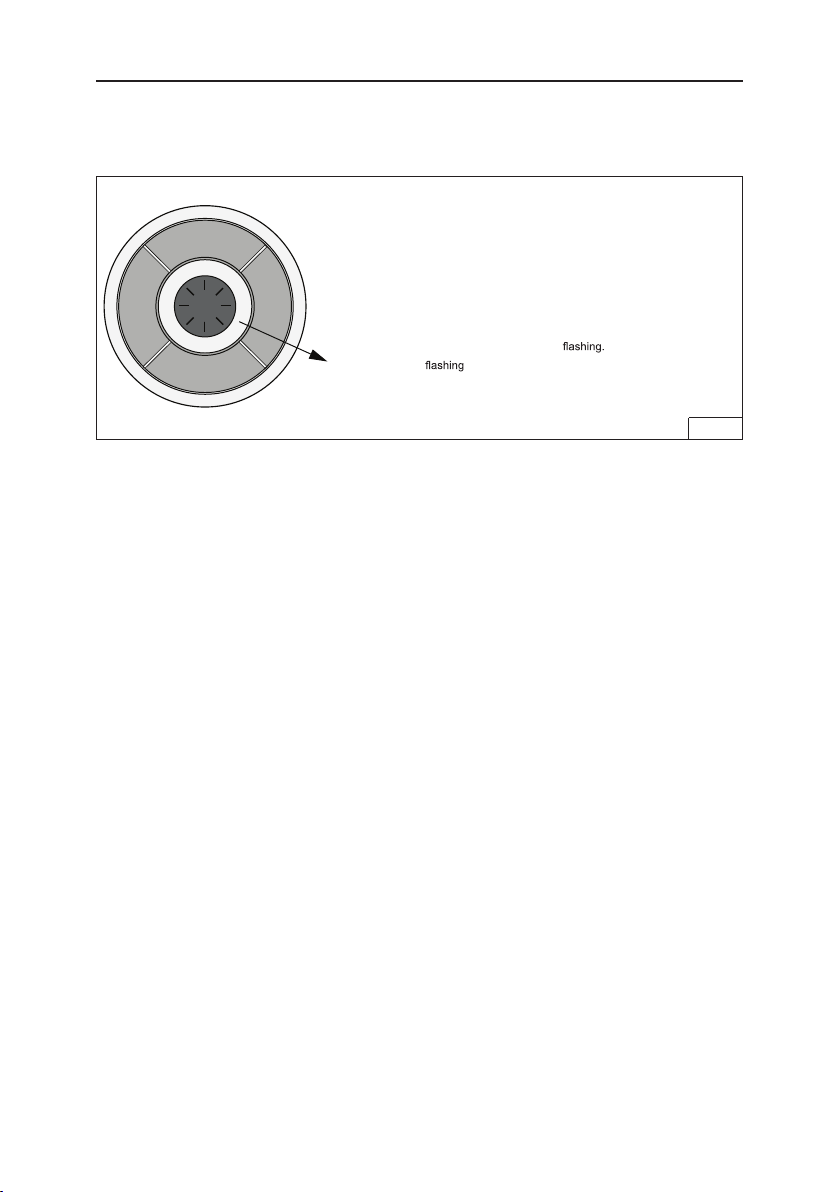
The hood is operated using the (5) push-buttons located on the hood and the remote control.
LED colors are displayed on hood control only.
FIG. 1
(P1) Delay- Off Switch
• Your hood includes a 10 minute blower delay off switch. Press this switch once to activate the
timer and the LED Ring (L1) flashes blue. The blower will continue to operate for 10minutes.
After 10 minutes, the blower turns off automatically.
• To cancel the 10-minute delay, press the delay switch once again.
(P2) Filter Alarm Switch
• After 30 hours of blower operation, the filter alarm is activated and the LED ring (L1) turns
red/flashes. It indicates that the grease filters need to be cleaned.
• After cleaning the grease filters, reset the hour counter by pressing the Filter Alarm/Timer
Reset button (P2) during display of the alarm.
(P3) Blower Speed Decrease and Off Switch
• Press to decrease blower speed, high to low. The LED ring (L1) flashes blue at a speed
proportionate to the blower setting (i.e.: four flashes is high speed, one flash is low speed,
etc.)
• Continue pressing this switch to turn the blower off.
(P4) Blower Speed Increase and On Switch
• Press this switch to turn the blower on to low speed.
• Press again to increase blower speed, low to high. The LED ring (L1) flashes blue at a speed
proportionate to the blower setting (i.e.: four flashes is high speed, one flash is low speed,
etc.)
(P5) Light Switch
Turns the lights on and off.
P1
P2
P3 P4
P1: Activate/deactivate delay-off (10 minute)
P2: Filter change indication timer reset
P3: Decreases fan motor speed until turned off (4>3>2>1>OFF)
P4: Turns fan motor on and increased speed (ON>1>2>3>4)
P5: Turns lights on/off
L1: LED Indicator Ring Signalling crown:
- Hood in standby: lights up green. 30 seconds after
the last key has been pressed the crown turns off
- Motor on: L1 lights up blue The
frequency is proportional to the speed setting.
- 10’ TIMER function : L1 lights up and flashes blue.
- Filter alarm active: L1 lights up red
L1
LED
RING
P5 +
-
ƒ
¤

- 5 -
CLEANING AND MAINTENANCE
Proper maintenance of the Range Hood will assure proper performance of the unit.
Motor
The motor is permanently lubricated and never needs oiling. If the motor bearings make excessive or
unusual noise, replace the motor with the exact service motor. The impeller should also be replaced.
Grease Filters
The grease filters should be cleaned frequently. Use a warm detergent solution. Grease filters are
dishwasher safe.
Clean all-metal filters in the dishwasher using a non-phosphate detergent. Discoloration of the filter may
occur if using phosphate detergents, or as a result of local water conditions - but this will not affect filter
performance. This discoloration is not covered by the warranty.
See “INSTALL FILTERS” section for removal and installation instructions.
Stainless Steel Cleaning
DO:
• Regularly wash with clean cloth or rag soaked
with warm water and mild soap or liquid dish
detergent.
• Always clean in the direction of original polish
lines.
• Always rinse well with clear water (2 or 3 times)
after cleaning. Wipe dry completely.
• You may also use a specialized household
stainless steel cleaner.
DON’T:
•
Use any steel or stainless steel wool or any
other scrapers to remove stubborn dirt.
• Use any harsh or abrasive cleansers.
• Allow dirt to accumulate.
• Let plaster dust or any other construction
residues reach the hood. During construction/
renovation, cover the range hood to make sure
no dust sticks to the stainless steel surface.
Avoid: When choosing a detergent
• Any cleaners that contain bleach will attack stainless steel
• Any products containing: chloride, fluoride, iodide, bromide will deteriorate surfaces rapidly.
• Any combustible products used for cleaning such as acetone, alcohol, ether, benzol, etc., are highly
explosive and should never be used close to a range.

- 6 -
PREPARE THE HOOD
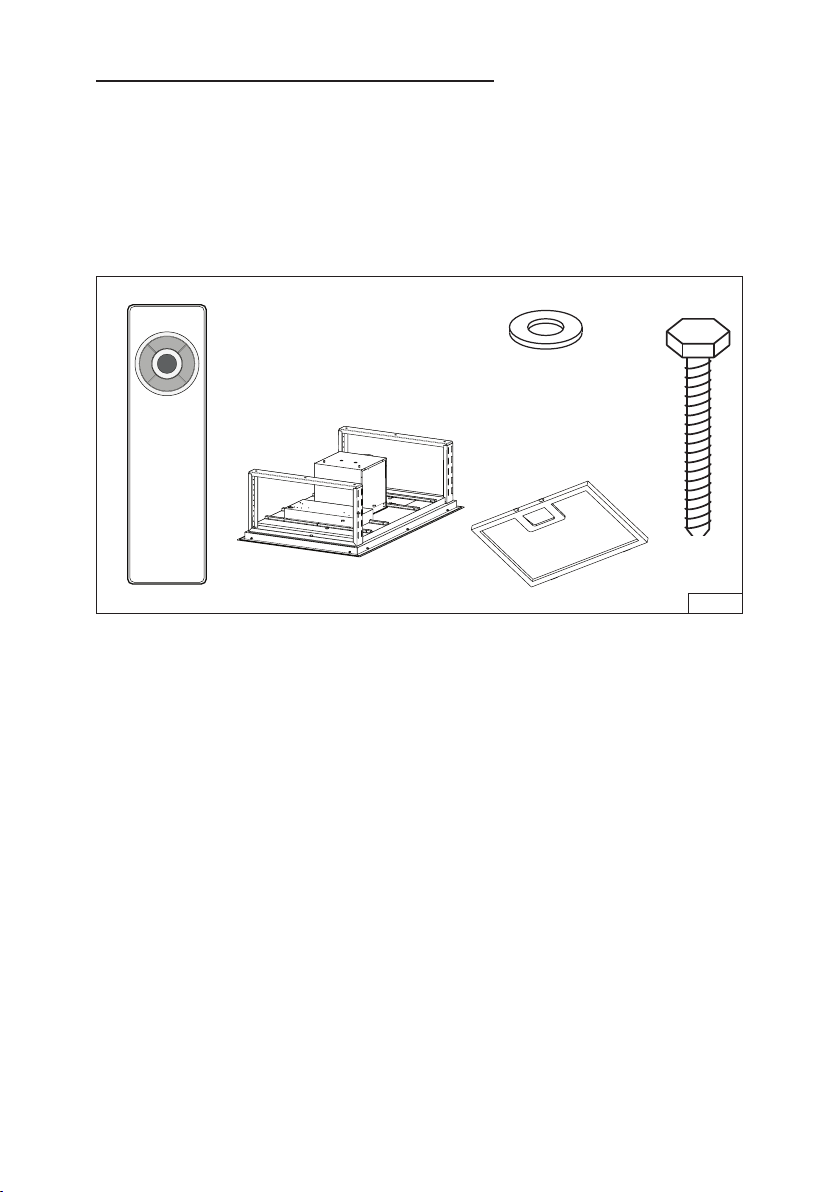
Unpack hood and check contents.
You should receive:
1 - Range Hood Body
1 - Remote Control
6 - Grease Filters
1 - Damper
6 - Lag Bolts, 6 x 70 mm
6 - Washers
DAMPER
6 LAG BOLTS
(6 x 70 mm)
FIG. 2
REMOTE
CONTROL
RANGE HOOD
BODY
6 GREASE
FILTERS
6 WASHERS

- 7 -
INSTALL THE DUCTWORK
PREPARE THE CEILING
OPENING
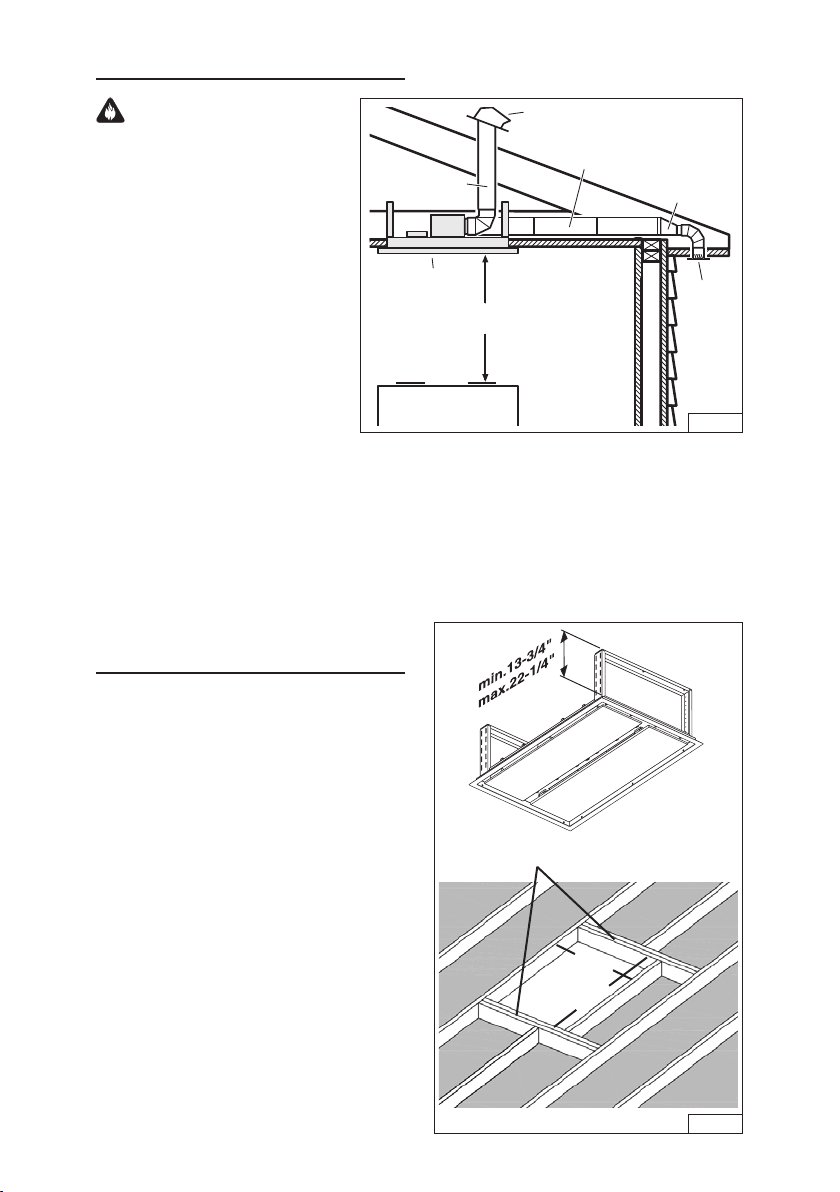
The hood should always be centered over the
cooktop. Make sure there is adequate space
in the ceiling structure to install the hood and
ductwork. The hood should be mounted 48”
to 72” above the cook top for best removal of
cooking impurities. Fig 4.
Use joist size lumber to frame in around the
range hood opening. The ceiling structure
must be able to support the weight of the
hood (64 pounds). Fig 5.
FIG. 5
FIG. 4
ROOF CAP
48" TO 72" ABOVE
COOKING SURFACE
HOOD
6" ROUND
DUCT
6" ROUND
TO 3¼” X 10”
REDUCER
3¼” X 10”
UNDER
EAVE
VENT
6" ROUND
DUCT
WARNING: To reduce the
risk of fire, use only metal duc-
twork.
1. Decide where the ductwork will
run between the hood and the
outside. Fig. 4.
2. A straight, short duct run will
allow the hood to perform most
efficiently.
3. Long duct runs, elbows, and
transitions will reduce the per-
formance of the hood. Use as
few of them as possible. Larger
ducting may be required for
best performance with longer
duct runs.
4. Install a roof cap, wall cap, or under-eave vent. Connect round metal ductwork to cap/vent
and work back towards hood location. Use duct tape to seal the joints between ductwork
sections.
5. The blower can be rotated according to the air outlet location. Fig. 7.
DOUBLE HEADERS
42
1
/
2
”
26¾”

- 8 -
PREPARE THE HOOD
SUPPORT
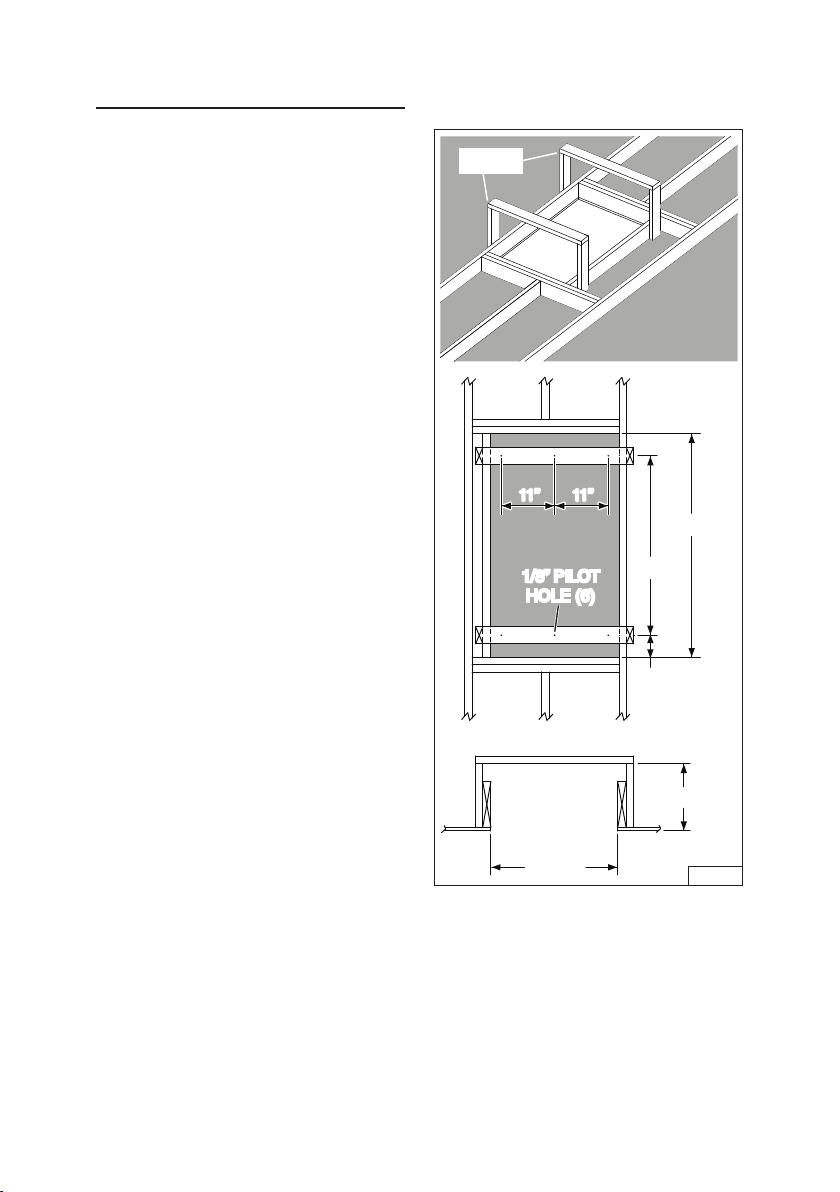
1. Construct a wood framing system as
shown in Fig. 6.
2. The structure must be capable of support-
ing its own weight, plus the weight of the
hood (64 pounds).
FIG. 6
2 x 4
FRAMING
37-1/4”
42-1/2”
14”
26-3/4”
2-5/8”
1/8” PILOT
HOLE (6)
11” 11”11” 11”
1/8” PILOT
HOLE (6)

- 9 -
INSTALL THE HOOD
CAUTION: At least two installers are
recommended because of the large size
and weight of this range hood.
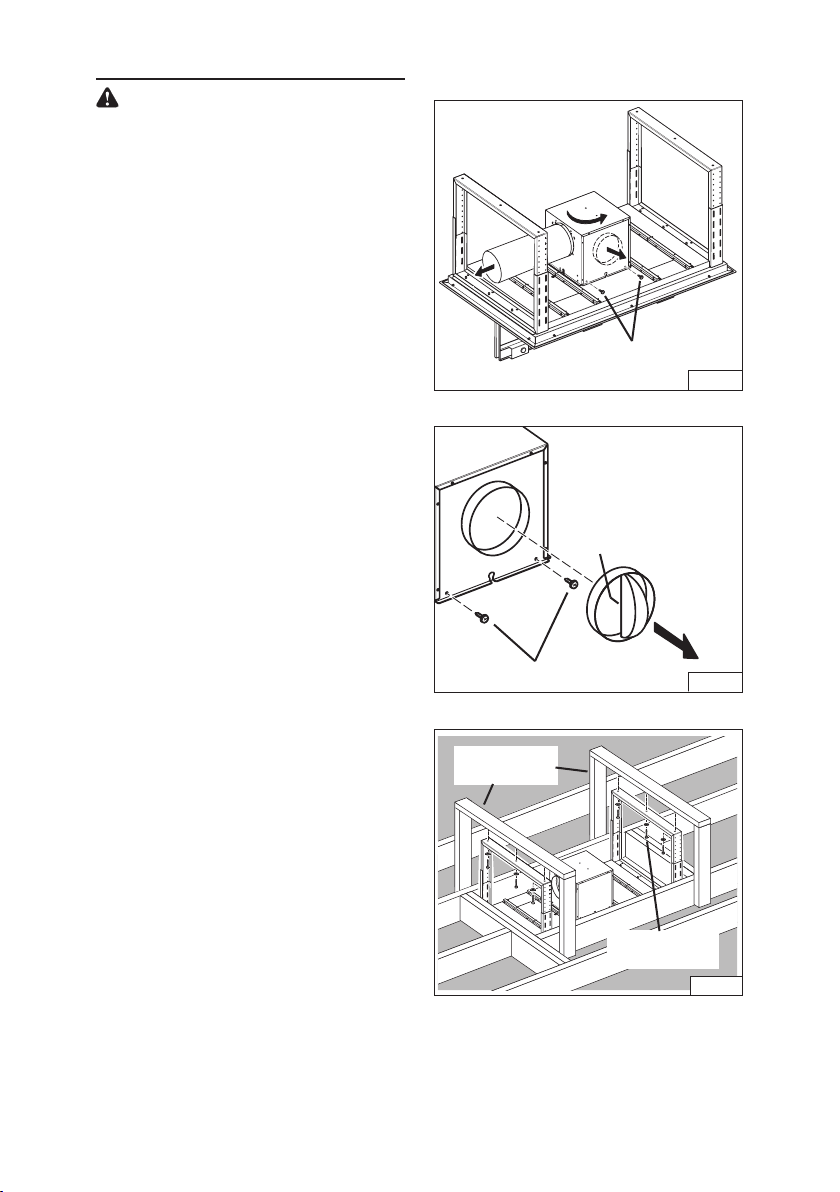
1. Hood is shipped in the horizontal duct
discharge position and is ready to be
installed.
2. To change direction of the duct without
using elbows. Fig. 7:
• Remove (4) screws from sides of blower
box.
• Remove blower, turn blower 90 degrees,
reinstall (4) screws.
3. Install damper into blower discharge collar.
Make sure damper flaps open in direction
of air flow as shown and pivot is vertical.
Fig. 8. Use duct tape to secure the damper
inside the discharge collar.
4. Lift range hood into the ceiling opening.
5. Secure each support frame to the wooden
hood support frame using (6) 6 x 70 mm
lag bolts and washers provided. Fig. 9.
6. Adjust height of the telescoping support
frame to ensure a tight fit between the
hood and finished ceiling.
7. At the blower discharge collar, connect
ductwork that exhausts air to the outside
discharge.
8. Duct tape all joints to ensure an air tight
seal.
FIG. 7
FIG. 8
SCREWS (4)
SCREWS (4)
DAMPER OPENS IN
DIRECTION OF
AIR FLOW
AIR FLOW
DAMPER
PIVOT
FIG. 9
2 X 4 WOOD
FRAME
(6) WASHERS
& LAG BOLTS

- 10 -
FIG. 10
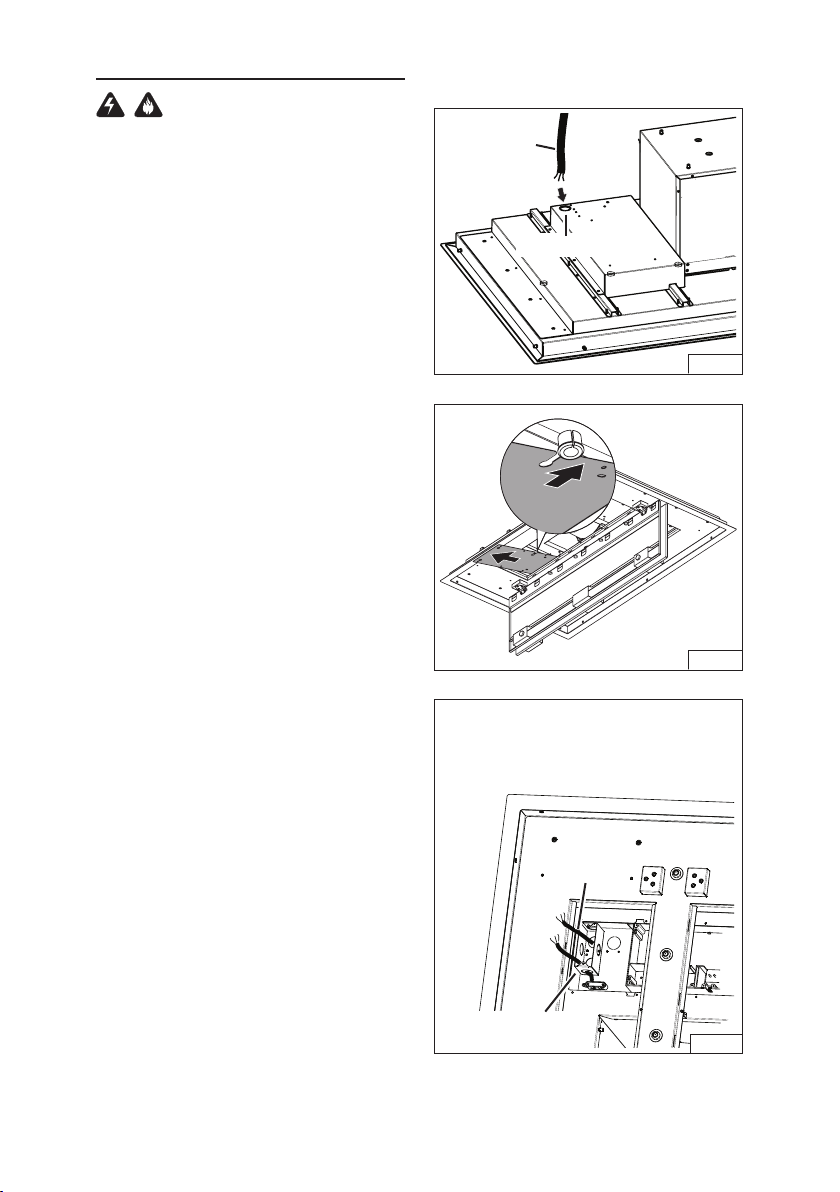
CONNECT THE WIRING
WARNING: All electrical wiring
should be done by a qualified person (s)
in accordance with all applicable codes
and standards. This range hood must be
properly grounded.
Do not turn blower on at the service panel
until all wires have been connected.
1. Run 2-wire plus ground, 120 VAC electrical
power cable to the ¾” knockout located on
the back of the hood. Fig. 10.
2. Remove ¾” electrical knockout from the
back of the hood.
3. From the room interior, pull down both
closure panels. Fig. 11.
4. Remove (4) screws from the electrical
compartment access panel. Slide the
panel sideways to expose the electrical
wiring box.
5. From the electrical box marked “120 VAC
Inlet”, remove (2) screws that secure the
cover to the metal wiring box. Fig. 12.
6. Pull 120VAC electrical power cable into
the box and secure with an appropriate
cable clamp.
7. Make electrical connections inside the
box. Connect white-to-white, black-to-
black and green-to-ground.
8. Replace the wiring box cover and the
screws. Make sure wires are not pinched
between the cover and box.
9. Replace the electrical compartments ac-
cess panel and (4) screws.
2-WIRE PLUS
GROUND
120 VAC
LINE IN
KNOCKOUT
FIG. 11
FIG. 12
120 VAC
LINE IN
BOX MARKED
“120VAC INPUT”
CONNECT
WHITE-TO-WHITE
BLACK-TO-BLACK
GREEN-TO-GROUND
Indice
Lingue:
Altri manuali Best Cappa di ventilazione

Best
Best K210A Manuale utente

Best
Best Range Hood U102E Manuale utente

Best
Best WTT32I Series Manuale utente

Best
Best WPP9IQ Manuale utente

Best
Best P195P1M52 Manuale utente

Best
Best IP29M Series Manuale utente

Best
Best WPD39M SERIES Manuale utente

Best
Best WP28M SERIES Manuale utente

Best
Best P195ES70SB Manuale utente

Best
Best KB 700 XS 90 VB Manuale utente

Best
Best WM45I Manuale utente

Best
Best WP29M SERIES Manuale utente

Best
Best DDEX30SS Manuale utente

Best
Best WPD29M Series Manuale utente

Best
Best HBN1 Series Istruzioni per l’uso

Best
Best K9388 Manuale utente

Best
Best ANKUP Series Manuale utente

Best
Best IPB9 Manuale utente

Best
Best P195 Manuale utente

Best
Best K260A series Manuale utente