Cameron BARTON 764 Manuale utente

BARTON®MODEL 764
DIFFERENTIAL PRESSURE
TRANSMITTER
User Manual
Part No. 9A-C10880, Rev. 05
January 2020
Contents
Section 1—Introduction................................................................................. 5
General.........................................................................................................5
Product Description.......................................................................................5
Dierential Pressure Unit (DPU) ...............................................................5
Electronic Transmitter................................................................................5
Power Supply............................................................................................5
Specications................................................................................................6
Performance..............................................................................................6
Application.................................................................................................7
Storage:.....................................................................................................8
Section 2—Theory of Operation.................................................................... 9
Basic Components........................................................................................9
Dierential Pressure Unit (DPU) ...............................................................9
Draining or Venting.....................................................................................9
TemperatureCompensation......................................................................10
Bellows......................................................................................................10
Strain GageAssembly...............................................................................10
Range Springs..........................................................................................10
Electronic Transmitter...............................................................................10
Basic Operation ...........................................................................................11
Reverse Polarity Protection......................................................................11
Regulator.................................................................................................12
Strain Gage Bridge Network....................................................................12
Signal Amplier........................................................................................12
Current Amplier......................................................................................12
Temperature Compensation........................................................................12
Section 3—Installation and Operation........................................................ 13
Unpacking/Inspection..................................................................................13
Pre-Operating Instructions..........................................................................13
Mounting.....................................................................................................13

Table of Contents Model 764 Differential Pressure Transmitter
Vibration..................................................................................................13
Piping..........................................................................................................14
Distance ..................................................................................................14
Slope.......................................................................................................14
Process Temperature.............................................................................. 14
Pulsation..................................................................................................14
Leakage...................................................................................................14
High-Pressure Connection..........................................................................14
Manifolding..................................................................................................14
Electrical Connections................................................................................. 15
Load and Line Resistance Calculations..................................................16
EMI/RFI Shielding.......................................................................................18
Initial Calibration Adjustments.....................................................................19
Calibration Check....................................................................................19
Startup Procedure...................................................................................21
Shutdown Procedure...............................................................................21
Section 4—Maintenance ............................................................................. 22
General Field and Periodic Maintenance....................................................22
DPU Inspection and Cleaning .................................................................22
Pressure Check.......................................................................................22
Cleaning the DPU....................................................................................22
Periodic Calibration ....................................................................................23
Transmitter Cover Removal........................................................................25
Transmitter Cover Reinstallation.............................................................25
Operation of the EGS Quick Disconnect Connector Assembly................... 26
Lead Wire/Connector Replacement............................................................27
Removal of the EGS Quick Disconnect Connector Assembly................. 27
Installation of the EGS Quick Disconnect Connector Assembly.............. 27
Removal of the Barton Style Connector Assembly.................................. 29
Installation of the Barton Style Connector Assembly............................... 29
Troubleshooting..........................................................................................31
Section 5—Assembly Drawing and Parts List........................................... 32
Section 6—Dimensional Drawings ............................................................. 34
Product Warranty........................................................................................35
Product Brand..............................................................................................35

Model 764 Differential Pressure Transmitter Table of Contents
Safety
Before installing this product, become familiar with the installation instruc-
tions presented in Section 3 and all safety notes throughout.
! WARNING:Thissymbolidentiesinformationaboutpracticesorcircum-
stances that can lead to personal injury or death, property damage, or
economic loss.
CAUTION: Indicates actions or procedures which if not performed correctly
may lead to personal injury or incorrect function of the instrument
or connected equipment.
IMPORTANT: Indicates actions or procedures which may aect instrument operation or
may lead to an instrument response that is not planned.

Table of Contents Model 764 Differential Pressure Transmitter

5
Model 764 Differential Pressure Transmitter Section 1
Section 1—Introduction
General
The Model 764 Dierential Pressure Transmitter provides a 4-20 mA or 10-
50 mA proportional-to-dierential pressure signal for transmission to remote
receiving, control, or readout devices.
The electronic components of the Model 764 transmitter are housed in a
pressure-sealed enclosure. The instruments are designed to operate beyond
their normal operating environmental specications for a limited period of
time under such adverse conditions as may be encountered within the contain-
ment of a nuclear power plant under accident and post-accident conditions.
These adverse environments include severe changes in ambient pressure,
temperature and humidity, seismic events, and radiation exposure.
Product Description
The Model 764 transmitter combines a dierential pressure unit (DPU) with
an electronic circuit. The 4-20 mA or 10-50 mA output is compatible with a
wide range of electronic receiving, control, and readout equipment. The in-
strument utilizes electronic circuits and a molecular-bonded strain gage sens-
ing cantilever beam, actuated directly by the bellows travel within the DPU.
Dierential Pressure Unit (DPU)
The mechanical actuating device for the Model 764 transmitter is a dual
bellows assembly enclosed by a set of two pressure housings. The dual bel-
lows assembly (Figure 2.1, page 9) consists of two internally-connected
bellows, a center block, overrange valves, a temperature compensator, a strain
gage assembly, and range springs. The internal volume of the bellows and
center block is completely lled with a clean, non-corrosive, non-conductive
liquid with a low freezing point and sealed. The motion-sensing cantilever
beam is also sealed within this environment.
Electronic Transmitter
The electronic transmitter supplies either a 4-20 mA or 10-50 mA direct cur-
rent output signal that is proportional to the dierential pressure sensed by the
DPU. The output signal is transmitted over a two-wire transmission line to
remote receiving devices.
Power Supply
A regulated direct current (DC) power supply is required to operate the trans-
mitting loop.

6
Section 1 Model 764 Differential Pressure Transmitter
Specications
Performance
Input Range....................................0-60 inches (water column) to 0-320 psid
Output.............................................4-20 mAor 10-50 mA, direct and reverse acting
Reference Accuracy*......................±0.5% of factory-calibrated span, including eects of
conformance (non-linearity), deadband, hysteresis,
and repeatability
Adjustability ....................................±5% eld adjustability of factory-calibrated span,
without aecting normal or accident condition perfor-
mance. Span is eld adjustable from 20% to 100%
of factory-calibrated span. Zero is eld adjustable for
up to 30% suppression. Zero or Span adjustments
beyond ±5% aect normal and accident condition
performance.Calibration is by the end-point method
with zero and full scale outputs held to ±0.05% of
true.
Sensitivity*......................................±0.01% of factory-calibrated span
Power Requirements......................15 VDC plus 2 VDC per 100 Ohm load to 53 VDC
maximum (4-20 mA)
15 VDC plus 5 VDC per 100 Ohm load to 52 ±1 VDC
(53 VDC maximum) for 10-50 mA
Load Range
(includes line and receiver).............50 Ohms per volt above 15 VDC (4-20 mA)
20 Ohms per volt above 15 VDC (10-50 mA)
Load Eect* ....................................< ±0.05% of factory-calibrated span per 100 Ohm
change (4-20 mA)
< ±0.1% of factory-calibrated span per 100 Ohm
change (10-50 mA)
Power Supply Eect*......................< ±0.025% of factory-calibrated span per 1 Volt
change (4-20 mA)
< ±0.05% of factory-calibrated span per 1 Volt
change (10-50 mA)
Suppression....................................100% of calibrated span (factory adjustment), 30%
with potentiometer
Span Control...................................20% to 100% of maximum span (±5% only without
degradation of specications); potentiometer range
is greater than 2:1 at maximum span and greater
than 1.5:1 at minimum span
Noise*.............................................< 0.5% peak-to-peak of factory-calibrated span
Thermal Eect* (combined
eect on zero and span).................±1.0% of factory-calibrated span per 100°F change
from +40°F to +150°F
±1.5% of factory-calibrated span per 100°F change
from +150°F to +320°F
Radiation*.......................................±10.0%@2 x 10⁸ Rads TID Gamma; pressure
boundaries tested to 9 x 10⁸ TID Beta
Seismic:
During Event*.............................< ±5.0% error
After Event*................................< ±0.5% error

7
Model 764 Differential Pressure Transmitter Section 1
LOCA Performance*.......................< ±5.0% error during the rst ve minutes of LOCA
(420°F)
< ±10.0% error thereafter to the conclusion of the
LOCA test, as performed per Document No.
9A-CR3-764-9
The LOCA errors include the cumulative eects of
thermal, mechanical, radiation, and seismic aging,
as performed per Document No. 9A-CR3-764-9.
Long Term Drift*..............................±1.0% of factory-calibrated span per year, cumula-
tive
Time Response ..............................< 180 msec. to reach 50% for 10% to 90% step
function
Maximum Safe Working Pressure..3,000 psig
Static Pressure Eects*
60" WC to 42 psid spans............±0.2% of the factory-calibrated span per 1000 psig
43 to 320 psid spans..................±0.5% of the factory-calibrated span per 1000 psig
Overpressure Eects
60" WC to 42 psid spans............±0.5% of the factory-calibrated span per 1000 psig
43 to 320 psid spans..................±1.0% of the factory-calibrated span per 1000 psig
Overpressure Limit.........................Up to maximum safe working pressure on either side
of DPU without damage to unit
Process Connections......................1/4" and 1/2" NPT on both high and low pressure
sides
Weight ............................................20.5 pounds
Electrical Interface..........................2-wire (16 AWG) pigtail (20' long)
*Note: Turndown has a directly proportional eect on the indicated specications.
IMPORTANT: The Model 764 transmitter has no integral electronic interference sup-
pression features. If an instrument is to be installed in an area containing
EMI/RFI sources and this interference cannot be tolerated, take precau-
tions to protect the transmitter signal. See also EMI/RFI Shielding, page
18.
Application
The Model 764 Dierential Pressure Transmitter was subjected to IEEE
323-1974/344-1975 qualications testing which found the device suitable for
functional service in a harsh environment (LOCA/MSLB).
The service conditions associated with the Model 764 Transmitter nuclear ser-
vice qualications are presented below:
Qualied Service Life
(accelerated aging for
1,830 hours at 257ºF......................85 years at normal conditions of 104ºF
54 years at normal conditions of 113ºF
35 years at normal conditions of 122ºF
23 years at normal conditions of 131ºF
10 years at normal conditions of 140ºF
Radiation Exposure........................200 x 106 Rads (TID Gamma)

8
Section 1 Model 764 Differential Pressure Transmitter
DBE Environment...........................Two 10-second temperature ramps to 486ºF maxi-
mum; 24 hour duration chemical spray exposure;
15 day total exposure to saturated steam at 250ºF
minimum
Long Term Severe Environment.....85 days at 200ºF and 95% RH
Seismic Qualications ....................OBE @ 9.0 G (series of 5)
SSE @ 12.5 G
5% critical damping
no resonance in frequencies below 75 Hz
Mechanical Aging ...........................500,000 pressure cycles during accelerated aging;
Cycled electrically to induce stress during acceler-
ated aging;
Vibration cycling using 0.2 G sweeps over the 1-100
Hz range @ 1.0 octave/min.
Storage:
Storage per ANSI N45.2.2-1978 Level B @ 70ºF (20ºC) ±20ºF (±11ºC) in
factory-sealed package for 2.5 years maximum will not aect installed service
life.

9
Model 764 Differential Pressure Transmitter Section 2
Section 2—Theory of Operation
Basic Components
Dierential Pressure Unit (DPU)
HP Housing
Valve Stem
HP Bellows
LP Housing
LP Bellows
Figure 2.1—DPU
The dierential pressure range of the dual-bellows type DPU is determined by
the force required to move the bellows through their normal range of travel.
To provide for various ranges, range springs are incorporated into the Bellows
Unit Assembly (BUA). The range springs, which are available in various
factory assemblies, accurately balance the dierential pressure applied to the
DPU.
In operation, the two bellows (which are connected by the valve stem shown
in Figure 2.1) move in proportion to the dierence in pressure applied across
the BUA. The linear motion of the bellows is picked up by the tip of the sili-
cone strain gage beam, which is actuated directly by the valve stem connect-
ing the two bellows. If the bellows are subjected to a pressure greater than the
dierential pressure range of the DPU, they will move through their normal
range of travel, plus a small additional amount of "overtravel," until the valve
on the stem shaft seals against its valve seat. As the valve closes on the seat, it
"traps" the ll liquid in the bellows, protecting the unit from damage or shift
in calibration.
Since the ll uid is essentially non-compressible, the bellows are fully sup-
ported and cannot rupture regardless of the over-pressure (up to the full rated
pressure of the instrument) applied to the unit. Furthermore, since the unit
contains opposed valves, protection against "overrange" in either direction is
provided.
Draining or Venting. The high and low pressure housings of the DPU are
provided with both top and bottom pressure connections which provide a
draining feature when the unit is used in gas installations, or a venting feature

10
Section 2 Model 764 Differential Pressure Transmitter
when the unit is used in liquid installations, when installed in accordance with
standard practices.
Temperature Compensation. The high pressure side of the DPU has extra
bellows convolutions to provide for expansion and contraction of the ll
liquid caused by ambient temperature changes. These extra convolutions are
connected to the measuring bellows by a passageway to permit the ll liquid
to change volume without materially aecting the internal pressure or the
physical relationship of the measuring bellows.
Bellows. Individual bellows diaphragms are stamped from special order Type
316 ELC (Extra Low Carbon) stainless steel sheets. The diaphragms are as-
sembled and seam welded to form the bellows.
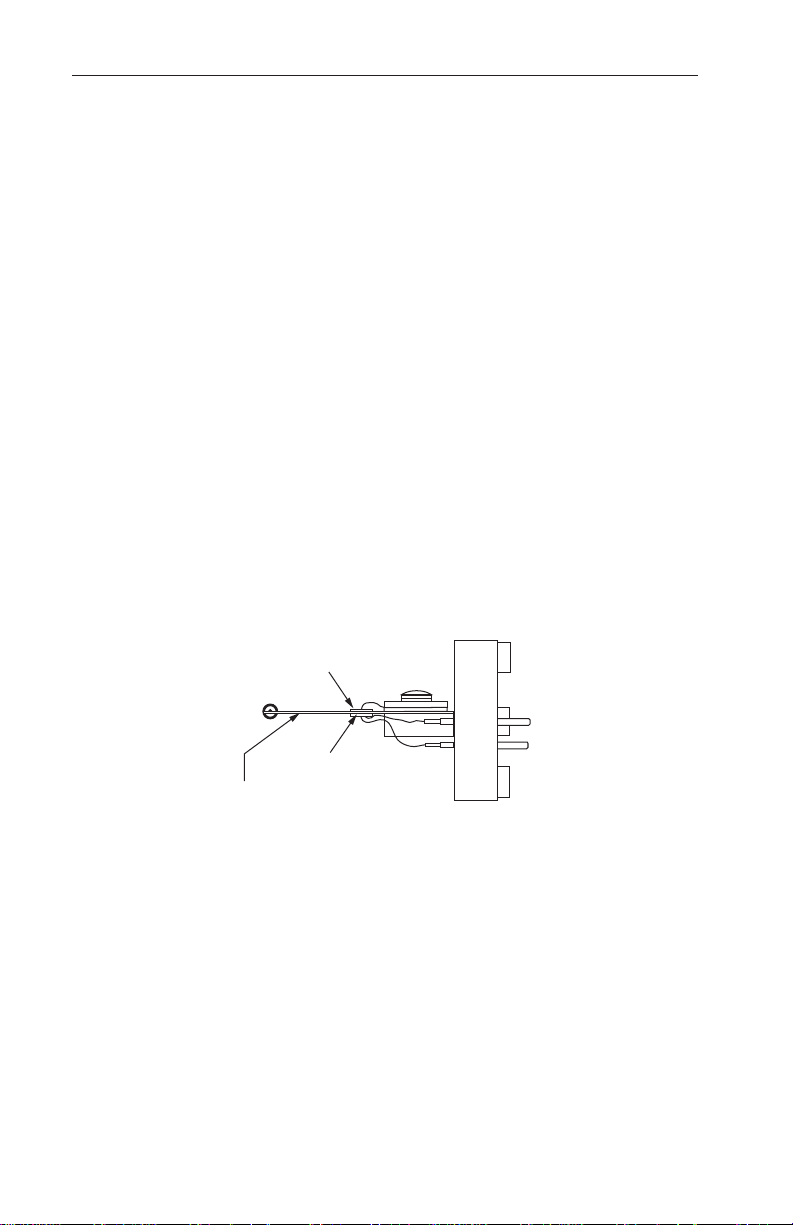
Strain Gage Assembly. The strain gage assembly (Figure 2.2) consists of
a strain gage beam and a glass-to-metal seal feed-through assembly. Strain
gages are bonded to opposite sides of the strain gage beam. The end of the
strain gage beam is installed directly into a cutout in the valve stem con-
necting the two bellows of the DPU. Any movement of the bellows in either
direction causes a corresponding linear movement of the strain gage beam
which acts upon the strain gages. Any action of the strain gages is monitored
by the electronic transmitter circuit.
Tension Strain Gage
Compression Strain Gage
Beam & Strain Gage Assembly
Figure 2.2—Strain Gage Assembly
Range Springs. The range springs act with the bellows to balance the dier-
ential pressure applied to the unit. The springs are fabricated of a material that
is compatible with the specic bellows material used. The number of springs
and their rate depends on the dierential range desired.
Electronic Transmitter
The DPU senses the dierence in pressure applied across the bellows unit as-
sembly. The pressure causes a linear motion of the bellows which is mechani-
cally transmitted to the strain gages by the strain gage beam. Motion of the
end of the strain gage beam applies tension to one gage and compression on
the other. The gage in tension increases in resistance, while the one under
Indice
Altri manuali Cameron Trasmettitore