SECTION
IV
Theory
of
Operation
4.1
INTRODUCTION
This section
contains
the
theory
of
operation
for
the
BEEHIVE
8150
Terminal. This discussion
is
presented
as
a functional description
at
a detailed
block diagram level referencing
appropriate
func-
tional blocks
on
the
diagrams.
4.2
GENERAL FUNCTIONAL DESCRIPTION
The
B
150
consists
of
four
basic functional
compo-
nents, Power Supply, Mani
tor,
Keyboard
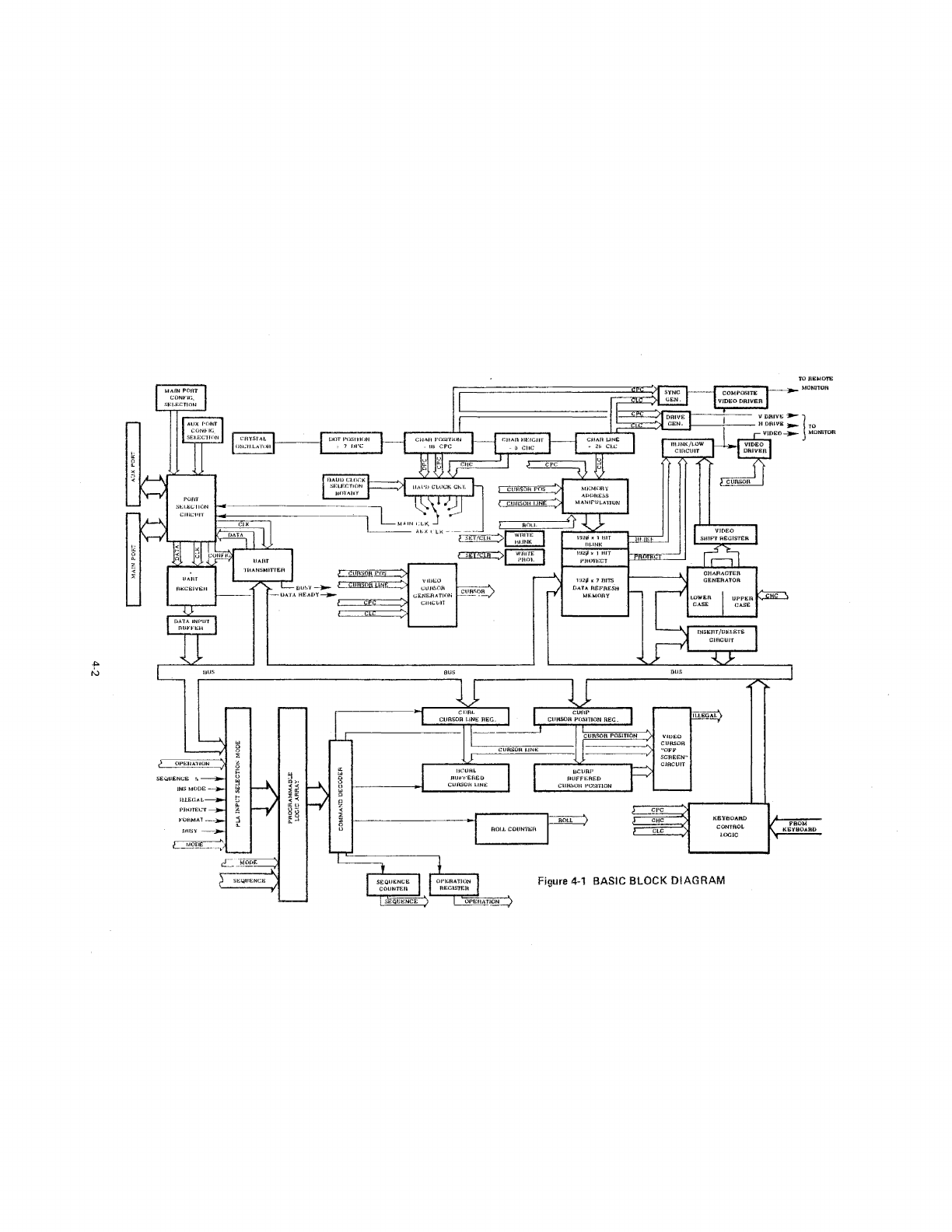
and Main Logic Board. Figure
4-3
shows
the
basic
functional flow diagram
of
the
terminal. These
functions
are briefly described
in
the
following
paragraphs.
4.2.1 Power
Supply
The Power
Supply
provides
the
required, regula-
ted
DC
voltages
to
the
terminal. This assembly
will
operate
on
100, 115,
or
230
V
AC
50/60
Hz
power (see Section
II).
·
4.2.2
Monitor
The Monitor Assembly includes a 12 inch (30.5
cm). diagonally measured,
CRT
and its
support-
ing solid-state circuitry.
The
Monitor
is
controlled
by
the
vertical
and
horizontal
synchronization
sig-
nals, and the video signals generated on
the
logic
board. A full screen
of
information
consists
of
24
4-1
lines
of
80
characters and a
one
raster scan
bet·
ween lines. Brightness and
contrast
adjustments
ai-e
provided by external
potentiometers
located
on
the
rear panel, (see Figure
2-2,
Se~tion
11
).
Other
monitor
adjustments are discussed
in
Section V and in Appendix
A-.
4.2.3 Keyboard
The
keyboard
is
the
input
device used
by
the
opera-
tor
to
communicate
with
the
terminal. The key-
board
contains
the switches and
supporting
circuitry
to
generate
the
appropriate
control
signals and
ASCII codes utilized
in
the
B
150
terminal.
The
key-
board
conforms
to
the
proposed ANSI
keyboard
standard
for
data
keys,
but
has been
expanded
to
facilitate
the
capabilities
of
the
8150.
4.2.4 Logic Board
The
Logic Board contains
the
major function and
control circuits in
the
B150 termina. It also
holds all
of
the
DC
voltage regulators
to
power
the
unit, with
the
exception
of
the
+5 V regulator.
The
basic operations accomplished by
the
main
logic board are: Generation
of
data
a!1d
control
signal~
for
the
monitor,
interaction with
the
key-
board,
control
of
the
data
sent
between
the
B
150
and any external device, and generation
of
the
basic timing signals essential for
the
operation
of
the
terminal.