
emitor Satlook Micro HD Manuale utente

Satlook Micro G2 / HD
User Manual
______________________________________
______________________________________

2
Contents
Overview
page 3
Quick Start
page 4
asyFind Mode
page 6
Digital Mode
page 7
Spectrum Mode
page 13
Analog Mode
page 15
Setup Functions
page 19
Loading New Firmware
page 24
Using PC to Transfer Transponder Data
page 25
Appendix A - Saved Parameters
page 26
Appendix B - Universal LNB Primer
page 27
Appendix C - DiS qC Primer
page 28
Appendix D - DVB-S and DVB-S2 Primer
page 30
Appendix – UniCable Primer
page 31
Appendix F - Satlook G2 and HD *.smd File Structure
page 33
Appendix G - Satlook G2 Specifications
page 34
Appendix H - Satlook HD Specifications
page 35
Glossary
page 36
This manual is applicable for the Satlook G2 with firmware level above smG2HD-106.
For earlier firmware revisions, use the Satlook G2 User manual
(updated September 20, 2010)

3
Overview
The Satlook G2 and Satlook HD are Satellite Test quipment for the professional made in
Sweden. The Satlook G2 can receive DVB-S satellite signals and the Satlook HD can
receive both DVB-S and DVB-S2 satellite signals. Both use advanced demodulators and
can “lock” on transponders using automatic modulation type, symbol rate and F C
selection. They are easily operated with just three controls and the basic functions are
easy to learn.
The instruments are provided with a 3" LCD which is used to display information such as
signal strength, Spectrum, or Digital information.
The Satlook G2 and Satlook HD can be used to measure satellite signals from two LNBs
at the same time. Signal strength is presented graphically on the LCD display in form of
thermometer scales.
They can also sound a tone which increases in pitch with signal level on an internal
loudspeaker.
They can store 100 positions of Satellite transponder information.
The instruments can easily scan through the memory positions and identify the various
Satellite transponders.
The polarisation of the LNB is switchable by setting the LNB voltage to 13V or 18V and
the High Low band with a 22 kHz signal. The DiS qC function controls all DiS qC
accessories such as LNBs, switches, and positioners.
The instruments are supplied with a built-in and rechargeable battery and a carrying case
for protection of the instrument in the installation environment.

4
Quick Start
Power On/Off Button
Menu Knob and Button
LNB-A connector
LNB-B connector
Power Input for charging
RS232 Port
Reset Button
Power On
The Satlook G2 / HD is turned on by pressing and
holding the power on button for one second.
Power on tones indicate that firmware loading has
started. This takes about six seconds for the Satlook
HD and is shown by a progress bar on the display
and a pattern on the blue L Ds.
The initial mode can be set by the user for
convenience. Pressing and holding the power
button also turns off the instrument. The button
must be held for more than one second in order to
turn the unit off. The Satlook G2 / HD also has an automatic power down that is
adjustable which will turn the unit off when there is no activity. This can be set using the
Setup Menu.
Navigation
The Menu Button and Menu Knob are the two controls used for navigation through the
menus and selection of functions. When the menu is off, pressing the Menu Button
shows the Menu. It is shown at the active mode, so if the Satlook G2 / HD is in Digital
mode,the menu is shown with the Digital entry at the top. Using the knob, the function
that is to be executed is shown highlighted. Pressing the Menu Button causes the
function to be performed. For simple functions such as switching the LNB Voltage with
the 13V/18V function, the Satlook G2 / HD performs this function, turns off the menu,
and immediately returns to the current mode.
For other functions, a new screen with choices is presented. Pressing the Menu Button
selects the highlighted item. Some of these other functions have an exit function that is
used to return to the current mode.

5
The Menu Knob is used for Frequency adjustment when in the Digital mode or the
Spectrum mode. When the Menu Knob is turned slowly, the frequency is changed by
1MHz, but if rotated rapidly, the frequency step is increased allowing for quick
movement to the correct frequency.
Charging
Before using the Satlook G2 / HD, it should be fully charged.
To charge the instrument, connect the external power supply or 12V Car Cigarette
Lighter Plug and then plug the external power supply into the DC Input connector. The
charging process will begin and the blue L D lights will cycle indicating charging. The
charging mode and time of charging are displayed on the screen.
A full charge can take up to 14 hours, but depending on the battery state can be
completed sooner. When charging is complete, the bottom L D will be lit indicating
that the charging is complete. The Satlook G2 / HD can be operated using the external
power supply, but when the instrument is on, no charging is being performed.
The battery state is indicated on the Analog screen by a battery symbol.

6
asyFind Mode
The asyFind Mode is an easy way to point the dish at installation. When the asyFind
Mode is entered, the Profile defined in the Setup asyFind Configuration is used. The
five satellite transponders (or in the case of All Sats, all of the memory positions) which
are in the Profile can be selected with the knob.
Initially the display will appear as in the left diagram above and the RF signal will be
indicated on the display and by a tone with increasing frequency as the RF signal
increases. Turn the knob to select one of the five transponders in the Profile. Point the
dish in the approximate position, and move it slowly until the Satellite is found as in the
right picture above. There is an audible indication of the correct satellite and a different
audible indication if the wrong satellite is found. If the indication is correct, then the
screen will show the NIT data after a few seconds for final confirmation. Now the Digital
mode can be used for final peaking. asyFind Mode is exited by pressing the button.

7
Digital Mode
About Digital Mode
When the user enters Digital Mode, the Satlook G2 will attempt to receive a DVB-S
signal at the current frequency and the Satlook HD will also try to receive a DVB-S2
signal. The current frequency is displayed in the centre of the screen and can be
changed by the knob (within the limits of the current LNB type and the 22 kHz setting).
The state of the battery is displayed in the upper right corner of the screen.
When a signal is received, the Satlook G2 / HD is “locked” and the modulation mode is
displayed. This will be shown as
QPSK
, or with the Satlook HD,
QPSK HD
or
8PSK HD
.
The current F C and symbol rate are shown along with the LNB type definition being
used.
If the signal is locked, then the frequency displayed includes the frequency offset to the
signal centre frequency. Usually, the instruments will lock to a signal up to 5MHz offset.
When not locked, the frequency display contains no offset and an Automatic Search is
started in the direction given by the knob.
Four boxes are shown in the upper left to indicate the state of locking. For the Satlook
G2, from left to right these are: QPSK Lock, Descrambler Lock, Byte Align Lock, Viterbi
Lock. For the Satlook HD, from left to right these are: Tuner Mixer Lock, Tuner
DAC Lock, F C Lock, Demod Lock.
In Automatic Search, the Satlook G2 / HD checks the signal power at each 3 MHz
interval and if the signal is a peak, it will attempt to lock using the current Modulation
settings defined in the Setup/Modulations screen (DVB-S, DVB-S2, DVB-S Low Symbol
rate). The Satlook G2 searches for QPSK signals. The search will stop when a signal is
locked. Turning the knob re-starts the search in the direction of the knob turn. For
Universal LNBs, if the frequency reaches 11900 MHz in low band, the 22kHz signal will
automatically switch on and the search continues in high band. When searching down,
when the frequency reaches 11520 MHz in high band, the 22kHz will automatically
switch off and the search continues down.
The Search will end when a signal is locked or the frequency limits are reached. Manual
Tuning can be entered using the Digital Menu and is active until the next press of the
menu knob. With the Satlook HD, in order to lock on signals when the signal symbol rate
is less than 15000 MSymbols/sec, the option “Low Symbol Rate” must be selected in the
Locked
Not Locked

8
Setup Modulations. On both instruments, for symbol rates below 7000 MSymbols/sec,
the signal identification may take several seconds.
A constellation pattern is shown which is formed from a small subset of the IQ decision
points received by the demodulator. Occasionally, during an attempt to lock, a
calibration pattern can be observed momentarily. This is not a real signal, but is an
artefact of the demodulator process.
The current state of the 22 kHz signal and the LNB voltage are displayed at the left.
These are mirrored by the blue L D displays.
Once a transponder signal is locked, the Network Information is displayed at the top of
the screen. This can take some time to appear once the transponder is locked. The first
information that will appear is ONID (Original Network ID) and TSID (Transport Stream
ID) data and then the NIT name and Orbital Position will follow. The ONID and TSID are
displayed in hexadecimal. The transponder is supposed to send this data at least every
10 seconds, but sometimes there will be a transponder not sending any NIT data. Also
you should be aware that sometimes a transponder will send incorrect satellite position
data, because they are being used to repeat a transport stream used on another satellite.
Visible Thermometer Bars
There are four thermometer bars displayed to indicate the state of the signal being
received. For all of these, the higher the thermometer bar, the better the signal quality.
ach of these thermometer bars has the recent maximum displayed as a single bar. This
maximum decays over time and so automatically allows for peaking adjustments. The
four thermometer bars are SIG, SNR, B R and M R.
SIG
SIGSIG
SIG
This is the power level of the signal
signalsignal
signal at the current frequency. It is always displayed
whether the signal is locked or unlocked. This is not the same as the display on the
Analog screen.
SNR
SNRSNR
SNR
This is the signal to noise ratio
signal to noise ratiosignal to noise ratio
signal to noise ratio of the locked signal. This is a measure of the meaningful
power in the signal to the background noise of the signal. It is shown in dB and is
calculated by the demodulator using
SNR = 10log
10
(P
signal
/P
noise
)
B R
B RB R
B R
This is the bit error ratio
bit error ratiobit error ratio
bit error ratio
of the signal. The lower this value is, the better the signal. It is
shown in reverse on the thermometer bar for convenience so that a maximum can be
easily found. For DVB-S QPSK signals, this is
B R = rror
preViterbi
/(Bit
Rate
Time
Lock
).
For DVB-S2 QPSK or 8PSK signals, the B R is estimated from the ratio of Un-correctable
blocks to Correctable blocks.
M R
M RM R
M R
This is the modulation error ratio
modulation error ratiomodulation error ratio
modulation error ratio in dB. It is calculated from the constellation pattern and
represents how close the I and Q decision points are to the ideal position. A typical M R
value is 16 dB. A higher value is better and represents a closer spread of IQ decision
points. A sample of 200 points is used for the calculation.
(
)
( )
+
+
=∑
∑
22
22
10
log10
errorerror
idealideal
QI
QI
MER

9
Accessing the Digital Menu
When in the Digital Mode, turning the knob will change the current frequency. The
Menu button will activate the Digital Menu.
Frequency / Search
Frequency / SearchFrequency / Search
Frequency / Search
This function enters Digital Mode with the Search function disabled. Tuning can be
performed manually using the knob. The manual tuning mode will remain active until
the Search function is executed.
Load Memory
Load MemoryLoad Memory
Load Memory
The Load Memory function is used to load the settings for frequency, polarisation, and
band from the permanent memory. The knob is used to select the desired memory and
the knob button loads this memory. Once a memory location has been loaded, Load
Mode is active. In Load Mode, turning the knob, turning the knob selects the next
memory location, loads the memory and displays the memory number and name.
To exit the load mode, the user presses the button once again and then the knob
determines frequency on the Digital screen as before.
When a frequency is locked in Digital Load Mode, and NIT data is available, it replaces
the memory position and name display, but if the knob is turned, then a new memory
position is loaded and the memory position number and name displayed. This is replaced
by NIT data when it is available.
10
Channels
ChannelsChannels
Channels
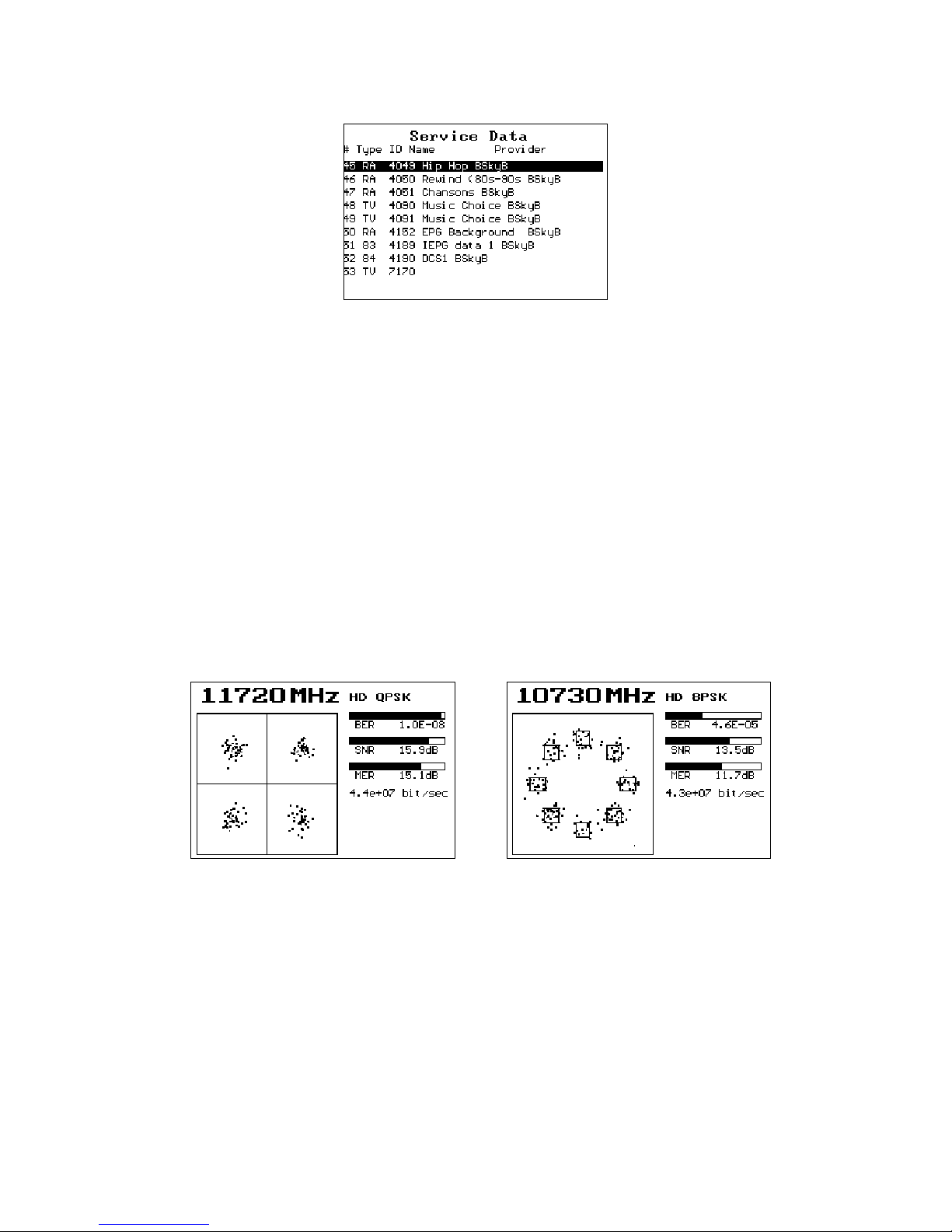
This shows the services available on the current transponder. The type of service is
shown in the first column. RA is a radio service, TV is a standard definition service and
HD is a High Definition service. Other service types are listed by number. The Service ID
number, Service Name and Service Provider are shown. The services shown will update
as more services are found. The knob can be used to scroll up and down to see all of the
services.
13V/18V
13V/18V 13V/18V
13V/18V
The LNB voltage can be switched from the Digital Menu.
22kHz
22kHz 22kHz
22kHz
The 22kHz signal can be switched from the Digital Menu.
DiS qC Command
DiS qC CommandDiS qC Command
DiS qC Command
This is the same as the function available on the Analog menu.
Constellat
ConstellatConstellat
Constellation
ionion
ion
This function shows a larger version of the constellation presentation for a more detailed
view. The current frequency is displayed at the top and rotating the knob will allow this
to be changed. If locked, the current modulation is displayed along with the B R, SNR,
and M R thermometer bars. The current Bit Rate of the transponder is shown with the
Satlook HD. This information is not available on the Satlook G2. The 8PSK display shows
the target boxes outlined. These target boxes are moved to the average target position.
Altri manuali per Satlook Micro HD
1
Questo manuale è adatto per i seguenti modelli
1
Indice
Altri manuali emitor Ricevitore


