LED Startup:
The LED of each microinverter blinks red for a while at the beginning, and then blinks
green to indicate normal start-up approximately 10 seconds after DC power is applied.
If the LED blinks red after DC power is on , it indicates a failure during the start-up.
Post-Startup LED Indications:
Check LED status to confirm the present situation.
Flashing Green: It indicates normal operation.
Flashing Red:
1. If red light flashes every 2 or 3 seconds, it indicates that the microinverter is waiting
for sun or prepare to produce energy.
2. If red light flashes continuously, it indicates that the microinverter is not operating
normally. The microinverter does not detect that the utility grid is within operable
voltage/frequency range. The microinverter cannot produce power until this is solved.
8.2 Troubleshoot an Inoperable Microinverter
To troubleshoot an inoperable microinverter, follow the steps in the order shown
below.
WARNING: Be aware that only qualified personnel should troubleshoot the PV array
or the Envertech microinverter.
Best Practice: Please do not disconnect DC connection while the system is working.
Ensure that no current is flowing in the DC wires prior to disconnecting. If necessary,
use an opaqueto cover the PV module prior to disconnecting the PV module. Always
disconnect AC power before disconnecting the PV module from the Envertech
microinverter. Disconnecting AC connectors of the microinverters is also a means of
cutting off AC power.
8.1
LED Status Indications and Error Report
1615
WARNING: The AC and DC connectors on the cabling are rated as a disconnecting
point only when used with an Envertech microinverter.
WARNING: Envertech microinverters are powered by DC power from the PV
modules. Please disconnect and reconnect DC power to check the LED blinks 1
minute after DC is applied.
1. Make sure AC breakers are on.
2. Check the connection to the utility grid and verify that the grid voltage is within
allowable ranges shown in the Technical Data section.
3. Verify that AC voltage at all solar power circuit breakers of the load centers are
within the ranges shown in the following table.
4. Verify that AC line voltage at the junction box for each AC branch circuit is within
the ranges required by local grid standards.
5. Confirm if the microinverter side is connected to the grid by measuring the voltage
from AC line to line and line to neutral.
6. Visually check if AC branch circuit connection is correctly done. Reinstall if necessary.
Check also for damage, such as rodent damage.
7. Make sure that all circuit breakers are off.
8. Disconnect and re-connect the PV modules’ DC connectors with microinverters.
The LED status of each microinverter will blink green to indicate normal start-up opera-
tion soon after DC power is applied (less than one minute).
9. Attach an ammeter clamp to one conducting wire of the DC cables from the PV
module to measure the microinverter’s current. This will be under 1 Amp if AC is
disconnected.
10. Check the DC connection between the microinverter and the PV module. The
connection may need to be tightened or reseated. If the connection is worn out or
damaged, it needs replacement.
3. Cover the PV module with an opaque, and then disconnect the PV module DC
connectors from the microinverter.
4. Loosen the grounding screw and remove the grounding wire.
5. Take off the microinverter from the PV frame.
8.3 Disconnect Microinverters from PV Modules
If your problems are still unsolved with the steps above, please contact Envertech tech
support through www.envertec.com. If Envertech approves the replacement, please
take off the microinverter according to the following instructions. In order to ensure
the disconnection between the microinverter and the PV Module will not be done
while the microinverter is at working status, , please strictly follow the steps below.
1. Turn off AC branch circuit breaker.
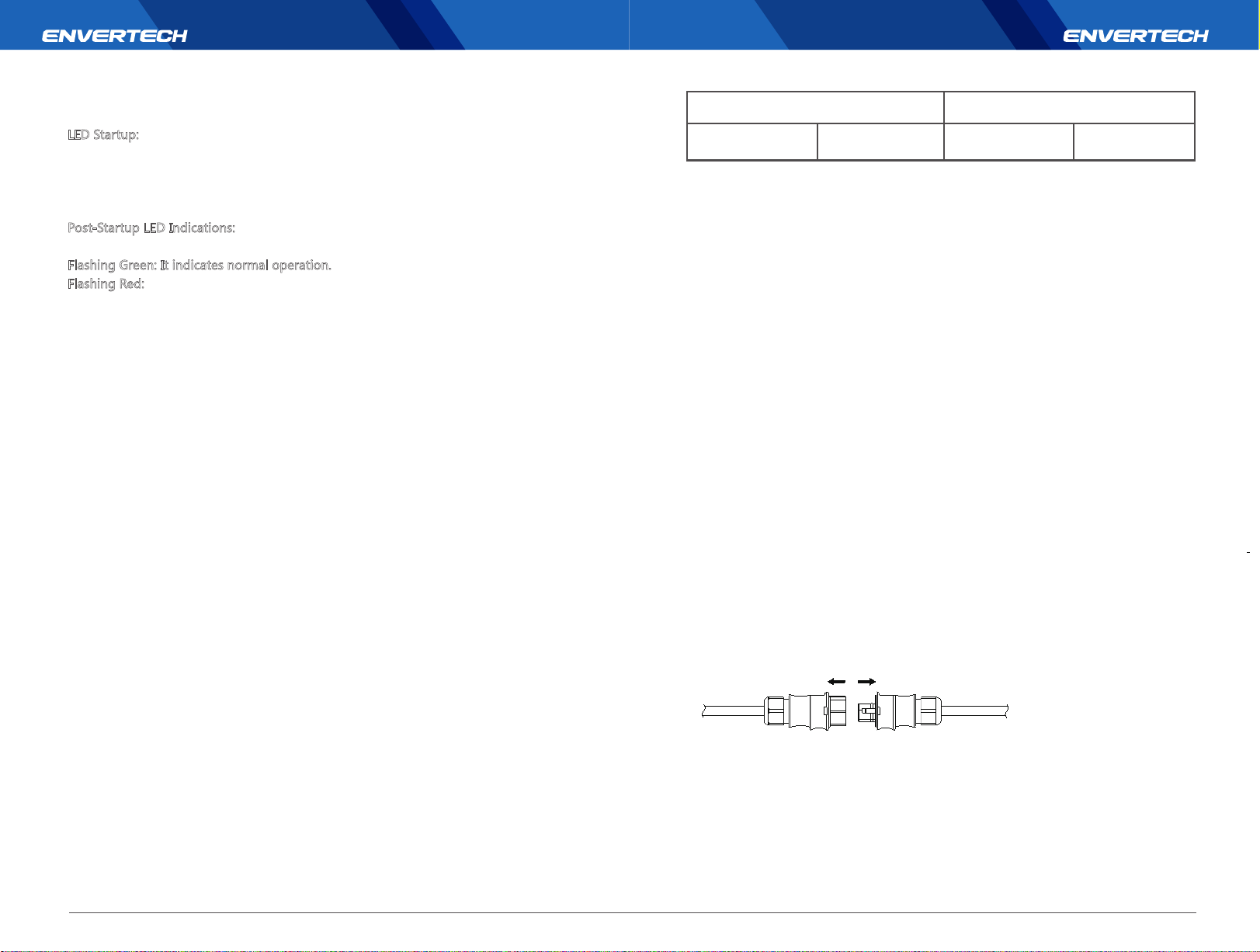
2. Disconnect the microinverters in the following procedure:
Pull the AC connectors of both sides of the microinverters in the opposite direction
with appropriate force.
Single-Phase 230 VAC
L to N 180 to 265VAC L1 to L2 to L3 310 to 460VAC
Three-Phase 230 VAC