Mase IS 30T Manuale utente

GB INSTALLATION MANUAL
IS 30 T 50 Hz

IS 30 T
Fig.1
Fig.2
830
1460
675
B
B
A
2
Fig.3

IS 30 T
Fig.7
Fig.6Fig.5
Fig.8
Fig.4
21
Valvola antisifone
Anti-siphon valve
Soupape antisiphon
Beluchter

IS 30 T
Fig.12
Fig.10
Fig.9
23 14
1 2 3 2
1
Fig.11

IS 30 T
Fig.13
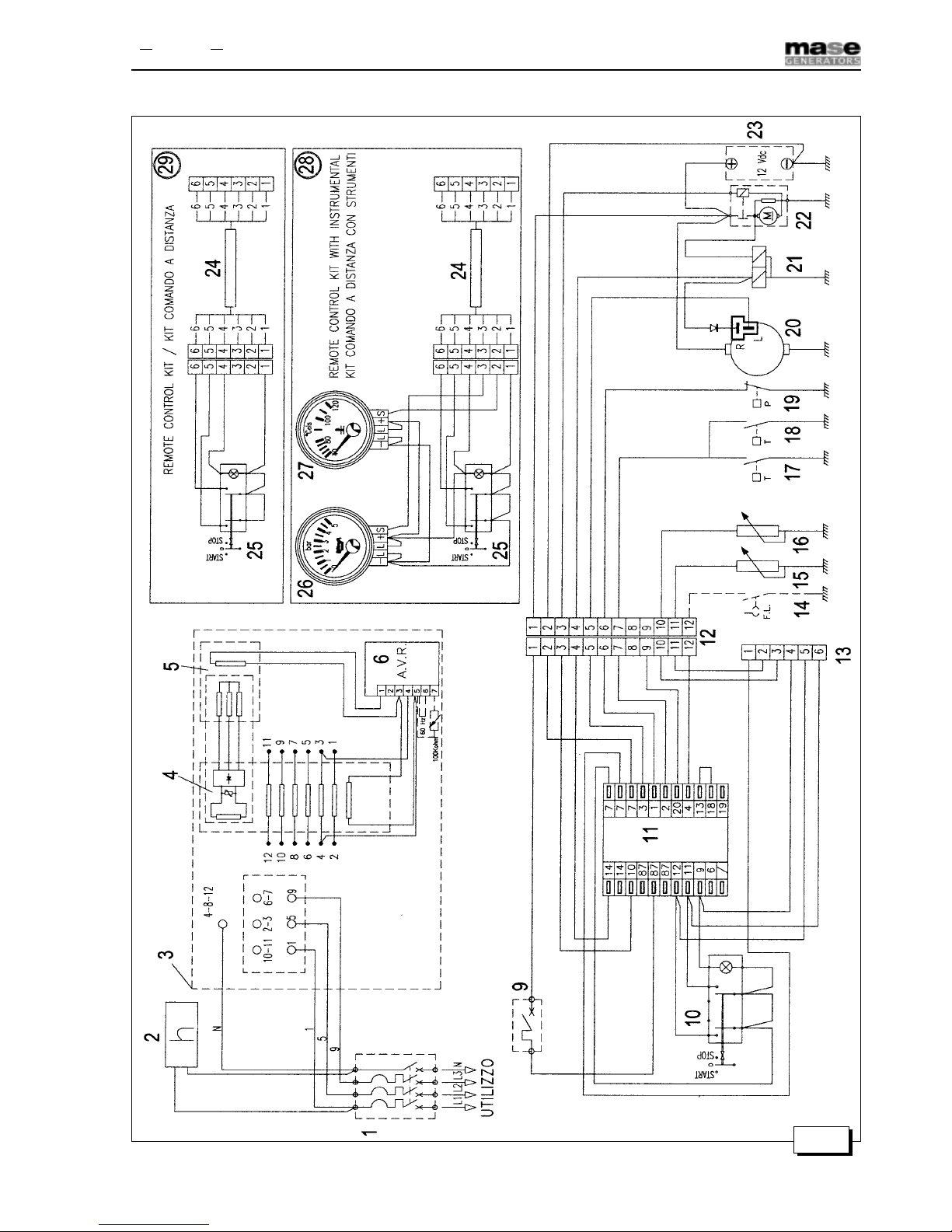
Wiring diagram "STANDARD" version

IS 30 T
Fig.14
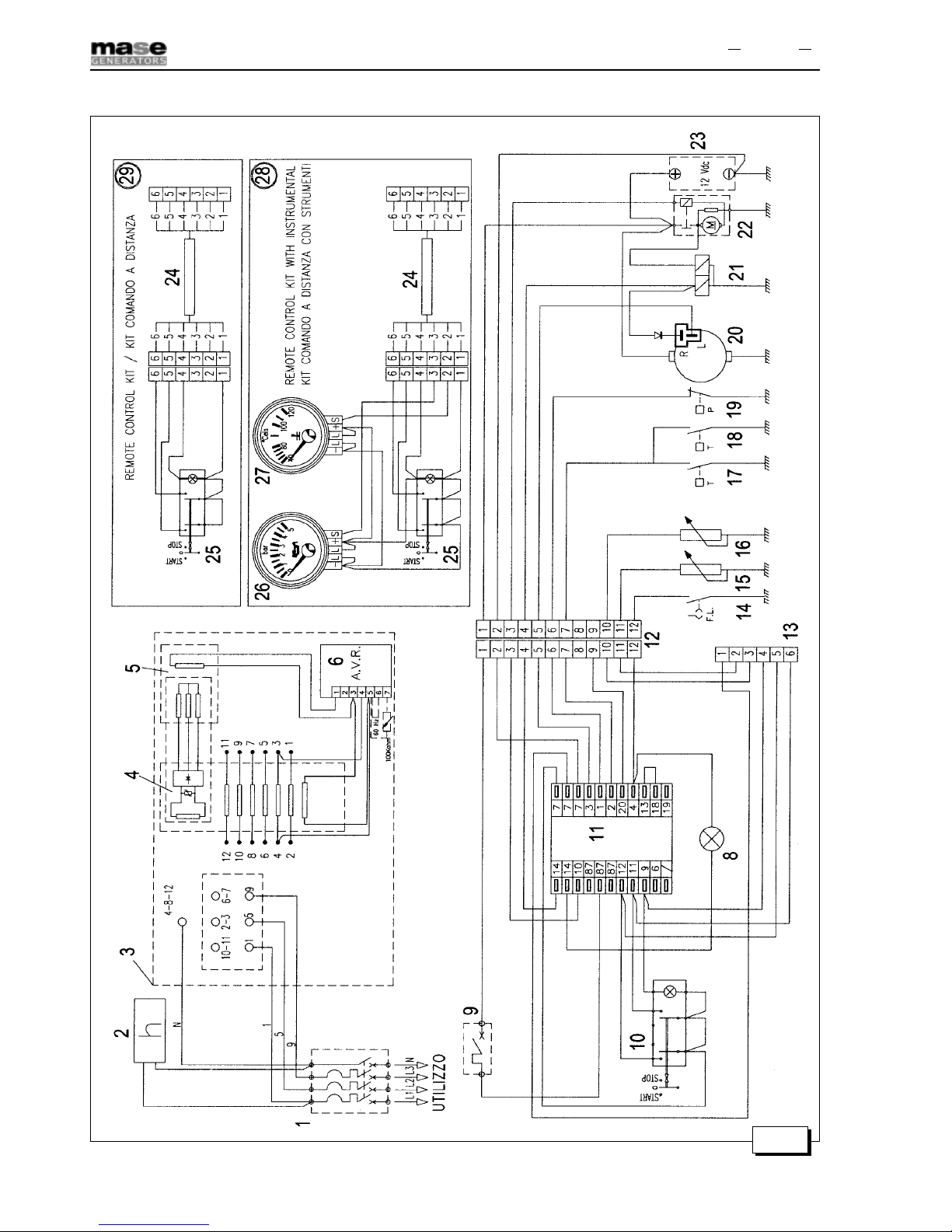
Wiring diagram "RINA" version

IS 30 T GB
INDEX
1 GENERAL INFORMATION ..................................................................................................................... 20
1.1 Purpose and field of application of the manual ............................................................................... 20
1.2 Symbols .......................................................................................................................................... 20
2 PRESCRIPTIONS FOR SAFETY DURING INSTALLATION AND SETUP ............................................ 21
3 INSTALLATION ...................................................................................................................................... 21
3.1 Characteristics of the installation space .......................................................................................... 21
3.2 Fastening the unit to the ground...................................................................................................... 21
3.3 Ventilation ........................................................................................................................................ 21
4 COOLING WATER CIRCUIT .................................................................................................................. 21
4.1 Sea water feed system.................................................................................................................... 21
4.2 Typical installation with generator above the waterline .................................................................... 22
4.3 Typical installation with generator below the waterline .................................................................... 22
4.4 Components .................................................................................................................................... 22
4.5 Drainage system ............................................................................................................................. 23
5 FUEL CIRCUIT ....................................................................................................................................... 23
6 ELECTRICAL CONNECTIONS .............................................................................................................. 23
6.1 Battery connection .......................................................................................................................... 23
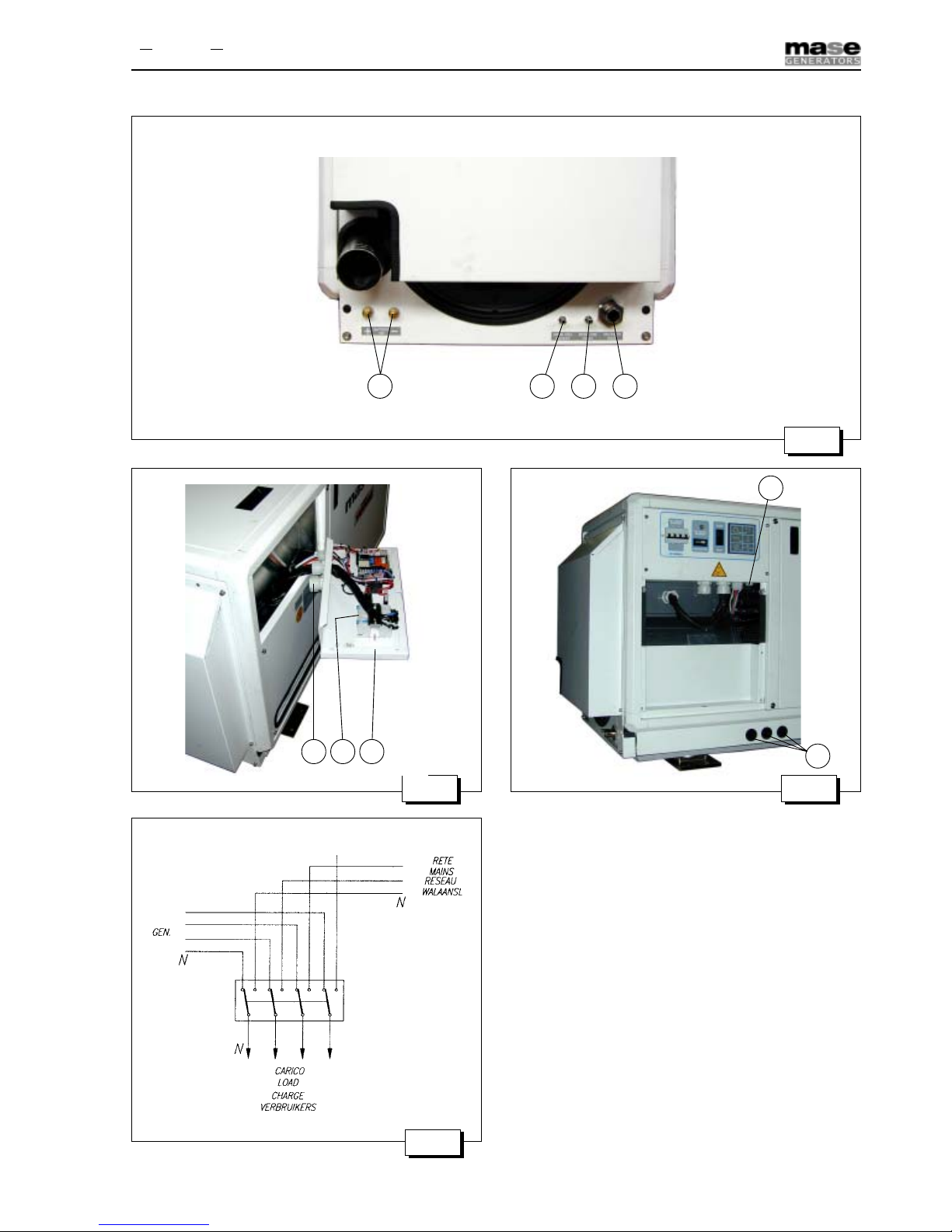
6.2 Remote control panel connection .................................................................................................... 23
6.3 AC connection ................................................................................................................................. 24
6.4 Generator-mains switching ............................................................................................................. 24
7 HANDLING ............................................................................................................................................. 24
8 WIRING DIAGRAMS .............................................................................................................................. 25
8.1 "STANDARD" version...................................................................................................................... 25
8.2 "RINA" version ................................................................................................................................ 25

IS 30 T
GB
1 GENERAL INFORMATION
FAILURE TO RESPECT THE SPECIFICATIONS CONTAINED IN THIS INSTALLATION MANUAL
WILL RESULT IN FORFEITURE OF THE GUARANTEE ON THE PRODUCT.
Carefully consult this manual before proceeding with any operation on the generator.
1.1 Purpose and field of application of the manual
Thank you for choosing a mase product.
This manual has been drawn up by the manufacturer with the purpose of providing essential information and
instructions for proper installation in conditions of safety and constitutes an integral part of the generator equipment.
The manual must be kept safely, protected from any agent which might damage it, for the entire life of the generator
and must accompany the generator if transferred to another user or owner.
The information contained in the manual is addressed to all those persons involved in the operating life cycle of the
generator, and is necessary to inform both those who effectively carry out the different operations and those who
co-ordinate the activities, arrange the necessary logistics and regulate access to the place where the generator will
be installed and operated.
The manual defines the purpose for which the generator was constructed and contains all the information necessary
to guarantee safe and proper use.
Constant observance of the instructions contained in this manual guarantees the safety of the operator, operating
economy and a longer life of the generator.
It is warmly recommended to carefully read the contents of this manual and the reference documents; only thus
can regular functioning and reliability of the generator be guaranteed over time, and protection against damage to
persons or things.
The drawings are provided by way of example. Even if the generator in your possession differs considerably from
the illustrations contained in this manual, the safety of the generator and the information provided are nevertheless
guaranteed.
To facilitate consultation, it has been divided into sections identifying the main concepts; for a quick look at the
topics, consult the index.
Note. The information contained in this publication is correct at the time of printing. The manufacturer in his pursuit
of a policy of constant development and upgrading of the product reserves the right to make modifications without
prior notice.
1.2 Symbols
Those parts of the text not to be ignored are highlighted in bold type preceded by a symbol, as illustrated and
defined below.
Indicates that particular attention must be paid in order to prevent running into serious danger
which could lead to death or possible hazards to the health of personnel.
A condition which may occur during the lifetime of a product, system or plant considered at risk
regarding damage to persons, property, the environment or economic loss.
Indicates that particular attention must be paid in order to prevent serious consequences which
could result in damage to tangible goods, such as the resources or the product.
Instructions of particular importance.

IS 30 T GB
2 PRESCRIPTIONS FOR SAFETY DURING INSTALLATION AND SETUP
• The personnel in charge of installation and starting of the generator must always wear a protective helmet; wear
safety shoes and overalls.
• Immediately change wet overalls.
• Use protective gloves.
• Do not leave disassembled parts, tools or anything else not forming part of the system on or near the engine.
• Never leave inflammable liquids or cloths soaked in inflammable liquids in proximity of the generator, near electric
equipment, (including lamps), or parts of the electrical system.
• Take the necessary precautions to prevent the danger of electrocution.
3 INSTALLATION
3.1 Characteristics of the installation space
The generator must be installed in a sufficiently
ventilated room, able to assure 800 m3/h air, which
corresponds to the quantity of air required for alternator
cooling and engine combustion.
The space must be separate and acoustically insulated
from living areas.
The generator should be positioned so that normal
maintenance operations can easily be carried out.
Propulsion motors are recommended for installation in
the area as long as they comply with the above-
mentioned conditions.
3.2 Fastening the unit to the ground
To fasten the unit securely, a base should be installed
to absorb vibrations and support the weight.
Drill holes in the base according to the instructions in
Fig. 1.
3.3 Ventilation
The generator is equipped with an internal forced cooling
system by means of the alternator fan.
The quantity of air required for alternator cooling and
engine combustion is aspirated through the opening
shown in Fig. 2, ref. A, and is expelled through the two
side vents shown in Fig. 2, ref. B. Therefore, ensure
that these openings are always clear.
4 COOLING WATER CIRCUIT
The engine is cooled by an closed circuit system heat
exchanger.
On installation a sea water feed circuit should be fitted
for cooling and a waste system to expel the mixture of
flue gas and water.
4.1 Sea water feed system
Boats usually use one of two systems to collect water,
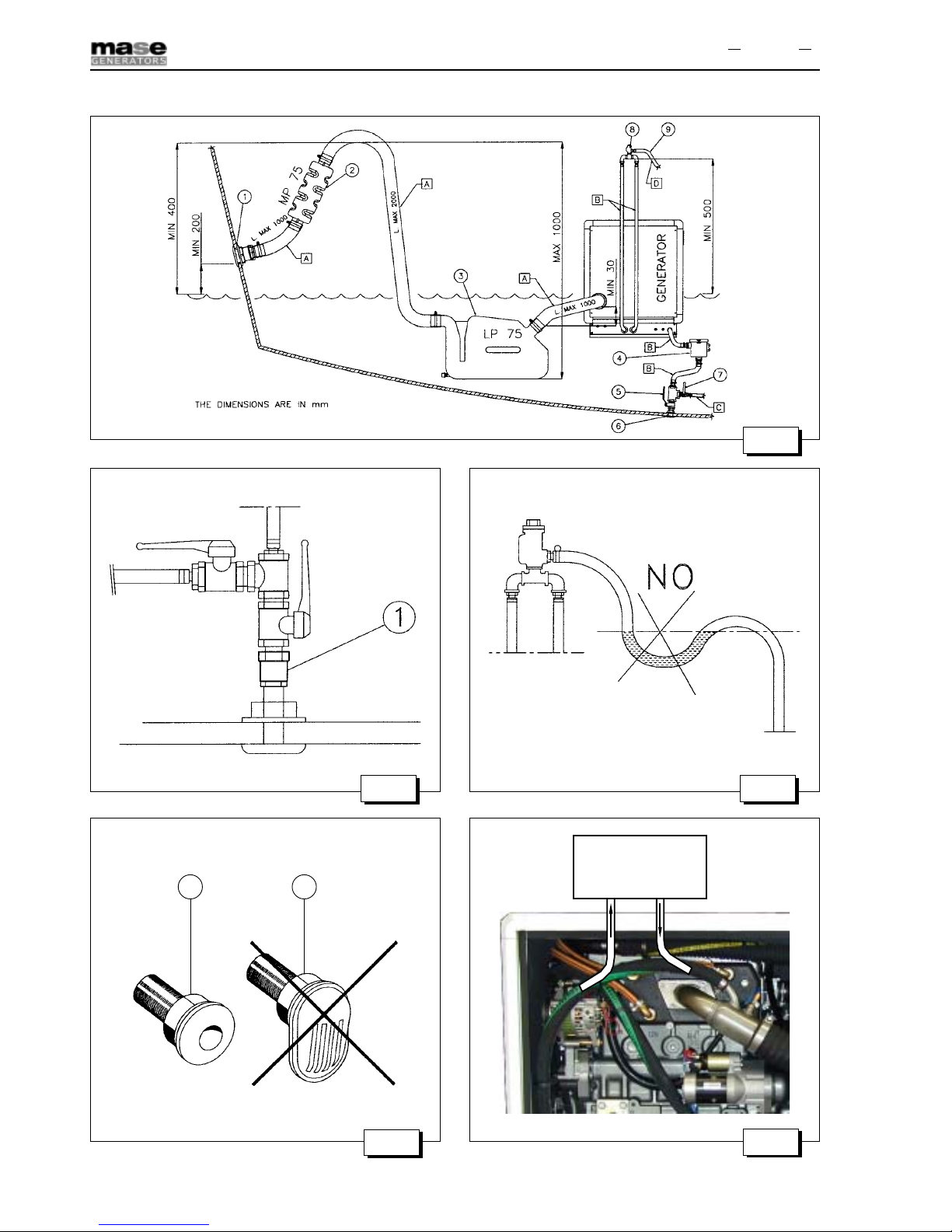
(Fig. 7).
1Direct infeed system.
2System with baffle.
mase recommends the direct infeed system, (Fig. 7,
ref. 1), since this system prevents water under pressure
entering the suction ducts and instead forms a pressure
which can easily be overcome by the water pump of
the electric generator.
Do not apply any type of protective hood to the direct
infeed system.
The baffle system might cause the following problems.
aIf it is installed with the slots facing the prow.
In this case, during navigation and with the electric
generator off, pressure is accumulated in the water
infeed duct which might cause the system to fill up,
even as far as the exhaust port, allowing water to
enter the cylinders.
bIf it is installed with the slots facing the stern.
In this case a depression might accumulate in the
water infeed duct during navigation, preventing the
water pump from starting up the cooling plant, or
limiting the capacity and subsequently causing the
electric generator to overheat.

IS 30 T
GB
4.2 Typical installation with generator above
the waterline
See Fig. 3
1 Sea exhaust
2 Silencer
3 Muffler
4 Water filter
5 Main system tap
6 Sea intake
7 Drain tap
A Pipes - inner diameter 75 mm
B Pipes - inner diameter 25 mm
C Pipes - inner diameter 16 mm
4.3 Typical installation with generator below
the waterline
See Fig. 4
1 Sea exhaust
2 Silencer
3 Muffler
4 Water filter
5 Main system tap
6 Sea intake
7 Drain tap
8 Antisiphon valve
9 Drainage
A Pipes - inner diameter 75 mm
B Pipes - inner diameter 25 mm
C Pipes - inner diameter 16 mm
D Pipes - inner diameter 14 mm
• It is very important to respect the distances shown in
the installation diagrams.
• The mufflers, (Fig. 3 and 4, ref. 3), have the function
of collecting the water left in the exhaust pipes when
the generator engine is turned off and preventing that
it flows into the engine through the manifold and the
exhaust valve. For this reason it is essential to respect
the position of the muffler and the length of the pipes
as indicated in the installation diagram.
4.4 Components
The sea water intake system must be separate from the
one for the engines propelling the boat.
•Direct sea intake 1/2".
If the unit is installed more than 1 m above the water-
line, a check valve should be fitted after the sea intake,
(Fig. 5, ref. 1), to prevent the water circuit emptying when
the motor is off. If this empties, the rotor of the water
pump might be damaged during start up; for the same
reason, when the unit is first started up, the suction tube
from the valve to the pump should be filled manually.
•Ball tap 1/2", (general).
•Ball tap 1/2", (drainage). This is used to drain the
cooling system of the electric generator for general
maintenance or when a long period of inactivity is
expected.
•Water filter, (can be inspected). This must provide
efficient protection for the cooling circuit from the
entrance of mud, sand and seaweed.
Rate of flow: 25 l/min.
The filter mesh should be very fine. Mesh 2 - 470 micron
is recommended; other sizes do not give good filter
performance.
•Anti-siphon valve. This is a valve that brings the
cooling circuit back to atmospheric pressure when
the motor is turned off, thus avoiding the formation
of siphons. It’s use obligatory when the base of
the generator group is under the water line and it
must be positioned at least 50 cm above sea level,
(see Fig. 4).
Anti-siphon valve must be inserted between the inlet of
the sea water pump and mixing elbow as indicated in
Fig. 8.
The drainage duct of the anti-siphon valve must run
beneath the valve itself in order to prevent water
accumulating in the duct, which should always remain
empty to allow air to pass through when the unit is
switched off, (see Fig. 6).
It is recommended that the drainage pipe from the anti-
siphon valve be fed into the bilge, as small amounts of
water might be drained through it during normal
operation.
Run the pipes connected to the antisiphon valve through
the holes shown in Fig. 2, ref. 2.
Indice
Altri manuali Mase Generatore portatile

Mase
Mase IS 8 Manuale utente

Mase
Mase I.S. 21.5 Manuale utente

Mase
Mase I.S. 18 Manuale utente

Mase
Mase IS 9.6 B Manuale utente

Mase
Mase I.S. 6.5 Manuale di istruzioni

Mase
Mase MPL 137 S Manuale utente

Mase
Mase MPL 66 S Manuale utente

Mase
Mase IS 3.5 Manuale utente

Mase
Mase PD 50 YS Manuale utente

Mase
Mase IS 9000 Manuale utente

Mase
Mase Silent 500 Guida

Mase
Mase IS3501 Manuale utente

Mase
Mase MPL 206 A Manuale utente

Mase
Mase IS. 2.5 Manuale di istruzioni

Mase
Mase I.S. 12 Manuale utente

Mase
Mase MARINER 1800 Manuale utente

Mase
Mase VS 10.5 Manuale utente

Mase
Mase PD 10 R Manuale utente

Mase
Mase FM 50H Manuale utente

Mase
Mase IS 7 Manuale utente