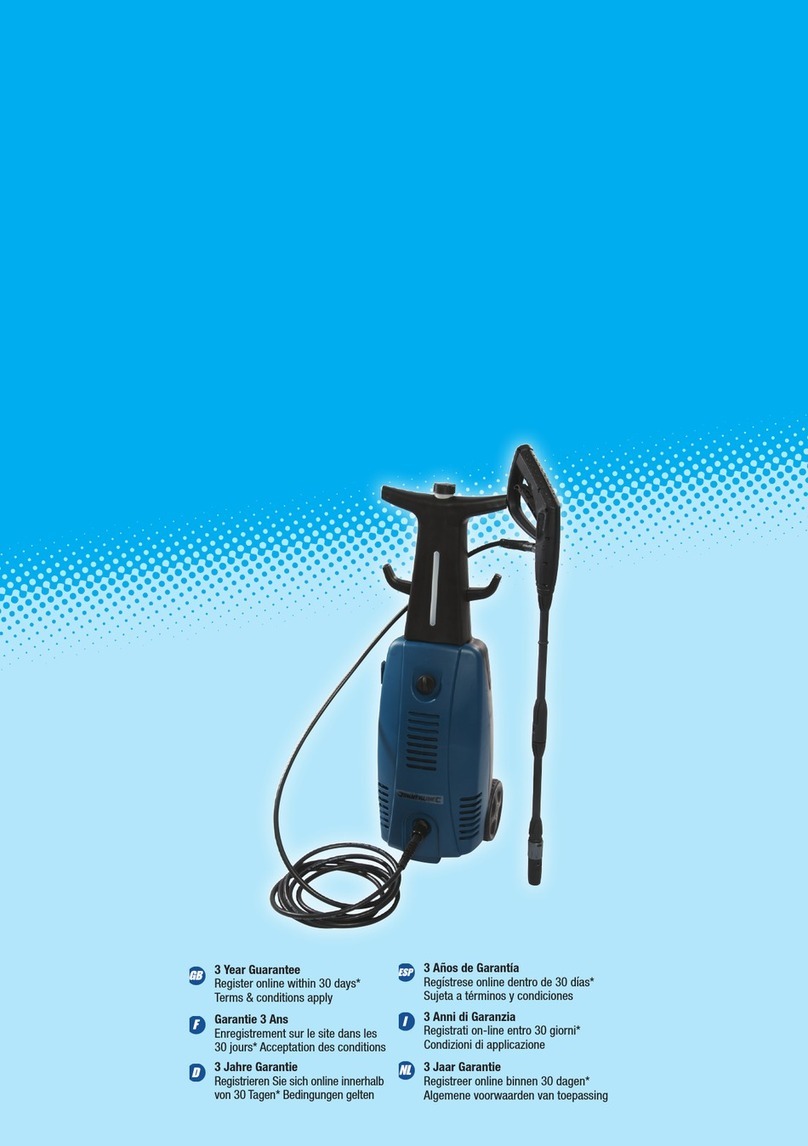
Silverline 943676 Manuale utente

Version date: 21.04.17 silverlinetools.com
Register online: silverlinetools.com
3
GUARANTEE
YEAR
ANS DE GARANTIE
JAHRE GARANTIE
AÑOS DE GARANTÍA
ANNI DI GARANZIA
JAAR GARANTIE
LATA GWARANCJI
XXXXXX
943676
FR Nettoyeur haute pression,2 100 W
DE Hochdruckreiniger,2100 W
ES Hidrolimpiadora,2100 W
IT Idropulitrice 2100 W
NL 2100 W hogedrukreiniger
PL Myjkawysokociśnieniowa2100W
2100W Pressure Washer 165bar Max
943676_Manual.indd 1 31/05/2017 10:36

2
1
2
10
1113
12
4
3
5
6
7
8
9
943676_Manual.indd 2 31/05/2017 10:36

silverlinetools.com
3
11
24 25
26
4
13
212019 22 23 14 15 16
17
18
943676_Manual.indd 3 31/05/2017 10:36

4
A
B
E
C
F
D
G
943676_Manual.indd 4 31/05/2017 10:37

silverlinetools.com
5
H
J
K
I
L
943676_Manual.indd 5 31/05/2017 10:37

6
Fig. I Fig. II
Fig. III Fig. IV Fig. V
Fig. VI
M
+
943676_Manual.indd 6 31/05/2017 10:37

silverlinetools.com
7
English ................08
Français ...............14
Deutsch................20
Español................26
Italiano................32
Nederlands ..........38
Polski ..................44
943676_Manual.indd 7 31/05/2017 10:37

GB
8
Technical Abbreviations Key
Voltage.....................................................230-240V~50Hz
Power...............................................................2100W
Working pressure (Bar) ...................................................110
Max pressure (Bar) . . . . . . . . . . . . . . . . . . . . . . . . . . . . . . . . . . . . . . . . . . . . . . . . . . . . . . .165
Workingowrate...................................................6.0L/min
Maximumowrate .................................................7.2L/min
High pressure hose length ................................................5m
Detergent tank capacity....................................................1L
Detergent ratio ......................................................Variable
Inlet water temperature range ..........................................5-50°C
Inlet water pressure .....................................................4bar
Protection class...........................................................
Ingress protection.......................................................IPX5
Power cord length .......................................................5m
Dimensions (L x W x H) .................................... 330 x 360 x 890mm
Weight................................................................20kg
Aspartofourongoingproductdevelopment,specicationsofSilverlineproducts
may alter without notice.
Sound & vibration information
According to Machinery Directive 2006/42/EC:
SoundpressureLPA . . . . . . . . . . . . . . . . . . . . . . . . . . . . . . . . . . . . . . . . . . . . . . . . . 76.7dB(A)
SoundpowerLWA..................................................89.71dB(A)
Uncertainty K..........................................................2.5dB
Weighted vibration ah...............................................<2.5m/s2
According to Outdoor Noise Directive 2000/14/EC:
Guaranteed sound power LWA ..........................................93dB(A)
The sound intensity level for the operator may exceed 85dB(A) and sound
protection measure are necessary.
Specication
Description of Symbols
The rating plate on your tool may show symbols.These represent important information about the
product or instructions on its use.
Wear hearing protection.
Wear eye protection.
Wear breathing protection.
Wear head protection.
Wear hand protection.
Read instruction manual.
Caution!
Risk of electrocution!
Class I construction (protective earth)
According to the applicable regulations,the appliance must never be used on the
drinking water supply without a system separator
Conforms to relevant legislation and safety standards
Environmental Protection
Waste electrical products should not be disposed of with household waste. Please
recycle where facilities exist.Check with your local authority or retailer for recycling
advice
VVolts
~, AC Alternating current
A, mA Ampere, milli-Amp
n0 No load speed
˚Degrees
Ø Diameter
Hz Hertz
W, kW Watt, kilowatt
/min or min-1 Operations per minute
Introduction
ThankyouforpurchasingthisSilverlinetool.Thismanualcontainsinformationnecessary
for safe and effective operation of this product.This product has unique features and,even if
you are familiar with similar products,it is necessary to read this manual carefully to ensure
you fully understand the instructions. Ensure all users of the tool read and fully understand
this manual.
Original Instructions
943676_Manual.indd 8 31/05/2017 10:37

2100W Pressure Washer943676
9
silverlinetools.com
WARNING:Always wear ear protection where the sound level exceeds 85dB(A) and limit the time
of exposure if necessary. If sound levels are uncomfortable,even with ear protection,stop using the
toolimmediatelyandchecktheearprotectioniscorrectlyttedandprovidesthecorrectlevelof
sound attenuation for the level of sound produced by your tool.
WARNING: User exposure to tool vibration can result in loss of sense of touch, numbness, tingling
and reduced ability to grip.Long-term exposure can lead to a chronic condition.If necessary,limit
the length of time exposed to vibration and use anti-vibration gloves. Do not operate the tool with
hands below a normal comfortable temperature,as vibration will have a greater effect.Use the
guresprovidedinthespecicationrelatingtovibrationtocalculatethedurationandfrequency
of operating the tool.
Soundandvibrationlevelsinthespecicationaredeterminedaccordingtointernationalstandards.
Theguresrepresentnormaluseforthetoolinnormalworkingconditions.Apoorlymaintained,
incorrectly assembled,or misused tool, may produce increased levels of noise and vibration.
www.osha.europa.eu provides information on sound and vibration levels in the workplace that
may be useful to domestic users who use tools for long periods of time.
Carefully read and understand this manual and any label attached to the tool before use.Keep these
instructions with the product for future reference.Ensure all persons who use this product are fully
acquainted with this manual.
Even when used as prescribed it is not possible to eliminate all residual risk factors.Use with
caution. If you are at all unsure of the correct and safe manner in which to use this tool, do not
attempt to use it.
General Safety
WARNING: Read all safety warnings, instructions, illustrations and specications
provided with this appliance. Failure to follow all instructions listed below may result in electric
shock, re and/or serious injury.
Save all warnings and instructions for future reference.
The term “appliance” in the warnings refers to your mains-operated (corded) appliance or battery-
operated (cordless) appliance.
1) Work area safety
a) Keep work area clean and well lit.Cluttered or dark areas invite accidents.
b) Do not operate appliances in explosive atmospheres, such as in the presence of
ammable liquids, gases or dust. Appliances create sparks which may ignite the dust or fumes.
c) Keep children and bystanders away while operating an appliance. Distractions can cause
you to lose control.
2) Electrical safety
a) Appliance plugs must match the outlet. Never modify the plug in any way. Do not use any
adapter plugs with earthed (grounded) appliances. Unmodied plugs and matching outlets
will reduce risk of electric shock.
b) Avoid body contact with earthed or grounded surfaces, such as pipes, radiators, ranges
and refrigerators. There is an increased risk of electric shock if your body is earthed or grounded.
c) Do not abuse the cord. Never use the cord for carrying, pulling or unplugging the
appliance. Keep cord away from heat, oil,sharp edges or moving parts. Damaged or
entangled cords increase the risk of electric shock.
d) When operating an appliance outdoors, use an extension cord suitable for outdoor use.
Use of a cord suitable for outdoor use reduces the risk of electric shock.
e) If operating an appliance in a damp location is unavoidable, use a residual current device
(RCD) protected supply. Use of an RCD reduces the risk of electric shock.
3) Personal safety
a) Stay alert, watch what you are doing and use common sense when operating an
appliance. Do not use an appliance while you are tired or under the inuence of drugs,
alcohol or medication. A moment of inattention while operating appliances may result in
serious personal injury.
b) Use personal protective equipment. Always wear eye protection. Protective equipment
such as a dust mask, non-skid safety shoes,hard hat or hearing protection used for appropriate
conditions will reduce personal injuries.
c) Prevent unintentional starting. Ensure the switch is in the OFF-position before connecting
to source and/or battery pack, picking up or carrying the appliance. Carrying appliances
with your nger on the switch or energising appliances that have the switch ON invites accidents.
d) Remove any adjusting key or wrench before turning the appliance ON. A wrench or a key
left attached to a rotating part of the appliance may result in personal injury.
e) Do not overreach. Keep proper footing and balance at all times. This enables better control
of the appliance in unexpected situations.
f) Do not let familiarity gained from frequent use of appliances allow you to become
complacent and ignore appliance safety principles. A careless action can cause severe injury
within a fraction of a second.
4) Appliance use and care
a) Do not force the appliance. Use the correct appliance for your application.The correct
appliance will do the job better and safer at the rate for which it was designed.
b) Do not use the appliance if the switch does not turn it ON and OFF. Any appliance that
cannot be controlled with the switch is dangerous and must be repaired.
c) Disconnect the plug from the source and/or remove the battery pack,if detachable,
from the appliance before making any adjustments, changing accessories, or storing
appliances. Such preventive safety measures reduce the risk of starting the appliance
accidentally.
d) Store idle appliances out of the reach of children and do not allow persons unfamiliar
with the appliance or these instructions to operate the appliance.Appliances are dangerous
in the hands of untrained users.
e) Maintain appliances and accessories. Check for misalignment or binding of moving parts,
breakage of parts and any other condition that may affect the appliance’s operation.
If damaged, have the appliance repaired before use. Many accidents are caused by poorly
maintained appliances.
f) Use the appliance, accessories and appliance bits,etc. in accordance with these
instructions, taking into account the working conditions and the work to be performed.
Use of the appliance for operations different from those intended could result in a hazardous
situation.
g) Keep handles and grasping surfaces dry, clean and free from oil and grease.Slippery
handles and grasping surfaces do not allow for safe handling and control of the appliance in
unexpected situations.
5) Service
a) Have your appliance serviced by a qualied repair person using only identical
replacement parts. This will ensure that the safety of the appliance is maintained.
Pressure Washer Safety
• Do not operate this appliance in the rain.Keep all electrical connections dry. Do not allow the
machine to become wet. Never allow water to enter ventilation holes
• Alwaysconnectabackowpreventer(alsocalledanon-returnvalve)betweenpressurewasher
andpotablewatermainstopreventabackowcontaminatingyourwatersupply.Alternatively,
connect the pressure washer to a water butt or other stored water supply
• Do not attempt to use this machine in temperatures below 0°C
• Alwaysconnecta‘continuousow’cleanwatersupplytothepressurewasher.Runningthe
pressure washer dry,or with dirty water,will cause permanent damage to the pump
• Never connect the pressure washer to a hot water supply; this will cause the pump to
malfunction and could result in permanent damage
• Ensure that the water supply to the pressure washer is at a constant pressure. If the water supply
is‘shared’byanotherappliance(e.g.washingmachine),ensurethattheotherapplianceis
switched OFF
• The pressure washer should always be used in an upright position
• Be aware that the lance will produce a recoil force when the pressure washer is operated. Hold
the lance securely
• Never direct the water jet at people or animals.The water jet is extremely powerful, and can cause
serious injury.Do not direct the water jet towards the pump body,or other electrical equipment
• Handle the lance with care, do not allow the nozzle to strike the ground.Do not allow the hoses
to be twisted, crushed,or strained
• Do not attempt to pressure wash any material suspected to contain asbestos
• When using detergents with pressure washers or cleaning oil and grease from surfaces,
take responsibility for any contaminated waste water you may produce.Always consider the
environment and the risk of polluting streams and other watercourses, plus the possibility of
contaminants accumulating in the ground and soil.Try to use detergents sparingly—they are not
always necessary. Contact your local environmental agency for how to deal with such waste water
legally and responsibly
943676_Manual.indd 9 31/05/2017 10:37

GB
10
1. High Pressure Hose Reel
2. Hose Reel Handle
3. Hose Connector
4. Power Cord Hook
5. ON/OFF Switch
6. Water Inlet
7. Nozzle Rest
8. Lance Bracket
9. Front Handle
10. Telescopic Rear Handle
11. Detergent Bottle
12. Wheels
13. Power Cord
14. Lance Handle Bayonet Socket
15. Lance High Pressure Hose Connector
16. Lance Handle Grip
17. Trigger
18. Trigger Lock
19. Nozzle
20. Pressure Adjustment
21. Nozzle Bayonet Connector
22. Lance Extension Bayonet Socket
23. Lance Extension Bayonet Connector
24. Cleaning Pin
25. Inlet Hose Connector
26. Rear Handle Release Button
Product Familiarisation
Intended Use
Pressure washer for general, light to medium duty cleaning tasks on vehicles, buildings and other
suitable surfaces, using a jet of cold, pressurised water,with or without detergent.
Unpacking Your Tool
• Carefully unpack and inspect your product.Fully familiarise yourself with all its features and
functions
• Ensure that all parts of the product are present and in good condition. If any parts are missing or
damaged, have such parts replaced before attempting to use this product
Before Use
• Always check all parts and attachments are secure,and that hoses are not kinked or obstructed
• Always wear appropriate personal protective equipment for the job at hand.Use of this appliance
requires safety goggles and waterproof clothing
• Always use an RCD when connecting a pressure washer to the mains with a tripping current of no
more than 30mA, and a delay in operating of no more than 30ms
• Make sure mains connection points are out of reach of the pressure washer water spray and any
water that may collect on surrounding surfaces
• Only use a mains extension cable suitable for outdoor use and capable of carrying the required
current for this product.The cable must be protected against water ingress and maintain water-
tight connections where it connects to the pressure washer
• This product must be earthed and any extension cables used must have an earth connection
• Alwaysusethepressurewasherverticallyandmakesureitisusedonaat,levelsurface
Assembly
• Do not connect the pressure washer to the water or electrical supply until fully assembled and
ready for use
• Remove all packaging materials from the product
Hooks & holders
• SlidetheLanceBracket(8)downontothesideclip(Fig.I)
• SlidetheNozzleRest(7)backontotheclip(Fig.II)andxwiththesuppliedscrew
• SlidethePowerCordHook(4)downontothesideclip(Fig.III)
Lance
• Assemble the Lance by connecting the Nozzle (19) shaft to the lance extension shaft,and these to
the lance handle (Image A)
• Todothis,inserttheNozzleBayonetConnector(21)intotheLanceExtensionBayonetSocket
(22), then push and rotate to lock into place (Image B)
• InserttheLanceExtensionBayonetConnector(23)intotheLanceHandleBayonetSocket(14),
then push and rotate to lock into place (Image C)
Note: When not in use, the assembled lance can be held in the Lance Bracket (8) with the Nozzle
(19) in the Nozzle Rest (7) (Image D).
High pressure hose
1. Carefully pull out a length of hose from the High Pressure Hose Reel (1) (Image E)
2. Attach the end of the hose to the Lance High Pressure Hose Connector (15) (Image F) and screw
the nut on tight
WARNING: If the high pressure hose is damaged it could burst and cause injury.A damaged hose
must be replaced, not repaired. Inspect regularly and prevent the hose from coming into contact
with sharp objects or rough surfaces.After use, always wind the hose back in using the Hose Reel
Handle (2) (Image G then H).
Connecting to water supply
WARNING: When connecting a pressure washer to a normal domestic water supply, it is important a
non-returnvalveisttedtothehose(alsocalledbackowpreventer)toensurethepressurewasher
cannotcontaminateyourwatersupplyifthereisabackow.
1. RemovetheplasticcapfromtheWaterInlet(6)(Fig.IV)andcheckthatthelterinsideisclearof
debris or other material; clean if required
2. Fit the Inlet Hose Connector (25) (Fig.V) and tighten by hand
3. Connect a hose from your water supply to the Inlet Hose Connector
Notes:
• Thespecicationlistssuitablewaterinletpressures.Atypical,normalUKhouseholdwatersupply
can range from 1–8bar pressure but 2–5bar is more typical.Do not exceed the maximum water
pressurestatedinthespecication
• If you do not know or are unable to measure the water pressure,keep the pressure low to prevent
damage to the pressure washer.Aim to set the pressure at mid-point between the lowest and
highest pressure accepted by the pressure washer.If preferred,a third party water pressure
gauge is available that connects directly to the tap.This will allow the water pressure to be set
more accurately
• Do not connect to a hot water supply.This will prevent the pump from cooling and may damage
the seals over time
• It is important that a good water connection is maintained while operating a pressure washer as
the pump will be damaged if run without water. Make sure the connections are secure before
switching on the pressure washer
Connecting to other water sources
Note: The pump featured in this pressure washer features a self-priming feature that allows use of
other water sources typically a water butt or other container of captured rain water or similar.
• Ensurethewatersupplyiscleanandlteredbeforeenteringthepressurewasher.Ensurethereis
no sediment
• For water butts,where the output is at the bottom, gravity will provide some pressure to assist the
pressure washer
• The hose to the water supply should not exceed 3m in length and the diameter should not be
less than 19mm or ¾”
Filling the detergent bottle
• RemovethecapontheDetergentBottle(11)andllwithapressurewasher-compatible
detergent if required (Image I)
• The pressure washer is designed to dispense detergent on the low pressure setting,and dispense
clear liquid on the high pressure setting
• The detergent ratio is variable depending on the pressure adjuster setting
943676_Manual.indd 10 31/05/2017 10:37
Indice
Lingue:
Altri manuali Silverline Idropulitrice

Silverline
Silverline 389431 Manuale utente

Silverline
Silverline 398920 Manuale utente

Silverline
Silverline 102580 Manuale utente

Silverline
Silverline 1400W Pressure Washer Manuale utente

Silverline
Silverline Silver Storm 102580 Manuale utente

Silverline
Silverline 633847 Manuale utente

Silverline
Silverline POWER 633777 Manuale utente

Silverline
Silverline 834832 Manuale utente

Silverline
Silverline 1400W Pressure Washer Manuale utente

Silverline
Silverline 102377 Manuale utente