
TE Connectivity T6112DS Manuale utente
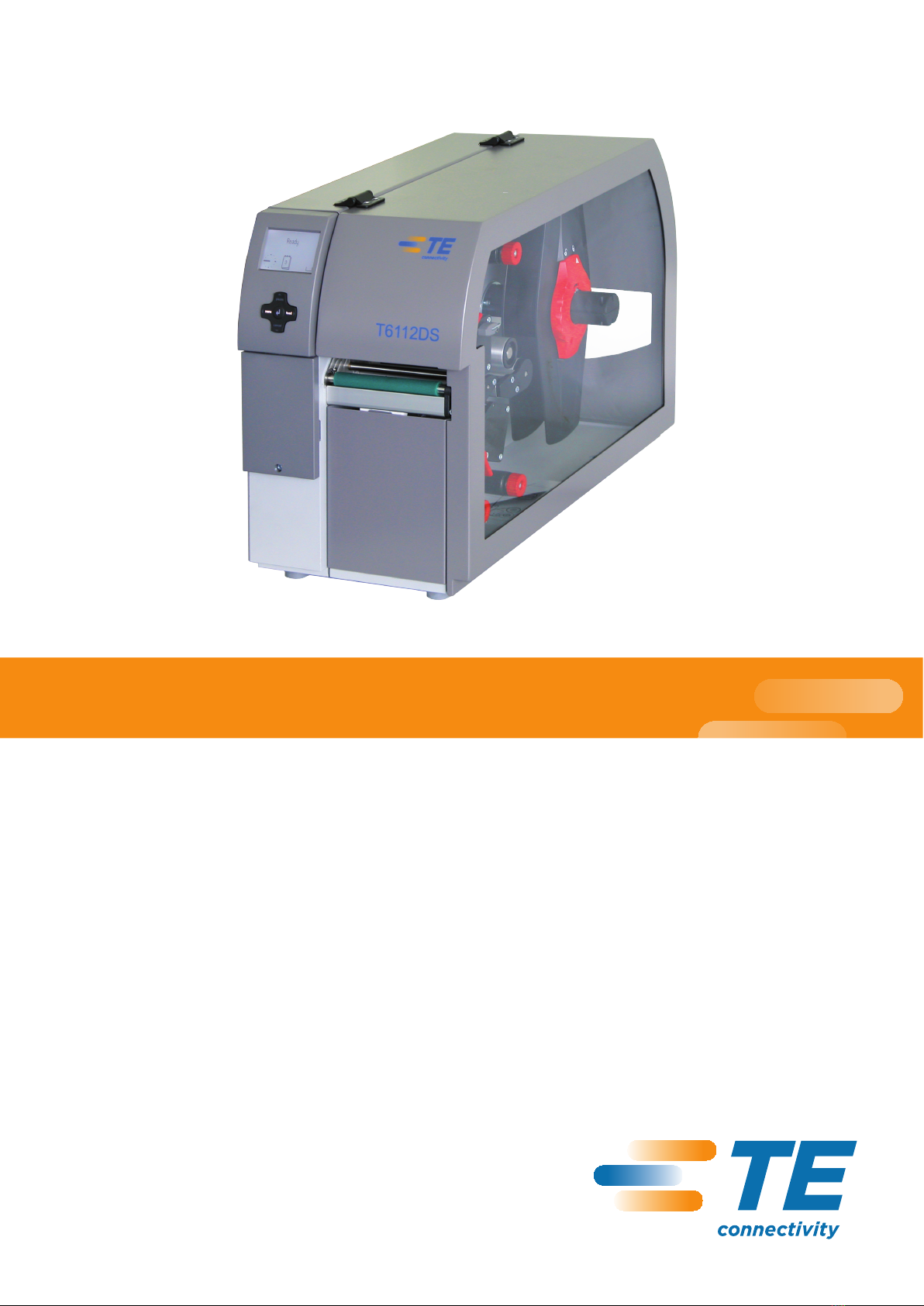
T6112DS Printer
Double Side Identication Heat Shrink Printer
Operator's-Manual
(412-121025 issue 3)

2 2
Edition: 412-121025 issue 3
Copyright
This documentation as well as translation hereof are property
of TE Connectivity.
The replication, conversion, duplication or divulgement of the
whole manual or parts of it for other intentions than its original
intended purpose demand the previous written authorization
by TE Connectivity.
Trademark
Centronics® is a registered trademark of the Data Computer
Corporation.
Microsoft® is a registered trademark of the Microsoft
Corporation.
Windows 2000®, 2003®, XP® are registered trademarks of the
Microsoft Corporation.
TrueTypeTM is a registered trademark of Apple Computer, Inc.
Topicality
Due to the constant further development of our products
discrepancies between documentation and product can occur.
Please check with your local TE Connectivity representative
for the latest update.
Terms and conditions
Deliveries and performances are effected under the General
conditions of sale of TE Connectivity.
Operator's Manual

2
3
Table of Contents
1 Introduction ............................................................................................................................................ 4
1.1 Instructions ............................................................................................................................................... 4
1.2 Intended Use ............................................................................................................................................ 4
1.3 Disclaimer ................................................................................................................................................ 4
1.4 Safety Instructions .................................................................................................................................... 5
1.5 Environment ............................................................................................................................................. 5
2 Installation .............................................................................................................................................. 6
2.1 Device Overview ...................................................................................................................................... 6
2.2 Unpacking and Setting-up the Printer ...................................................................................................... 8
2.3 Connecting the Device ............................................................................................................................. 8
2.3.1 Connecting to the Power Supply ........................................................................................................ 8
2.3.2 Connecting to a Computer or Computer Network .............................................................................. 8
2.4 Switching on the Device ........................................................................................................................... 8
3 Control Panel .......................................................................................................................................... 9
3.1 Structure of the Control Panel .................................................................................................................. 9
3.2 Symbol Displays ....................................................................................................................................... 9
3.3 Printer States ......................................................................................................................................... 10
3.4 Key Functions .........................................................................................................................................11
4 Loading Media ...................................................................................................................................... 12
4.1 Loading Media ........................................................................................................................................ 12
4.1.1 Positioning the Media Roll on the Internal Roll Retainer .................................................................. 12
4.1.2 Inserting media into the print mechanism ......................................................................................... 13
4.1.3 Setting the Material Sensor .............................................................................................................. 13
4.1.4 Loading Media from External Supply................................................................................................ 14
4.2 Loading Transfer Ribbon ........................................................................................................................ 15
4.3 Setting the Feed Path of the Transfer Ribbon ........................................................................................ 16
4.4 Setting the Head Locking Systems ........................................................................................................ 16
4.4.1 Setting the Plungers ......................................................................................................................... 16
4.4.2 Adjusting the Printhead Pressure ..................................................................................................... 17
5 Printing Operation ................................................................................................................................ 17
5.1 Printhead Protection ............................................................................................................................... 17
5.2 Synchronization in Cut Mode ................................................................................................................. 17
6 Cleaning ................................................................................................................................................ 18
6.1 Cleaning Information .............................................................................................................................. 18
6.2 Cleaning the Print Rollers ...................................................................................................................... 18
6.3 Cleaning the Printheads ......................................................................................................................... 18
7 Fault Correction ................................................................................................................................... 19
7.1 Types of Errors ....................................................................................................................................... 19
7.2 Problem Solution .................................................................................................................................... 19
7.3 Error Messages and Fault Correction .................................................................................................... 20
8 Ofine Menu ......................................................................................................................................... 22
8.1 Structure of the Ofine Menu ................................................................................................................. 22
8.2 Navigating in the Ofine Menu ............................................................................................................... 23
9 Conguration ........................................................................................................................................ 24
9.1 Local Settings ......................................................................................................................................... 24
9.2 Machine Parameters .............................................................................................................................. 25
9.3 Print Parameters .................................................................................................................................... 26
9.4 Interfaces ............................................................................................................................................... 28
9.5 Status Line ............................................................................................................................................. 29
9.6 Security .................................................................................................................................................. 30
10 Licences ................................................................................................................................................ 31
10.1 EC Declaration of Conformity ................................................................................................................. 31
10.2 Other Licences ....................................................................................................................................... 31
11 Index ...................................................................................................................................................... 32

4 4
1.1 Instructions
Important information and instructions in this documentation are designated as follows:
Danger!
Draws your attention to an exceptionally grave, impending danger to your health or life.
!
Warning!
Indicates a hazardous situation that could lead to injuries or material damage.
!
Attention!
Draws attention to possible dangers, material damage or loss of quality.
i
Notice!
Gives you tips. They make a working sequence easier or draw attention to important working processes.
Environment!
Gives you tips on protecting the environment.
Handling instruction
Reference to section, position, illustration number or document.
Option (accessories, peripheral equipment, special ttings).
Time Information in the display.
1.2 Intended Use
• The device is manufactured in accordance with the current technological status and the recognized safety rules.
However, danger to the life and limb of the user or third parties and/or damage to the device and other tangible
assets can arise during use.
• The device may only be used for its intended purpose and if it is in perfect working order, and it must be used with
regard to safety and dangers as stated in the operating manual.
• The device printer is intended exclusively for printing suitable materials that have been approved by the manufac-
turer. Any other use or use going beyond this shall be regarded as improper use. The manufacturer/supplier shall
not be liable for damage resulting from unauthorized use; the user shall bear the risk alone.
• Usage for the intended purpose also includes complying with the operating manual, including the manufacturer‘s
maintenance recommendations and specications.
1.3 Disclaimer
While TE has made every reasonable effort to ensure the accuracy of the information in this document, TE does not
guarantee that it is error-free, nor does TE make any other representation, warranty or guarantee that the information
is accurate, correct, reliable or current. TE reserves the right to make any adjustments to the information contained
herein at any time without notice. TE expressly disclaims all implied warranties regarding the information contained
herein, including, but not limited to, any implied warranties of merchantability or tness for a particular purpose. The
dimensions in this document are for reference purposes only and are subject to change without notice. Specications
are subject to change without notice. Consult TE for the latest dimensions and design specications.
Only the English Language version of this document is legally binding
i
Notice!
The complete documentation is included in the scope of delivery on CD ROM.
1 Introduction

4
5
1 Introduction
1.4 Safety Instructions
• The device is congured for voltages of 100 to 240 V AC. It only has to be plugged into a grounded socket.
• Only connect the device to other devices which have a protective low voltage.
• Switch off all affected devices (computer, printer, accessories) before connecting or disconnecting.
• The device may only be used in a dry environment, do not expose it to moisture (sprays of water, mists, etc.).
• Do not use the device in an explosive atmosphere.
• Do not use the device close to high-voltage power lines.
• It is always strongly recommended that the device is operated with the cover closed, to ensure safe operation,
media sensor reliability and increased cleanliness. However if the device is operated with the cover open, ensure
that clothing, hair, jewelry etc. do not come into contact with the exposed moving parts.
• The device or parts of it, especially the printheads can become hot while printing. Do not touch during operation,
and allow to cool down before changing material and before disassembly.
• Risk of crushing when closing the cover. Touch the cover at the outside only. Do not reach into the swivel range of
the cover.
• Perform only those actions described in this operating manual.
Work going beyond this may only be performed by trained personnel or service technicians.
• Unauthorized interference with electronic modules or their software can cause malfunctions.
• Other unauthorized work on or modications to the device can also endanger operational safety.
• Always have service work done in a qualied workshop, where the personnel have the technical knowledge and
tools required to do the necessary work.
• There are various warning labels on the device. They draw your attention to dangers.
Warning labels must not be removed, otherwise, you and others may not be aware of dangers and may be
injured.
• The maximum sound pressure level LpA is less than 70 dB(A).
Danger!
Danger to life and limb from power supply.
Do not open the device casing.
1.5 Environment
Obsolete devices contain valuable recyclable materials that should be sent for recycling.
Send to suitable collection points, separately from residual waste.
The modular construction of the printer enables it to be easily disassembled into its component parts.
Send the parts for recycling.
The electronic circuit board of the device is equipped with a lithium battery.
Take old batteries to collection boxes in shops or public waste disposal centers.
6 6
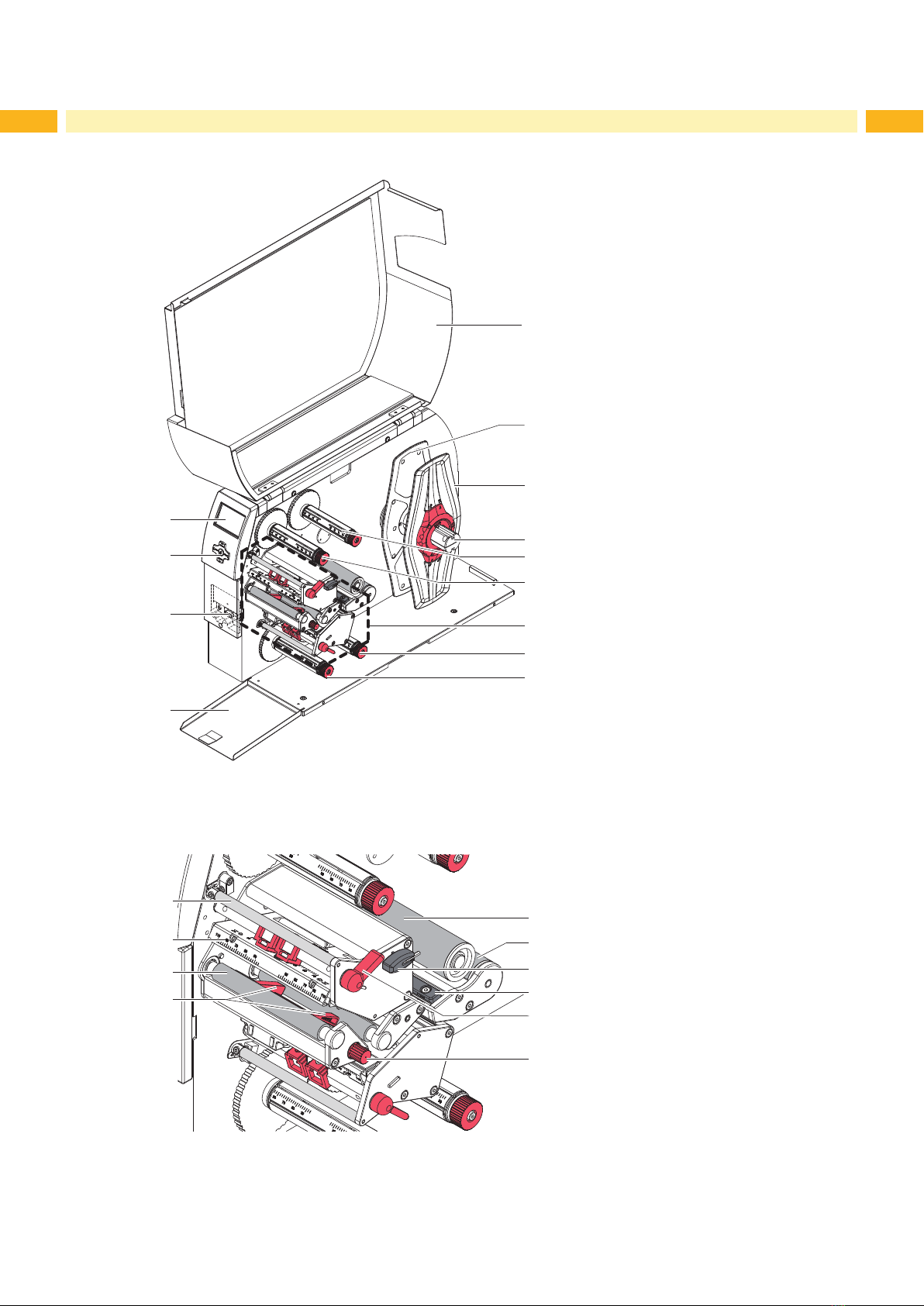
2.1 Device Overview
12
13
6
9
8
5
11
2
1
3
4
7
10
1 Display
2 Navigator pad
3 Peripheral port (covered)
4 Flap
5 Cover
6 Inner margin stop
7 Outer margin stop
8 Roll retainer
9 Upper ribbon supply hub
10 Upper ribbon take-up hub
11 Print mechanics
12 Lower ribbon supply hub
13 Lower ribbon take-up hub
Fig. 1 Overview
22
20
19
23
21
17
16
15
14
18 14 Upper ribbon deection
15 Printhead retainer with upper printhead
16 Upper print roller
17 Upper guides
18 Guide roller
19 Guide roller
20 Allen key
21 Material sensor
22 Upper printhead locking lever
23 Knob for guide adjustment
Fig. 2 Print mechanics - upper print unit
2 Installation

6
7
21
28
26
25
24
23
27
21 Material sensor
23 Knob for guide adjustment
24 Lower guides
25 Lower print roller
26 Printhead retainer with lower printhead
27 Lower ribbon deection
28 Lower printhead locking lever
Fig. 3 Print mechanics - lower print unit
29
30
31
32
33
34
35
36
37
29 Power switch
30 Power connection jack
31 Slot for PC Card Type II
32 Slot for CompactFlash memory card
33 Ethernet 10/100 Base-T
34 2 USB master ports for keyboard,
scanner or service key
35 USB high-speed slave port
36 Serial RS-232 C port
37 Slot in the cover for external media
supply
Fig. 4 Connections
2 Installation

8 8
2 Installation
2.2 Unpacking and Setting-up the Printer
Lift the transfer printer out of the box.
Check transfer printer for damage which may have occurred during transport.
Set up printer on a level surface.
Remove foam transportation safeguards near the printhead.
Check delivery for completeness.
Contents of delivery:
• Transfer printer
• Power cables
• USB cable
• Documentation
• Documentation on CD-ROM
i
Notice!
Please keep the original packaging in case the printer must be returned.
!
Attention!
The device and printing media will be damaged by moisture and wetness.
Set up transfer printers only in dry locations protected from splash water.
2.3 Connecting the Device
The standard available interfaces and connectors are shown in gure 4.
2.3.1 Connecting to the Power Supply
The printer is equipped with a wide area power unit. The device can be operated with a supply voltage of
230 V~/50 Hz or 115 V~/60 Hz without adjustment.
1. Check that the device is switched off.
2. Plug the power cable into the power connection socket (30).
3. Plug the power cable into a grounded socket.
2.3.2 Connecting to a Computer or Computer Network
!
Attention!
Inadequate or no grounding can cause malfunctions during operations.
Ensure that all computers and cables connected to the transfer printer are grounded.
Connect the transfer printer to a computer or network by a suitable cable.
For details of the conguration of the individual interfaces Accessory CD.
2.4 Switching on the Device
When all connections have been made:
Switch the printer on at the power switch (29).
The printer performs a system test, and then shows the system status Ready in the display.
If an error occurs during the system test, the symbol and type of error are displayed.

8
9
3.1 Structure of the Control Panel
The user can control the operation of the printer with the control panel, for example:
• Issuing, interrupting, continuing and canceling print jobs,
• Setting printing parameters, e.g. heat level of the printhead, print speed, interface conguration, language and
time of day chapter 9 on page 24,
• Start the test functions,
• Control stand-alone operation with a memory module,
• Update the rmware.
Settings made on the control panel make the basic settings of the transfer printer.
i
Notice!
It is advantageous, whenever possible, to make adaptations to various print jobs in the software.
1
2
Ready
6
The control panel consists of a graphic display (1) and the navigator pad (2) with ve
integrated keys.
The graphic display indicates the current status of the printer and the print job,
indicates faults and shows the printer settings in the menu.
Fig. 5 Control Panel
3.2 Symbol Displays
The symbols shown in the following table may appear in the status line of the display, depending on the printer
conguration. They enable the current printer status to be seen quickly. For the conguration of the status line
9.5 on page 29.
Symbol Description Symbol Description Symbol Description
Clock
Ethernet link status
User memory in the clock
circuit
Date sheet
Temperature of the
printhead
Used memory
Date/time digital
PPP funds
Input buffer
Ribbon supply
Debug window for abc
programs
Access to memory card
Wi-Fi signal strength
Control of the lower
display line is handed
over to an abc
program
Printer is receiving data
Table 1 Symbol displays
3 Control Panel

10 10
3 Control Panel
3.3 Printer States
State Display Description
Ready Ready
and congured symbol displays,
such as time and date
The printer is in the ready state and can receive
data.
Printing label Printing label
and the number of the printed
label in the print job.
The printer is currently processing an active print
job.
Data can be transmitted for a new print job.
The new print job will start when the previous one
has nished.
Pause Pause
and the symbol
The printing process has been interrupted by the
operator.
Correctable error
and the type of error
and the number of labels still to
be printed.
An error has occurred that can be rectied by the
operator without interrupting the print job.
The print job can be continued after the error has
been rectied.
Irrecoverable error
and the type of error
and the number of labels still to
be printed.
An error has occurred that cannot be rectied
without interrupting the print job.
Critical error
and the type of error
An error occurs during the system test.
Switch the printer off and then on again at the
power switch or
Press cancel key.
Call Service if the fault occurs persistently.
Power Save Mode
and the key lighting is switched
off
If the printer is not used for a lengthy period, it
automatically switches to power save mode.
To exit power save mode: Press any key on the
navigator pad.
Table 2 Printer states
Altri manuali per T6112DS
1
Indice
Altri manuali TE Connectivity Stampante

TE Connectivity
TE Connectivity T2212 Manuale utente

TE Connectivity
TE Connectivity BTT-02 Manuale utente

TE Connectivity
TE Connectivity T3212 Manuale utente

TE Connectivity
TE Connectivity HTP600 Guida alla risoluzione dei problemi

TE Connectivity
TE Connectivity T2212 Manuale utente

TE Connectivity
TE Connectivity T2212 Manuale utente

TE Connectivity
TE Connectivity T6112DS Manuale

TE Connectivity
TE Connectivity T3212 Manuale utente

TE Connectivity
TE Connectivity T3212 Manuale utente

TE Connectivity
TE Connectivity T3200 Guida


