Textron Greenlee TG-2000 Manuale utente

INSTRUCTION MANUAL
MANUAL DE INSTRUCCIONES
MANUEL D’INSTRUCTIONS
Read and understand all of the instructions and safety information in this
manual before operating or servicing this tool.
Lea y entienda todas las instrucciones y la información sobre seguridad
que aparecen en este manual, antes de manejar estas herramientas o
darles mantenimiento.
Lire attentivement et bien comprendre toutes les instructions et les
informations sur la sécurité de ce manuel avant d’utiliser ou de procéder à
l’entretien de cet outil.
Register this product at www.greenlee.com / Registre este producto en www.greenlee.com
Enregistrez votre produit en ligne, www.greenlee.com
TG-2000
Infrared and Contact
Thermometer
Termómetro infrarrojo
y de contacto
Thermomètre infrarouge
et à contact
52059454 © 2011 Greenlee Textron Inc. 4/11

2
Description
The Greenlee TG-2000 Infrared and Contact Thermometer is a hand-held surface temperature sensing
device. The non-intrusive measuring capability of this unit is safer and quicker than other methods,
and is well suited to checking the surface temperature of circuit breakers, motors, HVAC/R equipment,
engines, etc.
This device measures surface temperature by gathering three forms of infrared energy — emitted,
transmitted, and reflected — from an object and translating that energy into a temperature.
This temperature instrument includes the following features:
•Dual laser sighting. The two lasers indicate the approximate diameter of the measurement area.
•User-adjustable high and low temperature alarms.
•Automatic recording of maximum, minimum, difference, and average temperatures while making
measurements.
•Probe jack. Allows the thermometer to measure contact temperature using any K-type thermocouple
with a standard mini connector.
•Lock mode. Allows long-term measurements without holding the trigger. The lasers are turned off in
Lock mode unless the trigger is held down.
Safety
Safety is essential in the use and maintenance of Greenlee tools and equipment. This instruction
manual and any markings on the tool provide information for avoiding hazards and unsafe practices
related to the use of this tool. Observe all of the safety information provided.
Purpose of this Manual
This instruction manual is intended to familiarize all personnel with the safe operation and maintenance
procedures for the Greenlee TG-2000 Infrared and Contact Thermometer.
Keep this manual available to all personnel.
Replacement manuals are available upon request at no charge at www.greenlee.com.
Do not discard this product or throw away!
For recycling information, go to www.greenlee.com.
All specifications are nominal and may change as design improvements occur. Greenlee Textron Inc. shall not be liable
for damages resulting from misapplication or misuse of its products.
KEEP THIS MANUAL

TG-2000
3
SAFETY ALERT SYMBOL
This symbol is used to call your attention to hazards or unsafe practices which could result in an
injury or property damage. The signal word, defined below, indicates the severity of the hazard.
The message after the signal word provides information for preventing or avoiding the hazard.
Immediate hazards which, if not avoided, WILL result in severe injury or death.
Hazards which, if not avoided, COULD result in severe injury or death.
Hazards or unsafe practices which, if not avoided, MAY result in injury or property damage.
Read and understand this material before operating or servicing this
equipment. Failure to understand how to safely operate this tool could result in
an accident causing serious injury or death.
Electric shock hazard:
Do not use a thermocouple probe to measure the temperature of electrically
energized objects such as terminals, fuses, or bare wires.
Contact with live circuits could result in severe injury or death.
Important Safety Information

4
Important Safety Information
Electric shock and fire hazard:
•Do not expose this unit to rain or moisture.
•Do not use the unit if it is wet or damaged.
•Use this unit for the manufacturer’s intended purpose only, as described in this manual.
Anyotheruse can impair the protection provided by the unit.
Failure to observe these warnings could result in severe injury or death.
Electric shock hazard:
•Do not open the case, except for the battery compartment.
•Before opening the case, release the trigger, unplug the thermocouple probe from the unit, and
shut off the unit.
Failure to observe these warnings could result in severe injury or death.
This unit is not intended for medical applications.
Failure to observe this warning could result in severe injury or death.
LASER RADIATION
DO NOT STARE INTO BEAM
CLASS 2 LASER PRODUCT
CLASS II LASER PRODUCT
CAUTION–CLASS 2
LASER RADIATION WHEN OPEN
LASER RADIATION–DO NOT
STARE INTO BEAM
Max. Output <1 mW,
Wavelength: 635-660 nm
Complies with 21 CFR, Chapter 1, subchapter J
Laser hazard:
•Avoid laser exposure.
•Do not point laser directly at eye or at reflective objects.
Failure to observe these precautions may result in injury.

TG-2000
5
Important Safety Information
Burn hazard:
•Avoid contact with the probe until it has cooled. The thermocouple probe may
remain hot for several minutes after making a temperature measurement.
•Do not exceed the temperature rating of the thermocouple probe. Consult the
manufacturer’s specifications for the selected probe.
Failure to observe these precautions may result in injury and can damage the
unit.
Electric shock hazard:
•Do not attempt to repair this unit. It contains no user-serviceable parts.
•Do not expose the unit to extremes in temperature or high humidity. Refer to “Specifications.”
Failure to observe these precautions may result in injury and can damage the unit.
•Temperature readings will be inaccurate on highly reflective objects.
•Temperature readings will be inaccurate on objects if emissivity is not adjusted properly.
Followmasking and emissivity adjustment procedures.
•Allow 30 minutes for the unit to adjust to large changes in ambient temperature;
inaccurate readings can result.
•Clean lens periodically; inaccurate readings can result. Refer to the “Maintenance” section.
Failure to observe these precautions may result in injury and can damage the unit.
•Using this unit near equipment that generates electromagnetic interference can result in unstable
or inaccurate readings.
•Protect the unit against static electricity.

6
CE Certification
This instrument conforms to the following standards:
•EN50081-1:1992, Electromagnetic Emissions
•EN50082-1:1992, Electromagnetic Susceptibility
Readings may be affected if the unit is operated with a radio frequency electromagnetic field of
approximately 3 volts per meter, but the performance of the instrument will not be permanently
affected. From 200 to 600 MHz, the maximum error is 10 °C (18 °F).
CFR 21 1040.10 and 1040.11
Performance Standards for Light-Emitting Products
Important Safety Information

TG-2000
7
Identification
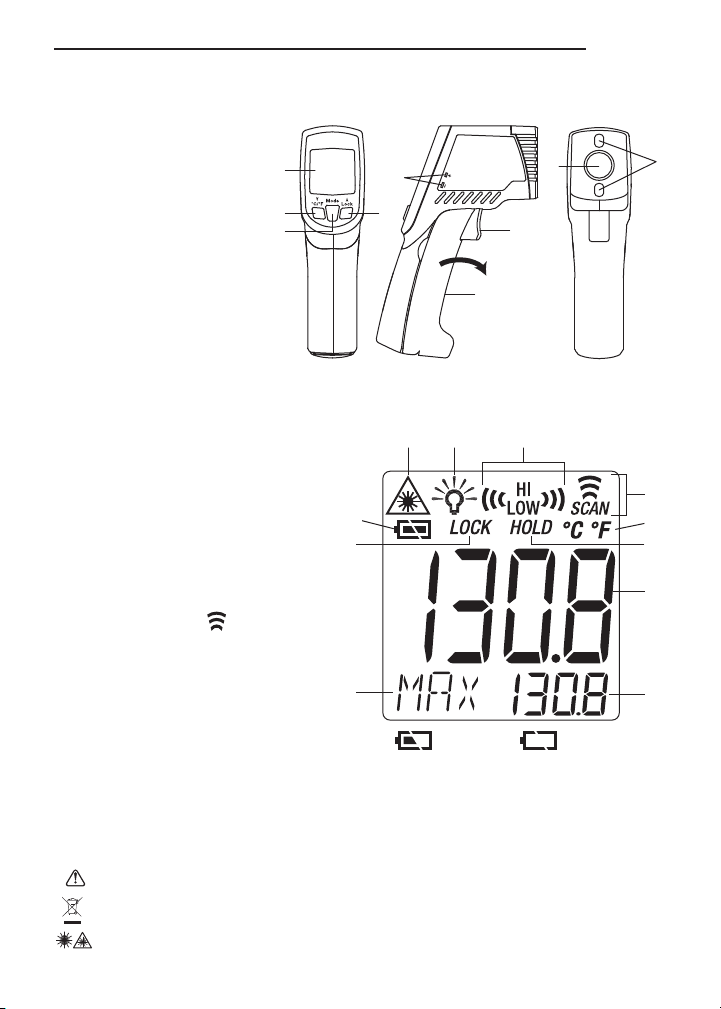
1. Display
2. Decrease button
and °C/°F selector
3. Mode selector
4. Increase button
and Lock button
5. Probe jack
6. Trigger
7. Battery compartment door
8. Lens
9. Lasers
Display Icons
11. Lock mode indicator
12. Full battery indicator
12A. Low battery indicator
12B. Dead battery indicator
13. Laser ON indicator
14. Backlight ON indicator
15. High/low alarm ON indicator
16. Scan mode indicator; blinks
when reading is updated
17. Celsius or Fahrenheit indicator
18. Hold mode indicator
19. Temperature indicator
20. Mode value indicator
21. Mode indicator
2
34
15
6
7
9
8
12*
11
21
18
17
13 14 15
*12A *12B
16
19
20
Symbols on the Unit
Warning—Read the instruction manual.
Recycle product in accordance with manufacturer’s directions.
Laser radiation is emitted from this unit.

8
Using the Features
Basic Features
•To turn the laser on or off: Press and hold the trigger, and then momentarily press the button.
•To turn the backlight on or off: Press and hold the trigger, and then momentarily press the button.
•To change between Celsius and Fahrenheit: If the LCD is blank, press and release the trigger.
Momentarily press the °C/°F button.
•To lock the trigger for continuous measurement: If the LCD is blank, press and release the trigger.
Momentarily press the Lock button. Momentarily press the Lock button again to return to normal
measurement. The unit will automatically exit Lock mode after 60 minutes.
Advanced Features
Press the Mode button to access the advanced features. They appear in this order: Emissivity Display
(E), Emissivity Setting (iEh), Maximum (MAX), Minimum (MIN), Difference (dIF), Average (AVG), High
Alarm Limit (HAL), Low Alarm Limit (LAL), and Probe (PRB).
Setting Alarm Points
After selecting the HAL or LAL mode, use the or button to set the alarm point. A tone will sound
and the alarm indicator will flash if the temperature is higher than or lower than the corresponding set
point. “HI” or “LOW” will appear with the alarm indicator.
Temperature Probe
To use a K-type thermocouple temperature probe (purchased separately), connect the probe to the
probe jack on the side of the thermometer. Select PRB mode. The probe temperature will appear in
the lower right corner of the display. The temperature detected by the infrared sensor will continue to
appear in the center of the display. You may still use the Mode button to access the other advanced
features, but the probe temperature is displayed only when PRB mode is selected.
Note: The probe will not trip the high alarm and low alarm.
Measurement Review
After the unit shuts off, press Mode to review the measurement:
•MAX — the highest recorded temperature among all of the readings.
•MIN — the lowest recorded temperature among all of the readings.
•dIF — the difference between the maximum and minimum readings.
•AVG — a weighted rolling average of all of the readings.
Note: Values for MAX, MIN, dIF and AVG are reset each time the trigger is pressed.
Note: The AVG feature acts as a filter to eliminate fluctuations from the temperature readings. It is not
an arithmetic mean, but rather a rolling weighted average of the readings that smoothes the data and
excludes sudden spikes.

TG-2000
9
Distance from Target
Thermometers measure the surface temperature of an object by sensing its emitted, reflected, and
transmitted energy. The sensor collects this energy from the area being measured (spot size). The spot
size varies as the distance to the target changes. The farther the distance from the area being targeted,
the larger the spot size.
When determining the appropriate distance from the object, the spot size must be somewhat smaller
than the target area. When accuracy is critical, the spot size should be half as large as the target. If the
spot size is larger than the target size, the thermometer will pick up the temperature of the back-
ground, resulting in inaccurate readings.
1 2
Object 1 is the correct distance from the unit. Note the target is slightly larger than the spot size being
measured.
Object 2 is too far away. The thermometer also measures the background because the target is smaller
than the instrument’s spot size. This can result in an inaccurate reading.
Distance to Spot Size
The distance to spot size is a ratio that provides the appropriate distance to the target.
The nominal distance-to-spot-size (D:S) ratio for TG-2000 is 16:1.
Distance (D) to Spot size (S)
D:S=16:1
Nominal Spot Diameter at 90% Energy

10
Operation
LASER RADIATION
DO NOT STARE INTO BEAM
CLASS 2 LASER PRODUCT
CLASS II LASER PRODUCT
CAUTION–CLASS 2
LASER RADIATION WHEN OPEN
LASER RADIATION–DO NOT
STARE INTO BEAM
Max. Output <1 mW,
Wavelength: 635-660 nm
Complies with 21 CFR, Chapter 1, subchapter J
1. Refer to “Typical Measurements” for specific measuring instructions.
2. Test the unit on an object with a known temperature.
•If the unit does not function as expected on an object of known temperature, replace the
batteries.
•If the unit still does not function as expected, call Greenlee for technical assistance
at 800-435-0786.
3. To measure the temperature of a selected area: Press and hold the trigger and point the ther-
mometer at the object to be measured. The dual lasers indicate the approximate diameter of the
measured area. “SCAN,” the measured temperature, and advanced feature data will appear on the
display. The scan icon will blink. Release the trigger after completing the measurement. “HOLD,”
the final temperature measurement, and advanced feature data will remain on the display for
1minute.
4. To take more than one temperature measurement, or to locate a hot spot: Press and hold the
trigger, and scan the objects to be measured. The unit will record the maximum, minimum, differ-
ence, and average temperatures.
To perform other functions, refer to “Advanced Features” in the “Using the Features” section.
Limitations
•The thermometer cannot measure through transparent objects, such as glass or plastic. It will
measure the surface temperature of the glass or plastic.
•Steam, dust, smoke, or other particles can prevent accurate measurement by obstructing the unit’s
infrared sensor.
Locating a Hot Spot
To find a hot spot, aim the thermometer outside the area of interest, and then scan across with an up
and down motion.
Altri manuali per Greenlee TG-2000
1
Indice
Lingue:
Altri manuali Textron Termometro