
TVS RTR 200 Fi4V 2018 Manuale utente

Dear Racer,
Thank you for choosing the TVS RTR 200 Fi4V.
Every feature in the RTR is honed on the race track to deliver the best in racing performance.
As a proud owner of the TVS RTR 200 Fi4V, you are now part of the one million strong TVS Racing families.
This manual explains the features and operations of your TVS RTR 200 Fi4V. Please read it carefully and follow the
instructions to enjoy the ultimate racing experience.
To have prolonged joy riding on your TVS RTR 200 Fi4V, we urge you to get your TVS RTR 200 Fi4V serviced only at TVS
Motor Company Authorised Distributors or Dealers / Authorised Service Centers.
Here’s your new lap on the RTR 200 Fi4V.
TVS MOTOR COMPANY LIMITED
FOREWORD
I
Always keep your Owner‘s Manual in the motorcycle and give it to the new owner if you ever transfer your TVS RTR 200
Fi4V.
Take time to familiarize yourself with your TVS RTR 200 Fi4V and its performance characteristics.
This Owner‘s Manual contains a host of useful information. Please take the time to read this manual before you ride your
new TVS RTR 200 Fi4V. Get familiarised with the operation of your motorcycle for maximum safety and pleasure. The
better you know your vehicle, the more pleasure you will experience riding your new vehicle. Ensure that anyone else
riding your TVS RTR 200 Fi4V does the same.
All information, illustrations, photographs and specifications contained in this owner's manual are based on the
latest product information available at the time of this publication. TVS Motor Company Limited may, however,
incorporate modifications or improvements on its vehicles at any time without notice, and therefore, in such
events it is possible that the relevant part of the owner‘s manual does not apply to your vehicle.
Prior permission of TVS Motor Company Limited is required for quoting, copying or reproducing any part of this owner's
manual.
Part Number : N9217210 Revision 1, Aug 2018
NOTICE
II
Note

Disregarding this message might result in injury to the rider or deadly accidents.
This message indicates special procedures or precautions to be followed to avoid damage to the vehicle.
This message provides further clarification for clear understanding of any particular information.
Caution
Warning
Note
Operating this vehicle safely is an important responsibility of the rider. To help you make decisions on safety, we have
provided necessary operating procedure and other information in this manual. This information alerts you on potential
hazards that could hurt you or others. Since it is not possible to warn you about all the hazards associated with operating
or maintaining the vehicle, you must use your own judgement.
You will find important safety information in following form in this manual. These words carry the following connotations:
SAFETY INFORMATION
III

Running-in information 01
Safe riding tips 02
Know your TVS RTR 200 Fi4V 06
Riding your TVS RTR 200 Fi4V 32
Maintenance 38
Service record sheet 58
Technical specifications 61
CONTENTS
IV

The first 1000 km is a crucial part of your motorcycle. Proper running-in operation during this period helps in ensuring a
maximum life and smooth performance of your motorcycle.
The reliability and performance of your motorcycle depends on the special care and restrain exercised during the
running-in period. It is especially important that you avoid operating the engine in high speed (RPM), which could expose
the engine parts to excessive stress. Recommended speed during the running-in is:
Maximum 50 km/h speed upto 750 km (vary the engine speed for better mating of parts).
The first service at 500 ~ 750 km is most important. During running-in period all the engine components and other parts
will have set in. All adjustments to be restored, all fasteners to be tightened. Engine cum transmission oil to be replaced.
Timely performance of the first service will ensure optimum service life and performance from the engine.
Replacing the engine cum transmission oil during first service is most important for better life of engine. Always use TVS
TRU4 FULLY SYNTHETIC oil (SAE 10W30 API-SL, JASO MA2) for better performance and life.
RUNNING-IN INFORMATION
01
Caution

Two wheeler safety starts with wearing a good quality helmet. One of the most serious injuries that can happen is a
head injury. Always wear a good quality helmet that should fit your head comfortably and securely. You should also have
good quality goggles to protect your eyes and help your vision.
To prevent or minimize accident, never consume alcohol or drugs before or during the operation of your vehicle. Even
minimal consumption of these will affect the rider’s ability to control the vehicle.
SAFE RIDING RECOMMENDATIONS
Any two wheeler riding requires some precautions to be taken to ensure the safety of the rider, pillion rider and other
road users. These precautions are:
Familiarise yourself with new TVS RTR 200 Fi4V
Riding skill and your mechanical knowledge forms the foundation of safe riding practices. We suggest you to practice
riding TVS RTR 200 Fi4V in a low-traffic condition until you are thoroughly familiar with your vehicle and its controls.
Remember practice makes you perfect.
Riding apparel
Loose, fancy clothing can be uncomfortable and unsafe when riding a two-wheeler. Choose good quality two wheeler
riding apparel.
Know your limits
Ride within the boundaries of your own skill at all times. Knowing these limits and staying within them will help you avoid
accidents.
SAFE RIDING TIPS
02
Warning

One-hand riding is dangerous. Keep both hands
firmly on the handle bar and both feet securely on the
foot rest. Under no circumstances should both the
hands be removed from the handle bar, as it is very
dangerous.
Avoid use of mobile phones while riding as it could
lead to fatal accident.
Do not downshift the gears in the midst of cornering.
Slow down to a safe speed before negotiating a
corner. If this is the first time that you are riding a
vehicle of this type, we suggest that you practice on a
safe, open area to thoroughly familiarise with the
operation of the vehicle.
Posture
Proper vehicle riding starts with proper posture.
1. Keep your elbows relaxed and flexible.
2. Sit and adjust yourself on seat so that the arms
and shoulders are relaxed.
3. Look widely instead of gazing at one point.
4. Keep the knees close to the fuel tank.
Cornering
When cornering, centrifugal force works in a direction
perpendicular to the direction in which the vehicle is
moving. Centrifugal force increases in proportion with
speed and the radius of the corner.
During cornering, reduce speed so as to reduce the
effects of centrifugal force. Avoid abrupt application
of brake or sudden steering by all means.
03
Warning
SAFE RIDING TIPS

3. Approximately 60% braking effect is from front
brake. Non-usage of front brake causes poor
braking.
As the vehicle speed increases, the stopping distance
also increases progressively. Be sure that, you have
sufficient distance between you and the vehicle or
obstruction ahead of you.
Using only the front or rear brake is dangerous and can
cause skidding and loss of control. Apply both
the brakes together and with great care on a wet
road or other slippery surfaces. Any abrupt braking
on slippery or irregular roads can cause loss of rider
control.
Braking
For safe riding, it is very important to master the
braking techniques.
1. Close / release the throttle.
2. Hold the vehicle upright as you apply the brakes.
3. Progressive application of brakes is safer.
4. Never depress the clutch lever while braking at
higher speeds.
5. Apply both the brakes.
6. While riding down hills, cornering and on wet
roads close the throttle and down shift the gear to
take advantage of gearbox and engine which acts
as an additional brake. This will avoid the loss of
control over the vehicle due to over speed.
Causes for poor braking
1. If the brake shoes / pads or drum / disc are worn
out or if there is water or oil on them, sufficient
friction does not develop and brakes do not work
well.
2. Even when the brakes work normally, if the road
surface is wet or the tyre surface is worn-out,
tyres do not take a firm hold on the surface,
increasing the stopping distance.
04
SAFE RIDING TIPS
Warning

If the vehicle needs any adjustments, please consult
nearest TVS Motor Company Authorised Distributor
or Dealer / Authorised Service Center.
While adequate care is exercised at the factory to
ensure that the emissions are within the limits, it is
essential for the owner to always maintain the
motorcycle in good condition by getting it periodically
checked and serviced by TVS Motor Company
Authorised Distributor or Dealer / Authorised Service
Center so that the emission and fuel consumption
levels are maintained as per norms.
ACCESSORY INSTALLATION AND SAFETY TIPS
Use extreme caution while selecting and installing the
accessories for your motorcycle.
The addition of unsuitable accessories can lead to
unsafe operating conditions. Your friendly
Distributor / Dealer will assist you in selecting quality
accessories and installing them correctly.
While selecting the accessories, make sure the
accessories should not obstruct lighting, steering,
suspension level and ground clearance. Please
ensure that if the tank cover is used, it is not getting
en-trapped between fuel tank and fuel tank cap.
Additional electrical equipments and controls
should not exceed the specified electrical system
load of the vehicle (capacity of battery and
magneto).
EMISSION CONTROL
All the TVS motorcycles are tested in the factory for
optimum fuel efficiency and lowest possible CO
levels.
Do not disturb the fuel supply settings as this may
lead to higher fuel consumption and also higher CO
levels.
05
SAFE RIDING TIPS
VEHICLE IDENTIFICATION NUMBER
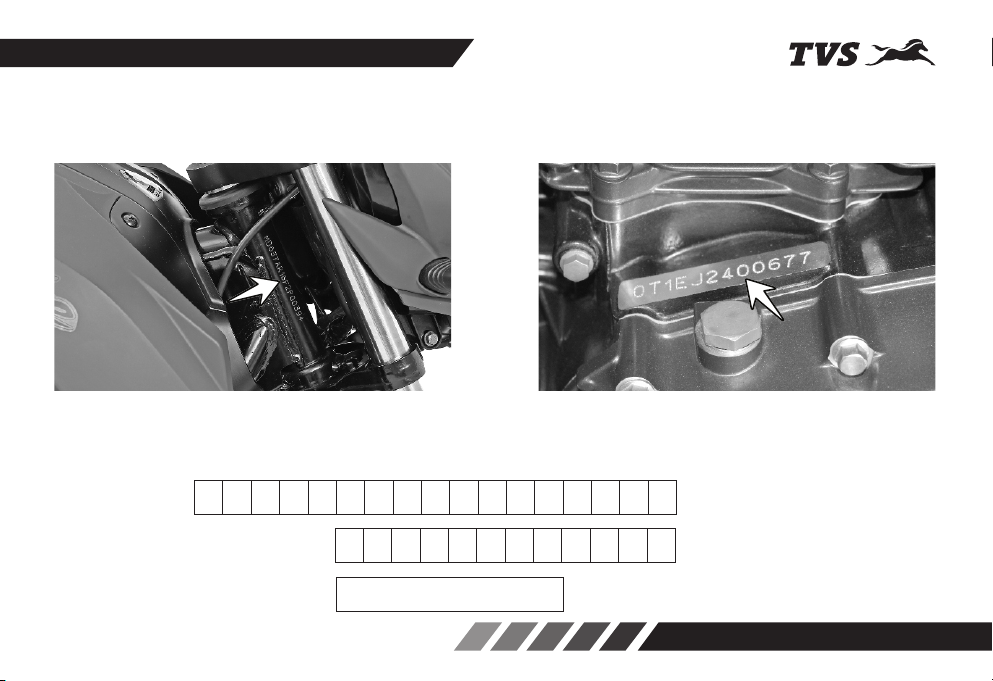
The frame and engine serial numbers are the only means of identifying your vehicle from others of the same model and
type. They are also required to assist your Dealer for ordering parts or referring to special information.
Please fill the above boxes now for future reference
Frame number
Engine number
Control key number
Frame serial number is engraved on the right side of
the steering head tube as shown in the above figure.
Engine serial number is engraved on the left side
crankcase assembly near cylinder block as shown in
the above figure.
KNOW YOUR TVS RTR 200 Fi4V
06
Indice
Altri manuali TVS Motociclo

TVS
TVS Apache RTR 200 4V ABS Race Edition 2.0 Manuale utente

TVS
TVS Apache RTR180 Istruzioni per l'uso e l'installazione

TVS
TVS RONIN Manuale utente

TVS
TVS APACHE RTR 200 Fi 4V Manuale utente

TVS
TVS RAIDER Manuale utente

TVS
TVS Metro Plus Manuale utente

TVS
TVS StaR City+ Manuale utente

TVS
TVS Apache RTR 200 4V Manuale utente

TVS
TVS Stryker 125 Manuale utente

TVS
TVS Apacha RTR 310 Manuale utente

TVS
TVS DAZZ Manuale utente

TVS
TVS Sport Manuale utente

TVS
TVS ZT125 Manuale utente

TVS
TVS NEO Series Manuale utente

TVS
TVS JUPITER 125 Manuale utente

TVS
TVS TVS XL 100 Manuale utente

TVS
TVS ETFi VS-VI Radeon Manuale utente

TVS
TVS Sport Manuale utente

TVS
TVS TVS StaR HLX 150 Manuale utente

TVS
TVS RTR 165 RP Manuale utente


