
Aironet 2000 series Manuale utente

Aironet Wireless Communications, Inc. • 367 Ghent Road, Suite 300
P.O. Box 5292 • Fairlawn, Ohio 44334-0292
User’s Guide
2000 and 1000 series
Wireless Access Points for
Token Ring
Products supported:
AP2000-T and AP1000-T
DOC-710-003849 Rev. A0

Aironet Wireless Communications, Inc.
No part of this document may be reproduced or transmitted in any means,
electronic or mechanical, for any purpose, without the written permission of
Aironet. Information in this document is subject to change without notice.
Aironet makes no representation or warranties with respect to the contents of
this manual and specifically disclaims any express or implied warranties of
merchantability or fitness for any particular purpose.
© 1997 Aironet Wireless Communications, Inc.
All rights reserved.
ARLAN® & Aironet® are trademarks of Aironet Wireless Communications, Inc.
Printed in USA
DOC-710-003849 Rev. A0
i
Manufacturers Federal Communication Commission
Declaration of Conformity Statement
Models : AP1000-T, AP2000-T
Manufacturer :
Aironet Wireless Communications, Inc.
367 Ghent Rd , Suite 300
Fairlawn, OH 44333
1-800-3-WIRELESS
This device complies with Part 15 rules. Operation is subject to the
following two conditions:
1) this device may cause harmful interference, and 2) this device must
accept any interference received, including interference that may cause
undesired operation.
This equipment has been tested and found to comply with the limits of a
Class A digital device, pursuant to Part 15 of the FCC Rules. These limits
are designed to provide reasonable protection against harmful interference
when the equipment is operated in a residential environment. This equip-
ment generates, uses, and radiates radio frequency energy, and if not
installed and used in accordance with the instructions, may cause harmful
interference. However there is no guarantee that interference will not
occur. If this equipment does cause interference to radio or television
reception, which can be determined by turning the equipment off and on,
the user is encouraged to correct the interference by one of the following
measures:
l
Reorient or relocate the receiving antenna.
l
Increase separation between the equipment and receiver.
l
Connect the equipment into an outlet on a circuit different from
which the receiver is connected.
l
Consult the dealer or an experienced radio/TV technician.
User Warning
The Part 15 radio device operates on a non-interference basis with
other devices operating at this frequency. Any changes or
modification to said product not expressly approved by Aironet could
void the user’s authority to operate this device.

ii
Department of Communications - Canada
Canadian Compliance Statement
This Class A Digital apparatus meets all the requirements of the Canadian
Interference - Causing Equipment Regulations.
Cet appareil numerique de la classe A respecte les exigences du
Reglement sur le material broilleur du Canada.
This device complies with RSS-210 of Industry of Canada. Operation is
subject to the following two conditions: 1) this device may cause harmful
interference, and 2) this device must accept any interference received,
including interference that may cause undesired operation.
European Telecommunication Standards Institute
Statement of Compliance
Information to User
This equipment has been tested and found to comply with the European
Telecommunications Standard ETS 300.328. This standard covers Wide-
band Data Transmission Systems referred in CEPT recommendation T/R
10.01.
This type accepted equipment is designed to provide reasonable
protection against harmful interference when the equipment is operated in
a commercial environment. This equipment generates, uses, and can
radiate radio frequency energy, and if not installed and used in accordance
with the instruction manual, may cause harmful interference to radio
communications.

iii
Declaration of Conformity
Aironet Model Number:
AP2000-T
Application of Council Directive: 89/336/EEC
Application of Council Directive: 72/23/EEC
CE Type Examination Certificate: HDTP/RDR/167/328880/11
Standards to which Conformity is Declared:
EN 55022 (A)
EN 55011 (A)
EN 50082-1
EN 60950
Manufacturer:
Aironet Wireless Communications, Inc.
367 Ghent Road, Suite 300
Fairlawn Ohio, 44333
The undersigned hereby declares that the equipment specified
above conforms to the directives and standards cited herein.
Michael Smedley
Director, Manufacturing Engineering
Aironet Wireless Communications, Inc.

iv
Safety Information
The FCC with its action in General Docket 93-62, 1997, has
adopted a safety standard for human exposure to radio frequency
(RF) electromagnetic energy emitted by FCC regulated equip-
ment. Aironet subscribes to the same safety standard for the use
of its products. Proper operation of this radio according to the
instructions in this manual will result in user exposure substantially
below the FCC recommended limits.
n
Do not move the AP1000-T/AP2000-T antenna(s) while the
unit is receiving or transmitting.
n
Do not hold any component containing a radio such that the
antenna(s) is(are) very close to, or touching, exposed parts of
the body, especially the face or eyes, while transmitting. Hold
such a component 15 centimeters (6 inches) or more from
your face.
n
Do not allow children to play with any radio equipment
containing a transmitter.
n
Do not operate a portable transmitter near unshielded
electrical blasting caps or in an explosive atmosphere unless
it is a type especially qualified for such use.
n
Do not turn on the AP1000-T/AP2000-T or attempt to transmit
data unless the antenna(s) is(are) attached; if the antenna(s)
is(are) not attached, the radio module may be damaged.
The AP1000-T/AP2000-T are compliant with ANSI C95.1.91
(1991).

v
Table of Contents
Before You Start .................................................................1
Terminology ........................................................................1
Understanding the Radio Network....................................2
Installing the Hardware ......................................................4
Configuring the Access Point............................................7
Console Port...................................................................7
Telnet Session................................................................7
System Identifier (SID)...................................................8
Bitrate/Frequency (2000 Series/2.4 GHz Models)..........8
Channel (1000 Series/900MHz Models) ........................9
Root Mode......................................................................9
Verifying Registration.....................................................9
Where to Go from Here ....................................................10
Technical Support ............................................................10
Shipping Address.........................................................10
Communications ..........................................................10
Web Site.......................................................................10

vi

1
The purpose of this User’s Guide is to allow you to install
and configure your Access Point, so that an end node or
another Access Point (acting as a Repeater) will be able to
register to it. For detailed installation and configuration
procedures, see the
AP1000-T/AP2000-T Technical
Reference Manual
.
Before You Start
After unpacking the system, make sure the following items
are present and in good condition.
• Wireless Access Point — 2000 or 1000 series
• 120VAC/60Hz or 90-264VAC/47-63Hz to 12-18VDC
Power Pack
• Standard 2dB Dipole Antenna
If any item is damaged or missing, contact your Reseller.
Save all shipping and packing material to repack the unit in
the future, should service be required.
Terminology
Root Unit - An Access Point which is located at the top of a
RF Network Tree. The Root Unit is the starting point in the
network and contains information in its Registration Table
regarding all nodes on the network.
Repeater - A Repeater is an Access Point which is used to
extend the radio range of your RF Network. A single Access
Point has a limited RF range. If your system configuration
includes nodes outside this range, you will need to add a
Repeater in order for them to communicate.
2
Radio Node - A PC, notebook computer, etc. containing a
Wireless LAN ISA, MCA card or PCMCIA Adapter.
End Node - A Radio Node that is at the end of the RF
Network Tree.
Understanding the Radio Network
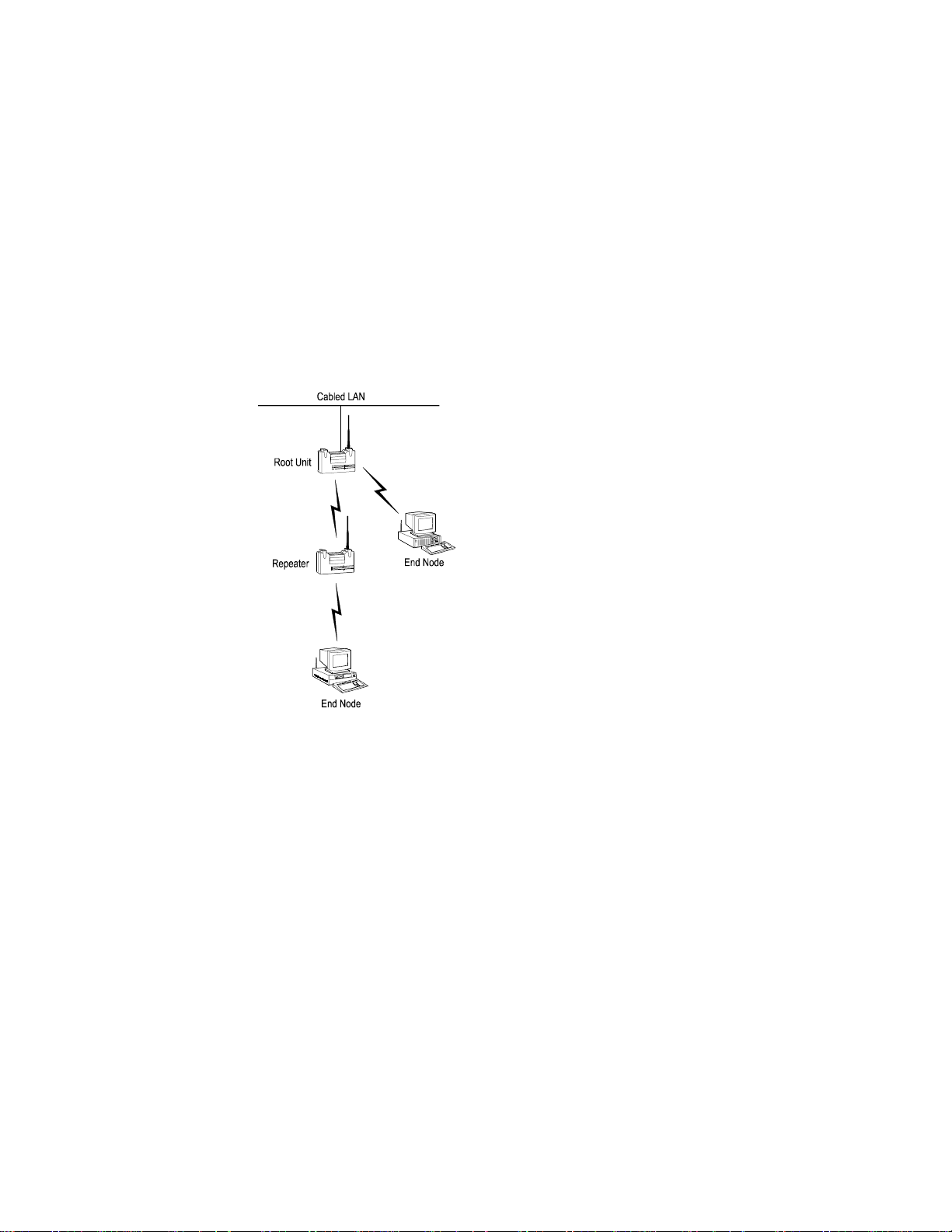
Advanced Radio Local Area Network (ARLAN) is designed
like an upside-down tree, with a Root Unit at the top and
repeaters and Radio nodes branching down and out from
the Root as shown in the figure below.
Wireless Access Points can serve as a Root Unit or Re-
peater, providing wireless data communications between
the Token Ring based network and other end nodes, or
within the radio network itself.
In the example shown, the
Root Unit does not register but
will accept Registration from
those nodes within Radio
Range (The Repeater).
The Repeater registers to the
Root Unit and will accept
registrations from those end
nodes within radio range.
The Repeater will pass along
the End Nodes’ registrations to
its parent, the Root Unit.
The Root Unit will have
registration information for all
nodes on the radio network in
the tree.
Questo manuale è adatto per i seguenti modelli
3
Indice
Altri manuali Aironet Punto di accesso wireless

Aironet
Aironet AP4500-E Manuale del prodotto

Aironet
Aironet AP4500 Manuale utente

Aironet
Aironet Arlan 630 Manuale utente

Aironet
Aironet AP3500-E Manuale utente

Aironet
Aironet AP4800B series Manuale utente

Aironet
Aironet AP1200-E Manuale utente

Aironet
Aironet UC3500 Manuale del prodotto

Aironet
Aironet 3500 Series Manuale utente

Aironet
Aironet AP4810B Manuale utente


