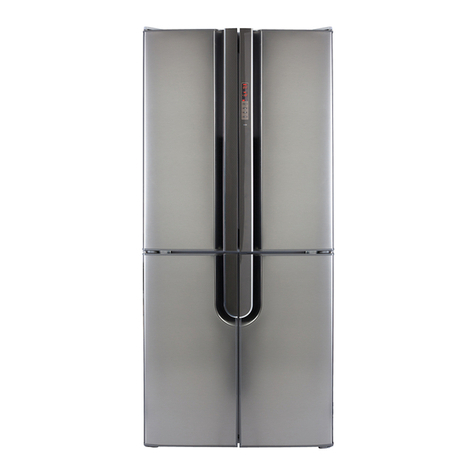
CDA fw852 Guida di sicurezza

Customer Care Department • The Group Ltd. • Harby Road • Langar • Nottinghamshire • NG13 9HY
fw852 / fw872 Integrated
Fridge Freezer
Manual for Installation, Use and Maintenance

2
Important
The manufacturer cannot be held responsible for injuries or losses
caused by incorrect use or installation of this product. Please note
that we reserve the right to invalidate the guarantee supplied with this
product following incorrect installation or misuse of the appliance.
This appliance is not designed to be used by people (including
children) with reduced physical, sensorial or mental capacity, or
who lack experience or knowledge about it, unless they have had
supervision or instructions on how to use the appliance by someone
who is responsible for their safety.
Under no circumstances should any external covers be removed for
servicing or maintenance except by suitably qualified personnel.
Appliance information:
Please enter the details on the appliance rating plate below for
reference, to assist CDA Customer Care in the event of a fault with
your appliance and to register your appliance for guarantee purposes.
Appliance Model
Serial Number
CE Declarations of Conformity:
This appliance has been designed, constructed and marketed in
compliance with safety requirements of EEC Directive 2006/95/EEC
(Low voltage) and requirements of EMC Directive 2004/108/EEC.

3
This appliance has been manufactured to the strictest standards and
complies with all applicable legislation, including Electrical safety (LVD)
and Electromagnetic interference compatibility (EMC). Parts intended
to come into contact with food conform to EEC/89/109.4
IMPORTANT INFORMATION FOR CORRECT DISPOSAL OF THE
PRODUCT IN ACCORDANCE WITH EC DIRECTIVE 2002/96/EC.
At the end of its working life, the product must not be disposed of as
urban waste. The refrigeration system contains insulating gases and
refrigerants, which require specialised waste disposal. The valuable
materials contained in this appliance can be recycle. It must be taken
to a special local authority dierentiated waste collection centre or to
a dealer providing this service.
Before disposing of an old appliance, remove the door seals, latch or
bolt lock to avoid the risk of child entrapment.
Disposing of a household appliance separately avoids possible
negative consequences for the environment and health deriving from
inappropriate disposal and enables the constituent materials to be
recovered to obtain significant savings in energy and resources. As a
reminder of the need to dispose of household appliances separately,
the product is marked with a crossed-out wheeled dustbin.

4
Important
Never store inflammable or explosive items and strong corrosive
acids or alkalis in the appliance.
This is a household appliance, which is produced in accordance with
the national standard. It is intended for food storage only, not for
storage of blood, medicine and biological products.
To prevent risk of fire, keep the appliance away from petrol or any
other inflammables.
To prevent risk of electromagnetic interference or other accidents,
do not place a microwave oven on top of the refrigerator or use any
electric appliance inside the refrigerator.
Do not allow children to play with or near the appliance.
The internal surface of freezer compartment is very cold when the
appliance is running. Do not touch the surface especially when hands
are wet.
Do not splash water onto the appliance. Keep it away from places of
high humidity that may have adverse eect on the electric insulation
performance.
This appliance is designed to be used in ambient temperatures
between 10 and 32˚C. Use outside of this range may cause the
appliance to fail.

5
Before First Use
You must allow the fridge to settle for at least twenty four hours
prior to switching the power on.
It is recommended that you clean the interior of the appliance prior to
first use, using a solution of bicarbonate of soda and warm water and
then thoroughly drying the interior.
The fridge may have an odour to it at first use. This will disappear as
the appliance cools.
When first switching the appliance on the fridge will default to 5°C
and the freezer to -18°C. The figure in the digital display for freezer
temperature will flash until the temperature drops below 0°C.
Please note:
The appliance will work continuously until it comes down to the
correct temperature.
If the appliance is switched o, you should allow five minutes
before switching it on again to prevent unnecessary damage to the
compressor.
Never store inflammable or explosive items and strong corrosive
acids or alkalis in the appliance.
This fridge cools your food by making the inside back of the cavity
cold. It is normal for frost to build up on this surface; it then dissipates
and drains through a small drain at the bottom, where it evaporates
harmlessly. The presence of frosting at the back is not a malfunction
of the fridge.

6
Use
Fridge
• Never put liquids in the refrigerator uncovered.
• Never put hot foods in the refrigerator. Warm food should be
allowed to cool to room temperature before being put into the
refrigerator.
• Nothing should rest against the rear wall of the refrigerator, as this
will cause frost and possible condensation problems which will be
dicult to remove.
• Make sure food is clean and any extra water is wiped away before
putting into the fridge.
• Wrap or cover food before putting into the fridge. This will help
prevent the loss of moisture, keep food fresh and avoid unpleasant
odours.
• Sort foods prior to storing. Any foods to be used soon should be
stored at the front of the shelf to prevent deterioration caused by
the door being open for prolonged periods.
• Do not overfill the fridge. There should be sucient space between
the foods to allow the cool air to circulate.
• Thawing frozen foods in the fridge compartment will help to keep
the temperature low and save energy.

7
Freezer
• The freezer compartments are designed to store only frozen food.
• Never put hot or warm foods in the freezer, allow them to cool fully
before putting them into the freezer.
• Follow the instructions on the food packaging for storage of frozen
food. If no information is provided, foods should not be stored for
more than three months after the purchase date.
• Store food in small packages (ideally less than 2.5kg). This reduces
the freezing time and improves the quality of the food after thawing.
• Wrap food before putting into the freezer. To stop the wrapping
sticking together, ensure it is dry.
• Label the food before freezing with information including type of
food and dates of storage and expiry.
• Once food is thawed, it must not be refrozen unless it has been
completely cooked. Only defrost as much food as is required, to
prevent wastage.
• Bottled or canned drinks should not be stored in the freezer
compartments as they could explode.
• Check the rating plate to confirm the maximum amount of fresh food
that can be frozen within a 24 hour period.
• Do not attempt to freeze more than the maximum amount.
• To freeze fresh food more quickly, switch on the super freeze
function a few hours prior to placing the food in the freezer.
• Do not use the super freeze function for more than 24 hours. Use
over the recommended time will place unnecessary strain on the
refrigeration system.

8
Storage
The fridge section is for short term food storage. Although the
temperature can be maintained between 0-10˚C, extended periods of
food storage is not recommended.
As the cold air circulates within the fridge, the temperature can vary
between the dierent sections. As such, foods should be stored in
dierent sections according to type. Section 6 is the coldest part of
the fridge.
1. Butter
2. Food in jars and bottles
3. Drinks, e.g. milk
4. Cooked food
5. Yogurts and cheese
6. Fresh meat and fish
7. Fruit and vegetables
The fridge shelves can be moved
according to the storage requirements
within the fridge section.
To move the shelf, lift up the front
section and then pull it outwards. To
replace, slide the shelf back into the
slot, and the lower the front section.
Fig. 1
Fig. 2
6
73
4
5
1
2

9
Control Panel
A. Refrigerator Button
This button is used to adjust the fridge temperature between 2°C and
10°C in 1°C increments.
To change the temperature setting, press this button once so the
display shows the set temperature and flashes. While it is still flashing,
press this button several times until the required temperature is shown
on the display. Approximately 5 seconds after your last press of this
button the new temperature is set and the display changes back to
showing the actual temperature inside.
After changing the temperature setting the time taken to achieve
the new temperature will depend on how big the change is from the
previous setting.
B. Refrigerator Temperature Display
In normal running this shows the actual temperature in the refrigerator
compartment. See above for how this is used in setting the
refrigerator temperature.
B C D
AE
Fig. 3

10
C. Freezer Temperature Display
In normal running this shows the actual temperature in the freezer
compartment. If the temperature in the freezer is higher than 0°C this
will flash, otherwise it will be static.
See below for how this display is used in setting the freezer
temperature.
D. Super Freeze Display
The super freeze function can be used to freeze large quantities of
fresh food as quickly as possible. Fig 3 shows how this display looks
when the super freeze is switched on.
To switch on the super freeze function, push and hold the freezer
button (E) for three seconds.
Once the food is frozen, push and hold the freezer button (E) for three
seconds again to switch o the super freeze function.
IMPORTANT Do not use the super freeze function for more than 24
hours at a time.
E. Freezer Button
The freezer temperature is regulated by this button between -25°C
and -15°C in 1°C increments.
To change the temperature setting, press this button once so the
display shows the set temperature and flashes. While it is still flashing,
press this button several times until the required temperature is
shown on the display. Approximately 5 seconds after your last press
of this button the new temperature is set and the display changes
back to showing the actual temperature inside: it will continue to flash
if the actual temperature in the freezer is above 0°C, and until the
actual temperature falls below zero.
Questo manuale è adatto per i seguenti modelli
1
Indice
Altri manuali CDA Frigorifero

CDA
CDA FW971 Guida rapida

CDA
CDA CW897 Manuale di riferimento

CDA
CDA PC85SC Manuale utente

CDA
CDA PC44 Manuale di riferimento

CDA
CDA PC86 Manuale di riferimento

CDA
CDA FW951 Manuale di riferimento

CDA
CDA PC880 Guida rapida

CDA
CDA FW951 Manuale di riferimento

CDA
CDA CRI951 Guida utente

CDA
CDA FW822 Guida rapida