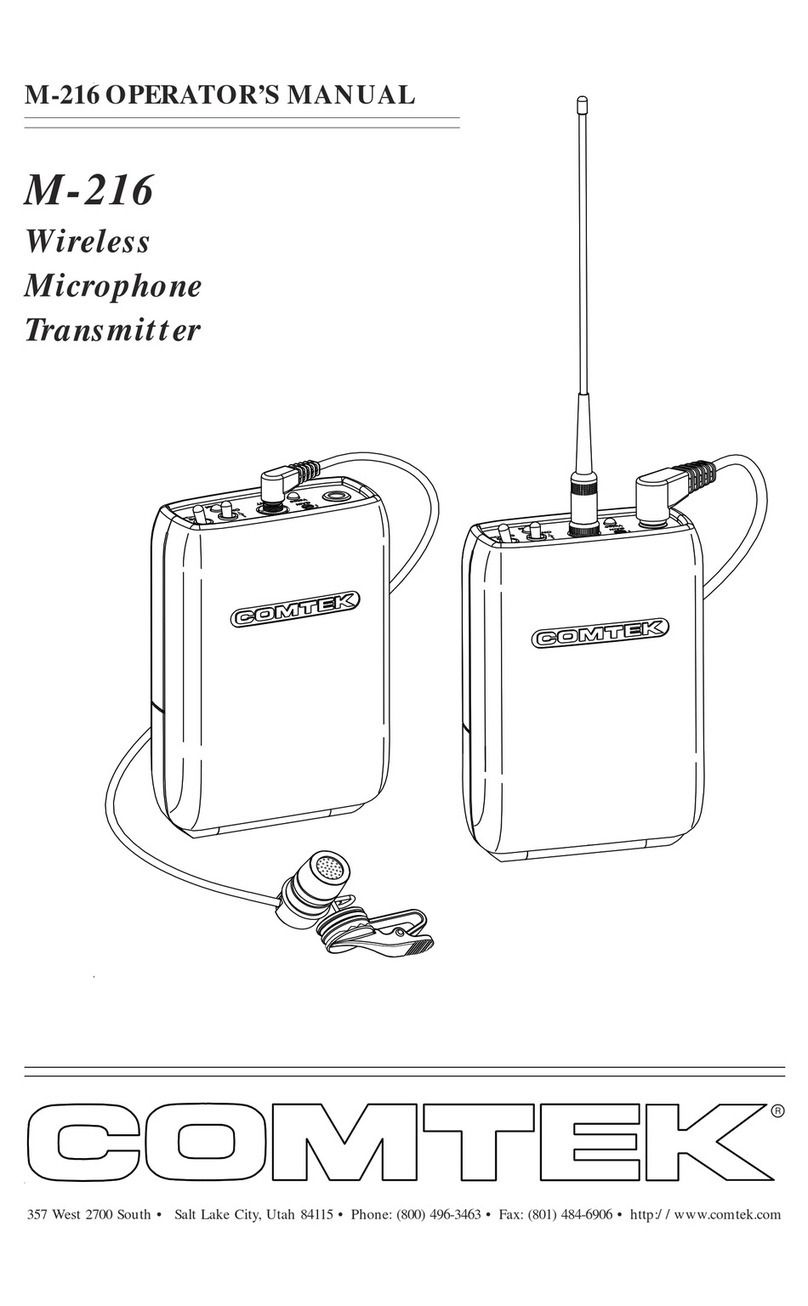
Comtek BST-50b Manuale utente

Synthesized
Base Station
Transmitter
BST-50b OPERATOR’S MANUAL (72-76 MHz)
357 West 2700 South • Salt Lake City, Utah 84115 • Phone: (800) 496-3463 • Fax: (801) 484-6906 • www.comtek.com

The BST-50b is a high fidelity, professional quality, base station
transmitter designed for assistive listening, language
translation, and remote monitoring applications. This transmitter
operates under F.C.C. Part 90 in the business band which allows
for higher power ideal for large area venues such as stadiums,
coliseums, and auditoriums. The BST-50b transmits on a
user-selectable channel in the 72-76 MHz band to a variety
of COMTEK personal receivers.
INTRODUCTION
BST-50b
Synthesized
Base Station
Transmitter
Page 1

Equipment Placement
The base station should be placed on top of an equipment
rack, control console table, or special shelf where the pull-out
whip antenna will be free of any metallic objects when fully
extended.
If the base station is to be rack-mounted, it should be
mounted away from equipment that uses large power
transformers to reduce 60 Hz hum possibilities.
Special Note:
When using the BST-50b in close proximity to other audio
equipment, ensure that the audio equipment is not susceptible
to RF interference, i.e. hum, oscillations, etc. This can be
accomplished by temporarily installing the BST-50b as per
above and then, while the BST-50b is operating, checking all
audio outputs for uncharacteristic noise. If a problem is
found, move the BST-50b or the remote antenna as far as
possible from the affected equipment. Should you continue
to have problems, contact Comtek's application engineering
department for assistance.
Remote Antenna
When the BST-50b base station is rack-mounted or when
greater system range is required, a remote antenna should be
used. The BST-50b base station transmitter has a 50 ohm
BNC antenna port which mates with a number of
standard external antennas including the Phase Right
antenna (model PRA-L 72-76 MHz). The antenna should be
mounted away from any metallic objects and away from
the equipment rack.
OPERATING INSTRUCTIONS
Page 2
IMPORTANT

Power Requirements
The base station is designed to be powered by 12 volts DC. A
power adaptor is furnished for use with standard 110V AC.
The on/off switch on the front panel of the base station turns
on the transmitter.
Audio Input Connections
The base station transmitter has facilities for audio input from
a mic, line, or speaker level source. The mic/line level audio
input is a true balanced input and requires a standard XLR-3
male connector. Unbalanced input is accomplished by
shorting pin-2 to pin-1 (audio ground), leaving pin-3 as the
audio source. Please note that it is recommended that all audio
input cables be kept as short as possible.
Set-up
a. Select an appropriate location for the BST-50b, i.e. a
sound cabinet or closet, where there is easy access to the
audio equipment and where the antenna can be extended to
the correct length.
b. Set the “MIC/LINE” switch, located on the back of the
BST-50b transmitter, to the appropriate position: "MIC"
position for low impedance microphones or “LINE” position
for line level feed from a mixer.
c. Connect the audio source or microphone to the BST-50b
using the appropriate input. Be sure to set the audio input
level adjust on the BST-50b to its full counter-clockwise
position.
Page 3

d. Plug the adaptor into a standard AC outlet, and
plug the power connector into the DC input jack of the
transmitter. Turn the display switch on the front of the
transmitter "ON" to allow monitoring of the transmitter
frequency. Turn the main power switch on the front of
the BST-50b to the "ON" position. The front display
should now be illuminated.
e. Mount the telescoping whip antenna in the hole on
top of the BST-50b, rotating it clockwise until it is firmly
seated. Extend the antenna completely. During normal
operation the antenna indicator should not flash. Turn on
the transmitter and verify that the antenna indicator is not
flashing. If the antenna indicator is flashing, shorten the
telescoping whip antenna by 2 inches and again check the
indicator. Continue this procedure until the indicator
remains off. If you experience trouble, please contact
Comtek's application engineering department for
assistance. If you are using an external type antenna, DO
NOT install the telescoping antenna. Instead, connect the
coaxial feed line for the external antenna to the external
antenna port on the back of the BST-50b.
Note:
For optimum performance when using the telescoping
whip antenna, the transmitter should be placed on a
large metallic surface. Adjustment of antenna length for
a “No Flash” condition on antenna indicator will insure
maximum radiation.
OPERATING INSTRUCTIONS (continued)
Page 4

Page 5
Adjustments
In order to ensure the highest possible transmission fidelity,
the transmitter must be modulating at least 50% with normal
speech (-3 dB on the VU meter). This adjustment is made in
the following manner:
a. Ensure that the audio source has been optimized for
best signal-to-noise ratio.
b. The “MIC/LINE” switch located at the back of the
transmitter should be switched to the appropriate setting:
"MIC" for mic level or weak line level input; “LINE” level for
line level input.
c. While normal program information is present, slowly
rotate the “LEVEL” control on the back of the base station
clockwise until the VU meter on the front panel begins to
deflect. Only very loud speech or music should deflect the
VU meter full scale.
Audio Processing and Frequency Selection
To accommodate a wide variety of receivers, the BST-50b base
station transmitter has the ability to operate both companded
and non-companded. (Refer to page 11 for listing of receivers
to determine whether you need to operate companded or
non-companded.) The display on the front panel will indicate
non-companded channels (1:1 audio processing) or
companded channels (2:1 audio processing). The up/down
button allows you to scroll through two sets of letter channels
(A-J 1:1 and A-J 2:1). All narrow-band number channels are
companded (2:1 modulation).
IMPORTANT

Page 6
Multiple Channel Operation
Simultaneous operation with more than two channels requires
coordination of the frequencies that are used to avoid interference.
This interference would result in poor or unusable performance.
When multiple transmitters are broadcasting, the RF signals will
“mix” together generating additional signals on other frequencies
in the receiver’s mixer. This condition, common to all RF receivers,
is called intermodulation or intermod.
If a mixed frequency product is generated close to a frequency
which you are using, the system on that frequency will experience
interference. Interference produces whistle and whine type
sounds and/or reductions of range. To avoid this type of
interference, you should select frequencies from one of the
standard groups (see frequency group charts on page 11), or
you can use COMTEK’s frequency selection guide software to
determine appropriate frequencies. (Contact COMTEK to obtain
a free copy of the frequency selection software.)
Test Tone
The BST-50b base station transmitter has an internal 400 Hz
source which is transmitted when the “TONE” switch is
enabled. This source is intended to be used to make technical
adjustments and for verification of the system. When using
this transmitter with “Tunable Receivers” use this tone to
assist in the proper tuning of the receivers. Tune the receiver
until it receives the tone and adjust the tuning until the tone is
as pure and distortion free as possible. Other possible uses
include; testing receivers, comparing receivers from different
manufactures, range testing the system, or other tests which
would require a modulated carrier. Under normal operation
the “TONE” switch should be disabled.
OPERATING INSTRUCTIONS (continued)

Speech EQ
On the back of the transmitter there is a switch labeled “EQ”. With
this function enabled (switch up), the audio dynamics and frequency
response are processed to improve intelligibility of speech. If the
primary audio source is going to be speech, you should enable this
processing. If the main audio source is going to include music or
other program information, you should disable it. You may want to
experiment to determine which position sounds most pleasing with
the program source you intend to use.
Display On / Off
The digital display can be turned on or off using the “DISPLAY”
switch. Disabling the display reduces the current consumption of the
transmitter for battery operation. In environments where the display
could be distracting, disabling the display may also be appropriate.
When the display is disabled, the tuning controls are also disabled,
ensuring the transmitter frequency is not changed inadvertently. With
the display disabled one segment is turned on as a power indicator.
Additionally the “LOCK OUT” indicator is illuminated indicating the
tuning is disabled. The VU meter and the “ANTENNA” indicator are
unaffected.
Lock Out
After the transmitting frequency has been determined the transmitter
tuning function can be disabled with the “LOCK OUT” switch on the
back of the transmitter. This ensures that the transmitter operating
frequency is not inadvertently changed. The “LOCK OUT” indicator
(above the first numeric digit on the display) will illuminate indicating
that the tuning has been disabled. When rack-mounting the transmitter
this switch must be accessed from behind the rack, this provides
added protection from intentional tampering.
Page 7

DISPLAY SWITCH: This switch disables the digital display to conserve
current when used with a battery.
TONE SWITCH: Enables/disables the internal 400 Hz test tone.
TUNING SWITCH: Selects the frequency on which the transmitter will
operate.
LOCK OUT INDICATOR: Illuminates when the “TUNING” switch is
disabled by setting the “LOCK OUT” switch (rear panel) to “ON”.
DIGITAL FREQUENCY DISPLAY: Displays the frequency on which the
transmitter is operating.
ANTENNA INDICATOR: Flashes when the transmitter senses a deficient
antenna condition.
VU METER: Displays the level of audio being transmitted. Used to
adjust the “LEVEL” (rear panel) control.
DIGITAL CHANNEL DISPLAY: Displays the channel on which the
transmitter is operating.
POWER SWITCH: Turns the transmitter on or off.
BST-50b FRONT PANEL
Page 8
9
8
7
6
5
4
3
2
1
1 2 3456 7 8 9

11
12
13
14
16
10
BST-50b REAR PANEL
LOCK OUT SWITCH: Disables the front panel “TUNING” switch,
locking the transmitter on one frequency.
DC INPUT JACK: Requires 12 VDC at 500 mA source (Pin-1 ground,
pin-4 +12 volts).
EXTERNAL ANTENNA JACK: BNC connector provides a standard 50
ohm RF output for use with an external antenna.
SPEECH ENHANCEMENT SWITCH: Enables and disables speech
enhance feature. Enable this function (switch up) for speech, and disable
it (switch down) for music.
LEVEL CONTROL: This control should be adjusted so that normal
audio deflects the VU Meter to midscale.
BALANCED AUDIO INPUT: Accepts audio from a PA system or dynamic
microphone (Pin-1: ground).
MIC/LINE SWITCH: Selects the desired audio input sensitivity.
15
Page 9
10 11 12 13 14 15 16
Indice
Altri manuali Comtek Trasmettitore