SK
Infrapasívny snímačpohybu vysielací
Návod na inštaláciu a používanie
POPIS FUNKCIE
Prístroj je spolu s prijímačom (tab. 1) určený k bezdotykovému
ovládaniu elektrických spotrebičov (svietidiel). Infrapasívny snímač
prijíma žiarenie v infračervenej časti spektra, ktoré je pre ľudské oko
neviditeľné. Ak zaregistruje snímačzmenu, ktorú vyvolá napr. pohyb
osoby v oblasti dosahu (obr. 1), dôjde k vyslaniu kódovaného RF
signálu.
Snímačpracuje v dvoch režimoch:
ON/OFF – snímačvysiela najprv signál pre zapnutie. Po ubehnutí
nastaveného časového pozdržania, vyšle signál pre vypnutie.
ON – snímačvysiela iba signál pre zapnutie. Vypnutie zaistí funkcia
časovačvopred nastavená na prijímači.
LED umiestnená pod šošovkou infrapasívneho snímača indikuje
vysielanie a v prípade vybitej batérie upozorňuje na potrebu jej
výmeny krátkym preblikávaním.
Upozornenie:
Veľkosťzóny, v ktorej infrapasívny snímačreaguje na pohyb osôb,
závisí v prípade stropnej montáže predovšetkým na výške
umiestnenia snímača a na jeho prípadnom natočení. Okrem toho je
veľkosťzóny ovplyvnená mnohými ďalšími okolnosťami, ako je
rýchlosťa smer pohybu vzhľadom k snímači, teplota okolia,
prítomnosťrušivých zdrojov (vykurovacie telesá, osvetlenie apod.).
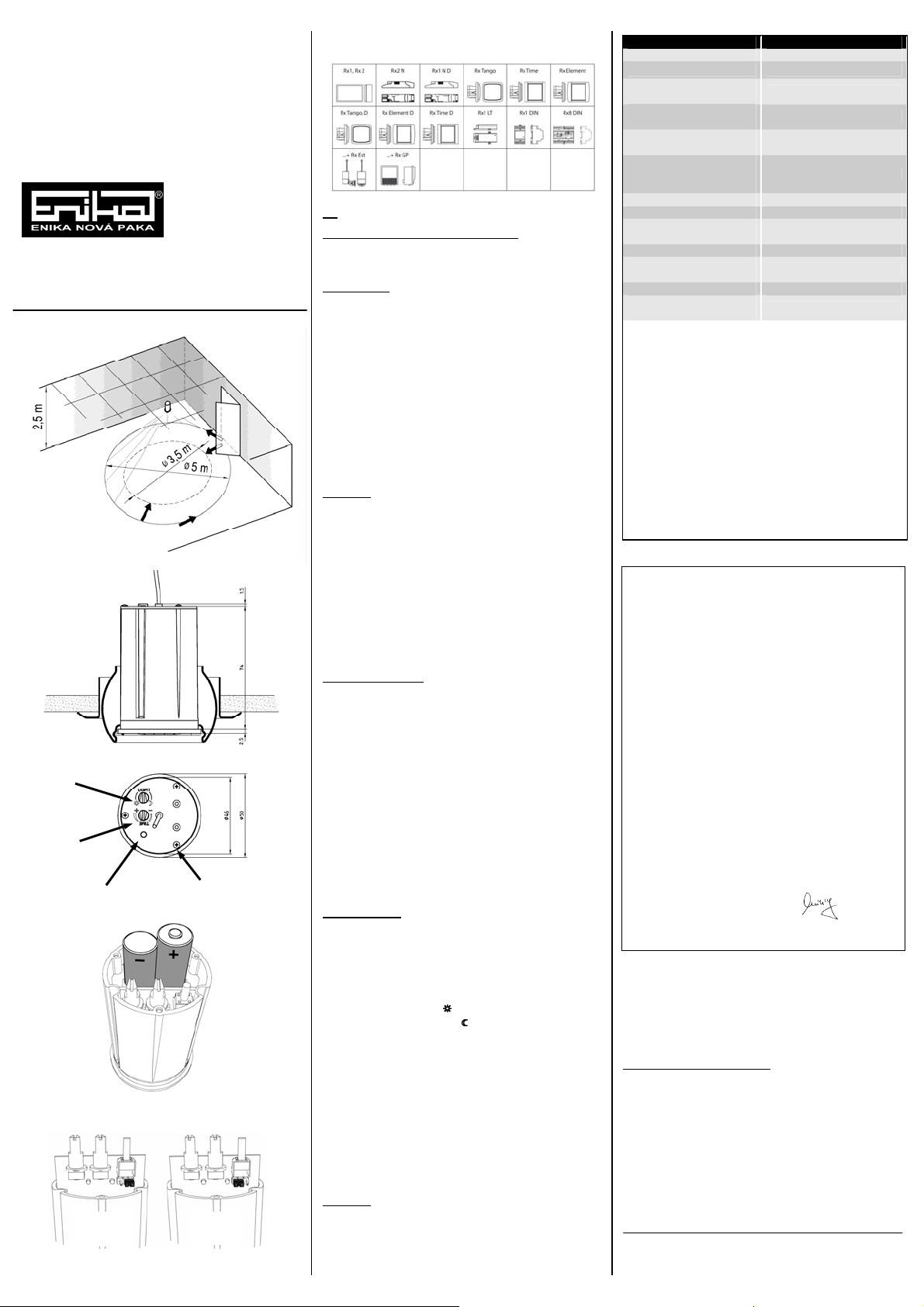
Informatívna zóna dosahu v závislosti na smere pohybu vzhľadom k
orientácii snímača je znázornená na obr. 1 (výška snímača nad
podlahou je 2,5 m). Pri montáži do väčšej výšky (až asi 3,5 m) sa zóna
dosahu úmerne zväčšuje. Pokiaľto typ držiaku umožňuje, je možné
naklopením snímača nasmerovaťa pretiahnuťzónu dosahu aj mimo
osu montážneho otvoru.
MONTÁŽ A NASTAVENIE
Infrapasívny snímačje určený pre montáž do stropných podhľadov do
držiakov halogénových žiaroviek MR16, ktoré umožňujú pretiahnutie
tela snímača (obr. 2). Anténa vystupujúca zo zadnej časti krytu by po
zasunutí snímača do držiaku mala byťpre dosiahnutie maximálneho
dosahu vysielania dostatočne vzdialená od všetkých vodivých
predmetov.
Do snímača je najprv potreba vložiťbatérie (obr.4).
- pomocou krížového skrutkovača odstráňte skrutky(obr. 3-d),
- odložte zadnú časťkrytu,
- vložte batérie (pozor na správnu polaritu),
- vráťte kryt na pôvodné miesto a upevnite skrutky.
Rovnako sa postupuje i pri ich výmene:
Funkcia je z výroby nastavená na režim ON/OFF. Pokiaľpotrebujete zmeniť
režim na ON, pri odmontovanej zadnej časti krytu vysuňte tlačený spoj a
prestavajte prepojku (obr. 5)
Nastavovacie prvky
Na zadnej strane snímača sú dva nastavovacie prvky (obr. 3 - a, 3 -
b):
a) LIGHT (hladina okolitého osvetlenia)
Snímačreaguje na pohyb, ak je úroveňosvetlenia v mieste inštalácie
nižší než nastavená hodnota. Pri vyššej úrovni okolitého osvetlenia je
prístroj deaktivovaný (signál sa nevysiela ani v prípade detekcie
pohybu). Pri nastavení do ľavej krajnej polohy ( ) prístroj spína
prakticky za akéhokoľvek osvetlenia, v pravej krajnej polohe ( ) spína
len za tmy.
b) TIME (oneskorenie vypnutia / potlačenie vysielania)
V režime ON/OFF sa týmto nastavovacím prvkom nastavuje
oneskorenie vypnutia, čo je doba, počas ktorej bude svietidlo zapnuté
od okamžiku ukončenia detekcie pohybu. Dobu je možné nastaviťod
asi 5 sekúnd do 10 minút. Poloha v strede rozsahu zodpovedá asi 90
s.
V režime ON sa oneskorenie vypnutia nastavuje na prijímači, ktorý
musí byťvo funkcii časovač. Nastavovacím prvkom na snímači sa v
troch hodnotách nastavuje potlačenie vysielania, čo je minimálna doba
medzi dvomi vysielaniami signálu pre zapnutie pri trvalom pohybe
pred snímačom. V krajnej polohe je hodnota 10 s, uprostred 30 s a
v krajnej polohe + 2 minúty.
Upozornenie:
Doba potlačenia vysielania by mala zodpovedaťminimálne polovičnej
dobe oneskorenia nastavenej na časovači prijímača. To znamená, že
pre dobu potlačenia 10 sekúnd je vhodné nastavenie časovača na
prijímači od 20 sekúnd do 1 minúty atď.
Z dôvodu dosiahnutia maximálnej životnosti batérie je treba čo najviac
obmedziťpočet vysielaní. Preto je vhodné, pokiaľto konkrétne
prevádzkové podmienky pre použitie snímačov umožňujú,
nenastavovaťzbytočne krátku dobu oneskorenia vypnutí v režime
ON/OFF a rovnako tak nenastavovaťnajkratšiu dobu potlačenia
vysielania v režime ON.
Zápis snímača do pamäti prijímača
- na prijímači nastavte požadovanú funkciu (viďmanuál príslušného
prijímača) podľa režimu snímača – ON/OFF pre režim ON/OFF
alebo časovačpre režim ON,
- pre odvysielanie kódu potrebného pre zápis do pamäti prijímača
stlačte pri zaclonenej šošovke dvakrát vysielacie tlačítko na zadnej
strane snímača (obr. 3c) po dobu > 1 s s pozdržaním 5 s. Vysielanie
kódu je indikované blikaním LED pod šošovkou snímača.
Enika spol. s. r.o. týmto prehlasuje, že tento Tx PSMR16 je v zhode so
základnými požiadavkami a ďalšími príslušnými ustanoveniami
smernice 1999/5/ES.
GB
Transmitting Passive Infrared Switch
Instructions for installation and use
OPERATING PRINCIPLE
The device (with a receiver - see table 1) is designed to switch on/off
electric appliances (luminaries) without manual control. The sensor
receives invisible infrared radiation. If it detects a change caused e.g.
by movement of a person in the detection zone (see Fig. 1), the coded
RF signal is transmitted.
The sensor works in two modes:
ON/OFF - first, the sensor transmits the ON signal. After the switch-off
delay expires, it transmits the OFF signal.
ON - the sensor transmits the ON signal only. The timer function
(preset on the receiver) will switch off the appliance.
The LED located under the lens of the passive infrared switch
indicates transmitting. Fast flashing indicates low battery.
Note:
The size of the area covered by a ceiling-mounted PIR switch
depends mainly on its installation height and turning angle. In general,
the size of the movement detection zone is affected by a lot of other
factors too, e.g. speed and direction of the person‘s movement with
respect to the switch, ambient temperature or presence of interfering
sources (heaters, lighting, etc.). Informative indication of the detection
zone depending on the movement direction with reference to the
switch orientation is specified on fig. 1 (installation height of 2.5 m). If
installation height is higher (up to 3.5 m), the detection zone expands
appropriately. If the type of the bracket permits, tilting the switch can
direct and extend the detection zone even out of the installation hole
axis.
INSTALLATION AND ADJUSTMENT
The infrapassive switch is used in ceiling mountings, in holders of
Mr16 halogen bulbs. These bulbs allow extension of the switch body
(see fig. 2). To achieve the maximum transmission range, the antenna
projecting from the rear cover should be sufficiently distant from all
conducting objects after inserting the switch into the bracket.
First of all, insert batteries into the switch (Fig. 4).
- use Phillips screwdriver to remove bolts (Fig. 3 - d);
- remove the rear cover;
- insert batteries (pay attention to polarity);
- install the cover to its place and tighten bolts.
Follow the same procedure when replacing batteries.
The factory setting of the function is ON/OFF mode. If you want to change
setting to ON, remove the rear cover, pull the printed circuit and replace the
jumper according to fig. 5.
Adjusting elements
Two adjusting elements are located on the rear side of the switch (see
fig. 3a, 3b):
a) LIGHT (response threshold)
The switch responses to movement, if the illumination level in the
installation location is lower than the set value. If the level of the
ambient illumination is higher, the device will be deactivated (the
signal will not be detected even in case of movement detection). If set
to the left limit position ( ), the device will switch in any level of
illumination, in the right limit position ( ), it will switch only in dark.
b) TIME (switch-off delay / suppression of transmitting)
Use this adjustment in the ON/OFF mode to set the switch-off delay,
i.e. the time of the ON status of the luminary from the time of the last
movement detection. A period between 5 seconds and 10 minutes can
be set. The middle position represents the period of approximately 90
seconds.
In the ON mode, the switch-of delay is set on the receiver that must be
set to the timer function. The adjusting element on the switch is used
to set suppression of transmitting in three values. Suppression of
transmitting means the minimum period between two switch-on signal
transmissions in case of permanent movements in detection zone of
the switch. The left limit position represents 10 seconds, the middle
position 30 seconds and the right limit position 2 minutes.
Note:
The time of suppression of transmitting should correspond to at least a
half of the switch-off delay period set on the receiver timer. This
means that for suppression of transmitting time of 10 seconds, it is
desirable to set the receiver timer from 20 seconds to 1 minute etc.
In order to achieve the maximum battery lifetime, number of
transmissions must be minimized. Therefore, it is suitable (if the
specific operating conditions permit) not to set unnecessarily short
switch-off delay in the ON/OFF and, at the same time, not to set the
shortest time of suppression of transmitting in the ON mode.
How to program the switch into the receiver memory
- on the receiver, set the required function (see the instruction manual
of the appropriate receiver) according to the receiver mode - ON for
the ON/OFF mode or timer for the ON mode.
- to transmit the code necessary to register (program) in the receiver
memory, press twice the transmitting button on the rear side of the
switch for more than 1 s with the 5-second delay while blinding the
lens (see fig. 3c). Code transmission will be indicated by flashing LED
in front of the switch lens.
Hereby, Enika spol. s r.o. declares that this Tx PSMR 16 complies with
the essential requirements and other relevant provisions of Directive
1999/5/EC.