
JAMO D 830 Manuale utente

Item no.
69477
31.01

4
2
1

5
ab
6
3
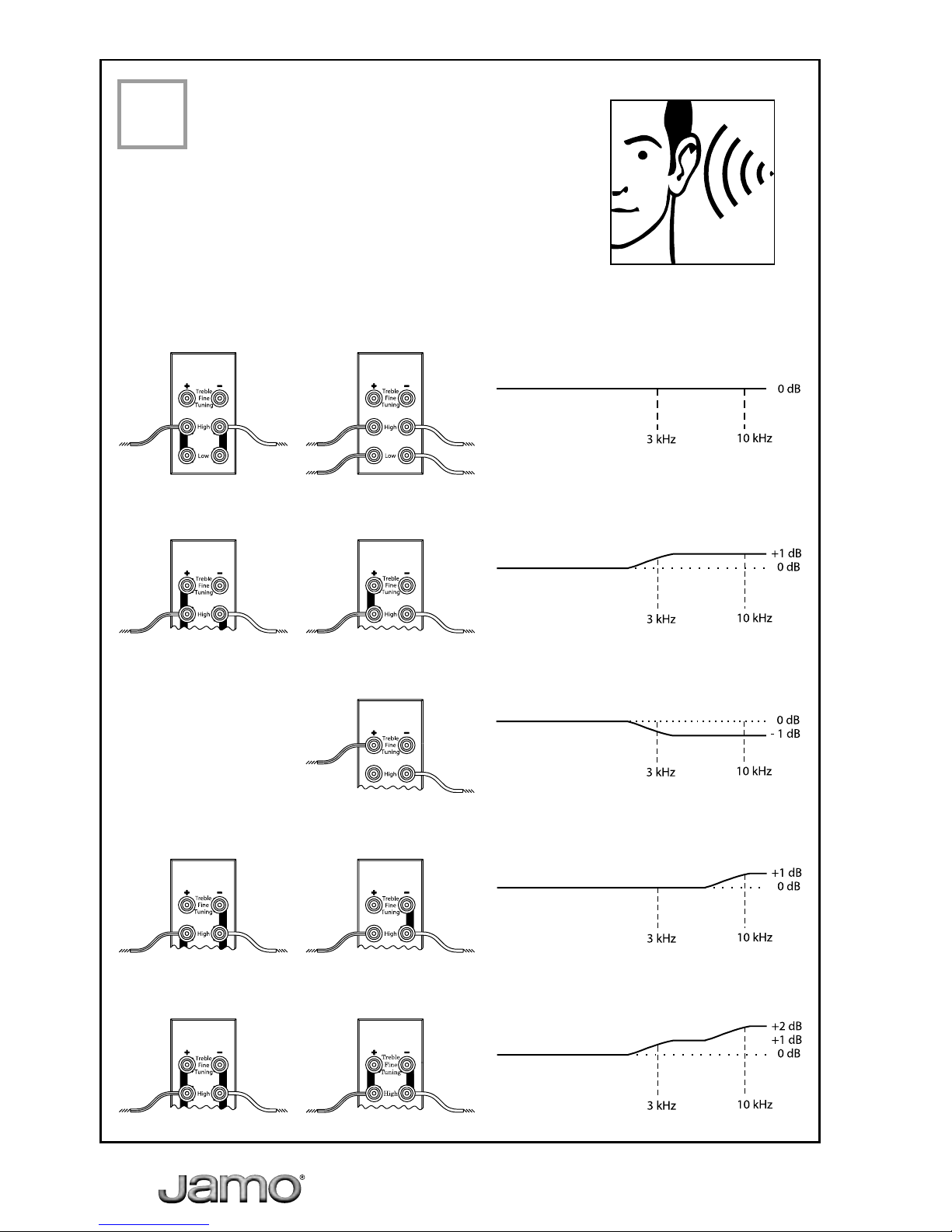
Single wiring Bi- wiring
7
Type...............................................................D 870
System..................................3 Way Bassreflex
Woofer............................................6½ / 165 mm
Midrange.......................................6½ / 165 mm
Tweeter...............................................1 / 25 mm
Power handling*.......................150W / 200W
Frequen y range...................30 - 22.000 Hz
Impedan e................................................4 Ohm
Dimensions....................1035x278x381mm
40,7x10, x15,0in
Weight.......................................32,5 kg / 71,7 lb
5
4
Specifications subject to technical changes.
*Long / Short term power, According to IEC 68-5.
6
www.jamospeakers.com

D 830 / D 870
Advanced Owners Manual

2
GB
Introduction
Congratulations on your choice of Jamo D 8. By choosing this high-end loudspeaker, you are ensured a very detailed natural sound
reproduction - that is, of course, if the rest of your system can match the loudspeakers. For you will also e a le to mercilessly reveal any
possi le shortcomings in the rest of the music chain as well as the music material used.
In order to get the maximum enefit it is therefore important to go through these instructions which offer good advice a out installing/
connecting the units and a out the acoustics of the listening room. We also tell you a little a out the techniques we have used and the
decisions we have made to reach the goal - to present what it is all a out - MUSIC!
A few comments on quality
To us at Jamo it is of fundamental importance that no Jamo loudspeaker is found to deviate from the reference model, irrespective of
production time.
In order to meet this requirement, all components and units must e approved within very narrow tolerances even at entry level. A
continuous quality control is performed on all semi-manufactures, and in the end all Jamo loudspeakers are put through a compulsory
final quality control efore leaving the factory.
Jamos consistent high levels of quality and workmanship, and thus the uniform quality in production, are ased on several factors,
nota ly the experience and expertise which have accumulated at Jamo since the companys start in 1968, as well as the fact that Jamo
was the first loudspeaker manufacturer in the world to o tain certification according to the strict ISO 9001 quality norm in 1992.
Unpacking
When you unpack your new loudspeakers, you might think that the glow of the ca inets and/or the colour play of the veneer do not
completely match the demonstration models that you may have seen at your Jamo dealers. However, this is just a result of the fact that
each piece of genuine veneer will have its own individual features, and since it is a natural material, you will find that the colour play and
the glow change as the loudspeakers are exposed to light and air. So in time they will look even etter and have even more soul!
Remem er also that loudspeakers should e roken in, that is play for some time, efore they can perform at their est! If you do not
want to do this when you are at home, set your tuner etween two stations, so that a hissing sound is heard from the loudspeakers. Then
leave the loud-speakers to play for a few hours at a medium sound level.
After this, the rest is up to you - we are sure that you will get many hours of fine entertainment.
Enjoy yourself!
Preben Jakobsen Julius Mortensen
The scope of the warranty
The warranty period will come into force as from the purchase
date stated on the invoice. The warranty will apply for the following
period of time:
2 years for electronics (power supply, amplifier, etc.)
7 years for other parts (ca inet, speaker units, etc.)
In case of warranty inquiries, please contact your dealer.
In case of request for service under warranty, please enclose your
original receipt.
Defects covered y the warranty:
Except for the defects stated elow, the warranty covers any
production and material defects of the product.
Defects not covered y the warranty:
Defects arising from accidents, misuse, normal wear and tear,
mis-maintenance, voltage variation, overloading, stroke of
lightning, and other force majeure events
Defects arising from incorrect installation or operation
Defects arising from modification/repair/attempt of repair y a
non-authorised service centre
Defects arising from the use of non-original spare parts
Defects on products with altered or lacking series num er
Other defects due to conditions or circumstances eyond the
suppliers control
Transportation costs for servicing are not covered y the warranty.
The supplier is lia le only to repair or replace defective parts or
products. A replacement cannot exceed the value of the product
under warranty.

3
GB
Design Background
In the development of this loudspeaker series we have given a high priority to o taining a neutral and natural sound alance, so that the
sound is reproduced with the exact same tonal characteristics as the original material. A natural enefit of this is that these loudspeakers
are a le to reproduce all forms of music, speech etc. without adding any sort of colour to the sound.
Having started out with such an am itious goal, an o vious requirement is to avoid any sort of compromise in the entire selection of
materials - from terminals to ca les, drivers and ca inets.
In the actual developing phase we have therefore carried out listening tests of countless components efore making the final selection.
We have also tested innumera le com inations of amplifiers, CD players and ca les with all types of music and speech in order to ensure
construction of an entirely unique loudspeaker series to give you optimum performance in all circumstances.
Tweeter
The tweeter used was chosen ecause of its musical and ultra-precise reproduction capa ilities.
This has een achieved partly y using a special SONOTEX diaphragm - the result of a process where the textile diaphragm is coated four
times to achieve the optimum com ination of rigidity and internal dampening.
In order to prevent over pressure/under pressure from forming ehind the diaphragm, this is vented through a hole in the magnet
leading into a carefully dampened cham er, mounted at the ack of the unit. We have focused on o taining a high sensitivity to allow
reproduction of the fine tre le details, and therefore the voice coil is wound with silver thread and is controlled y a dou le magnet
system. Furthermore, the unit is equipped with low-viscosity magnetic oil, partly to ensure optimum cooling of the unit - and there y a
high load capacity - and partly to dampen undesired resonances. The front affle of the tweeter has een die-cast in solid zinc, which
ensures maximum mechanical contact with the ca inet and a minimum amount of undesired resonances. In addition, the tweeter area
on the front panel is slightly horn-shaped, resulting in a more linear reproduction of the lower tre le to ensure optimum transition to the
midrange unit.
Woofer/Midrange Unit
In the D 8 series we wanted the important midrange area to e handled y a single unit, partly to achieve optimum phase characteristics.
However, this makes high demands on the unit used, as it must e a le to reproduce a wide frequency spectrum and thus e a le to
endure high loads.
The units diaphragm is made in die-cast magnesium - a very light and rigid material - and mounted in natural ru er suspension, which
effectively prevents vi rations from travelling ack to the diaphragm. Therefore, the result is a very well-controlled diaphragm that will
operate without reak-ups up to a full 4 kHz. Furthermore, the highly controlled reak-ups can e completely eliminated in the crossover
network.
Waterfall plot showing the well-controlled diaphragm
break-up characteristics of the D 8 unit.
Waterfall plot showing the diaphragm break-up
characteristics of a good conventional woofer/midrange.
The heavy-duty magnet system has uilt-in copper rings which ensure significantly reduced distortion, as they will short out the eddy
currents which the voice coil will inevita ly send into the magnet system when the signal current runs through it.
The units most eye-catching feature, however, is pro a ly its acked-off copper phase plug. When a phase plug is used, it is no longer
necessary to mount a dust cap over the voice coil.
The advantage of this is that reak-ups around the mounting point of the dust cap are avoided. As the phase plug is manufactured in solid
copper, it will also improve the efficiency of the copper rings and at the same time effectively remove heat from the magnet system.

4
GB
The units frame is manufactured in die-cast magnesium. Here the rigidity of the material is utilised to ensure that the heavy magnet
system and the voice coil remain in perfect position in relation to each other.
Furthermore, the magnesium frame ensures that the magnetic force stays concentrated in the magnet system instead of spreading out
into the asket.
Woofer, D 87
The keywords for choosing the woofer to e used in the D 870 were deep and transient. The woofers pressure die-cast magnesium
frame is therefore equipped with a powerful magnet system to control the travel of the long voice coil and the pressure die-cast PP
diaphragm, whose total mass is relatively large.
This careful com ination of features results in an authoritative, pure and undistorted reproduction of even the deepest frequencies.
Crossover network
As descri ed a ove, it has een of primary importance that the speaker units used should e of such
superior quality that they would have no shortcomings which would later have to e corrected for in
the crossover network.
Therefore, the crossover network in the D 8 Series is a relatively simple - in the most positive sense of
the word - low-order construction.
The advantage is that oth the acoustic and the electrical phase angles are kept at very small values -
which of course is of great importance, oth in terms of sound quality and amplifier load.
Another advantage is the high temperature sta ility achieved, meaning that the crossover frequencies
will always remain sta le - even when the speakers heat up, which causes a change in their impedance.
The result is that the speaker units will always work within the intended frequency areas and that the
transition etween the units remains perfectly sta le in all circumstances.
Of course only components of the est quality have een employed in the crossover network: Foil
capacitors, wire-wound resistors and coils with a high Q factor. For the important midrange area, coils
with air cores are used to eliminate hysteresis errors.
The crossover network is mounted directly on the solid 24K gold-plated loudspeaker terminals to
ensure the shortest possi le signal path and there y prevent signal loss.
The internal wiring for connection to the woofer and midrange units is made with the newly developed
Jamo High Definition OFC (Oxygen Free Copper) Flat Ca le with a sectional area of 2.5 mm2. This ca le
features low resistance, no self-induction and low capacitive reactance, which means that it will not
affect the signal from the amplifier in any way, thus permitting full control over the units.
The advanced tweeter makes other demands on the ca le. To ensure a natural reproduction of even the most delicate harmonics, it is
very important to have as low a capacitive reactance as possi le. This has een achieved with another newly developed ca le type, the
Jamo High Resolution Frequency Control OFC Flat Ca le. This ca le has a sectional area of 1.5 mm2 and large separation etween the two
conductors.
Cabinet
Even the est units will never e a le to provide optimum performance if a similarly serious approach has not een applied in manufac-
turing the ca inet. Therefore the units are mounted in Jamos world-patented NCC (Non Coloration Compound) material. The NCC front
is a sandwich construction consisting of two die-cast plastic shells which enclose a core consisting of a mix of quartz sand and a
resonance-dampening inding agent. One of the characteristics of the NCC material is that it is very heavy and extremely resonance-
dead. The efficient natural dampening means that when you listen to Jamo D 8, all you will hear is the sound of the units - there will e
no contri ution or sound colouring from the front plate - not even when you play loud! Also, the sound cannot travel ack and forth in
the affle etween the units.
The units are naturally countersunk in the front panel, just as all edges are rounded in order to reduce diffraction to a minimum - for the
same reason we have manufactured the front fa ric panel in thin MDF oard and made sure there is a very close contact etween the
loudspeaker and the fa ric panel.
5
GB
The ca inet itself is manufactured in 25 mm veneered MDF oard which in addition is raced internally and carefully dampened with
acoustic a sorption foam. The surface of the foam has een furnished with a honeycom pattern to give it the largest possi le surface
area and hence maximise dampening of the sound emitted from the rear of the unit.
Installation
Placing
Placing speakers in a listening room is always a very critical operation, and therefore we have provided a few guidelines elow, ut we
also recommend that you experiment with the placing until you think the sound reproduction is perfect.
In general, placing a loudspeaker near a rear and/or side wall will oost the low frequency level ut at the same time create reflections
in the midrange and tre le area, which results in a deterioration of the stereo perspective.
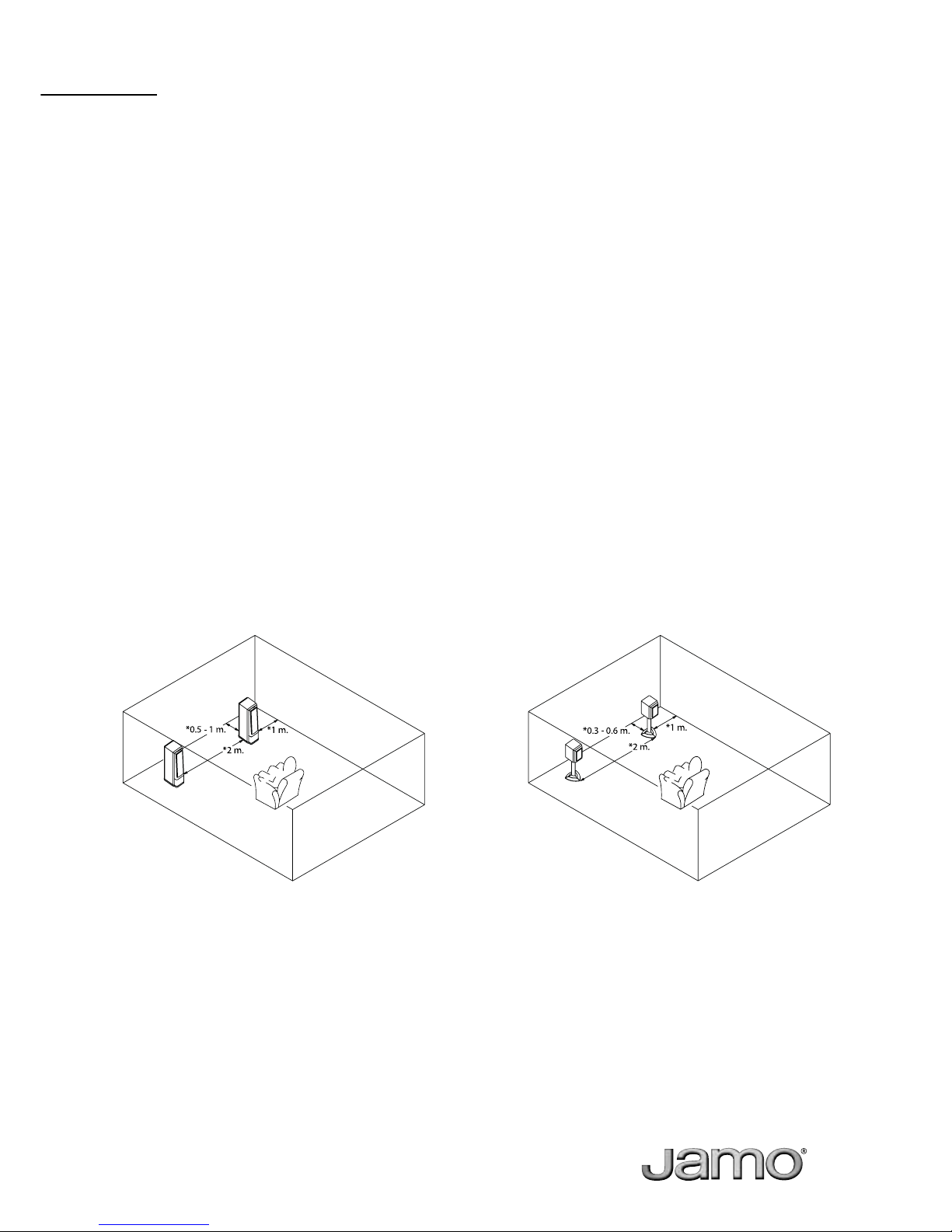
Therefore, it is not possi le to recommend one perfect placing in relation to the rear wall, as the optimum distance will depend very
much on the acoustics of the listening room. As a guideline for placing D 830, the optimum placing will e a out 30-60 cm / 12 - 25 in.
from the rear wall, and for D 870 it will e a out 50-100 cm / 20 - 40 in.
For oth models, the distance to the side walls should e at least 1 m / 40 in.
In order to achieve optimum sound reproduction, the distance etween the loudspeakers should e the same as the distance from either
loudspeaker to your preferred listening position (an equilateral triangle).
The loudspeakers might e angled slightly toward the listening position, to adjust the tre le level to suit the room acoustics and your
taste. This will also ensure that the optimum listening position ecomes less critical.
There should e no furniture or other o stacles etween the speakers and the listening position.
NOTE: If you are also using the D 8 loudspeakers in a surround sound configuration, the loudspeakers may e placed as near as approx.
15 cm / 6 in. from the television set without any discoloration of the picture.
Recommended placing of D 8 0 Recommended placing of D 830
Also, D 830 should e placed at the proper listening height. For
this specific purpose we have manufactured Stand 60. Using this
stand will ensure that the loudspeakers are placed at the optimum
listening height.
Altri manuali per D 830
1
Indice
Altri manuali JAMO Altoparlanti

JAMO
JAMO IC 408 LCR Manuale utente

JAMO
JAMO DS3 Manuale utente

JAMO
JAMO 1A2 Manuale utente

JAMO
JAMO IC 610 Manuale utente

JAMO
JAMO STUDIO8 Series Manuale utente

JAMO
JAMO A303 Manuale utente

JAMO
JAMO R-400 Manuale utente

JAMO
JAMO A 330 Manuale utente

JAMO
JAMO R 907 Manuale utente

JAMO
JAMO E 500 Manuale utente

JAMO
JAMO 3A2 Manuale utente

JAMO
JAMO IW 408 Manuale utente

JAMO
JAMO A 510 Manuale utente

JAMO
JAMO S17 HCS Manuale utente

JAMO
JAMO STUDIO7 Series Manuale utente

JAMO
JAMO D 500SUR Manuale utente

JAMO
JAMO C 80 SUR Manuale utente

JAMO
JAMO R 907 Manuale elenco delle parti

JAMO
JAMO R 909 Manuale elenco delle parti

JAMO
JAMO E 660 Manuale utente


