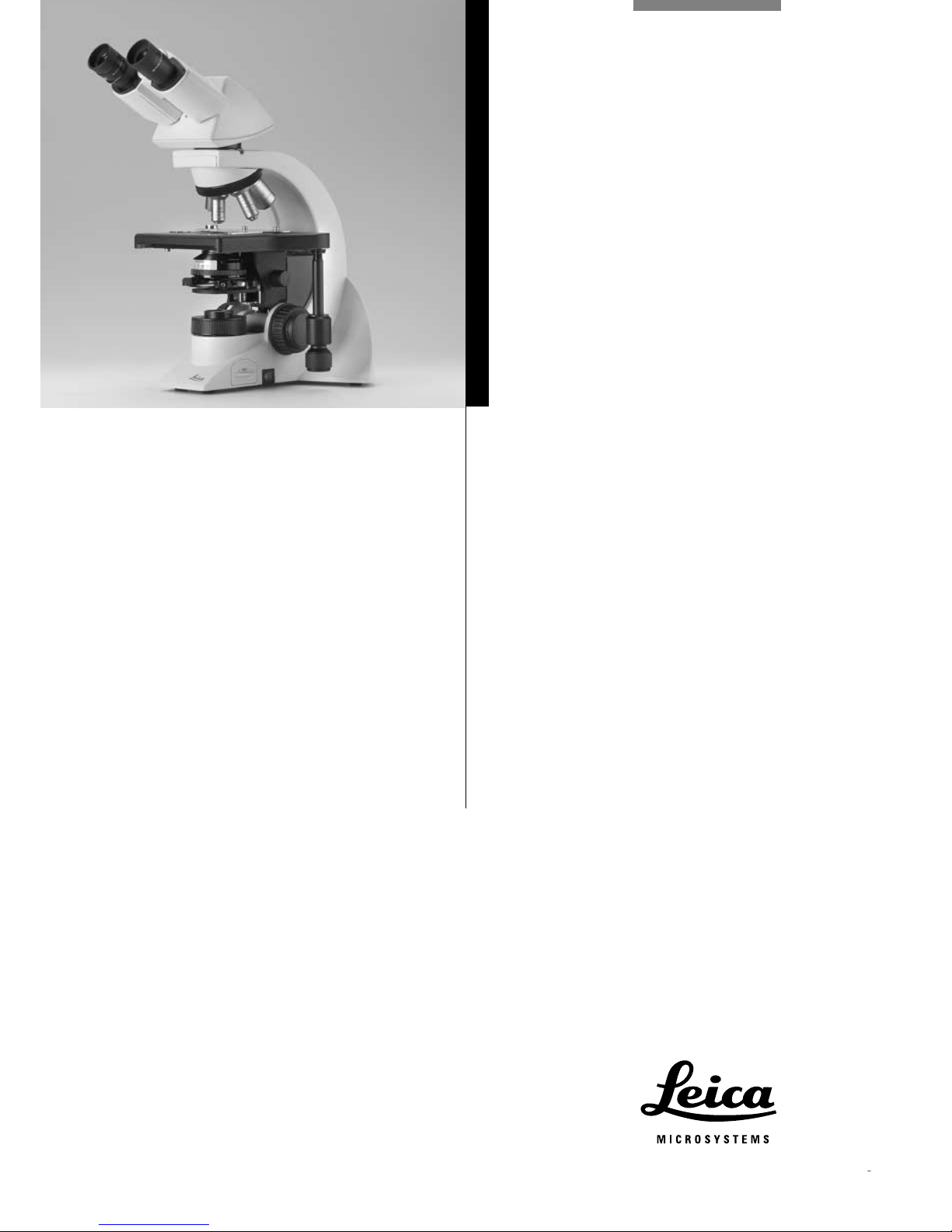
Leica DM1000 LED Manuale utente

Leica DM1000
Operating manual
Bedienungsanleitung
Mode d’emploi
MICROSYSTEMS

Phone/Tel./Tél. +49 (0) 6441-29 22 86
Fax +49 (0) 6441-29 22 55
E-Mail/Email/Courriel MQM-Hotline@leica-
microsystems.com
Published September 2004 by/
Publiée en septembre 2004 par/
Herausgegeben September 2004 von:
Leica Microsystems CMS GmbH
Ernst-Leitz-Strasse
D-35578 Wetzlar (Germany)
Responsible for contents/
Responsable du contenu rédactionnel/
Verantwortlich für den Inhalt:
Dr. Jasna Röth, Peter Schmitt
(Clinical Microscopy, Product Management)
Holger Grasse
(Safety Officer according to MPG §30/
Sicherheitsbeauftragter nach MPG §30/
Responsable de la sécurité conformément à la loi
relative aux dispositifs médicaux, §30)
In case of questions, please contact the hotline/
Pour toute question, contacter notre service
d’assistance téléphonique/
Bei Fragen wenden Sie sich bitte an die Hotline:

3
Leica DM1000
Operating Manual

4
Copyrights
Copyrights
All rights to this documentation are held by
Leica Microsystems CMS GmbH. Reproduction
of text or illustrations (in whole or in part) by
print, photocopy, microfilm or other method (in-
cluding electronic systems) is not allowed with-
out express written permission from Leica
Microsystems CMS GmbH.
The instructions contained in the following
documentation reflect state-of-the-art technol-
ogy and knowledge standards. We have com-
piled the texts and illustrations as accurately as
possible. Nevertheless, no liability of any kind
may be assumed for the accuracy of this manu-
al’s contents. Still, we are always grateful for
comments and suggestions regarding potential
mistakes within this documentation.
The information in this manual is subject to modifi-
cation at any time and without notification.

5
Contents
8.4 Tubes........................................................37
8.5 Eyepieces .................................................... 38
8.6 Objectives ................................................... 39
8.7 Light Sources ............................................. 40
8.8 Aperture Diaphragm ................................. 40
8.9 Field Diaphragm ......................................... 41
9. Contrast Methods ...................................... 42
9.1 Transmitted Light ....................................... 42
9.1.1 Brightfield......................................... 43
9.1.2 Phase Contrast................................ 44
9.1.3 Darkfield ........................................... 44
9.1.4 Oblique Illumination ....................... 45
9.1.5 Polarization ...................................... 45
9.2 Fluorescence.............................................. 46
10. Measurements with the Microscope ... 47
10.1 Linear Measurements .............................. 47
10.2 Thickness Measurements ....................... 48
10.3 Differentiation of Gout / Pseudo Gout ... 49
11. Troubleshooting......................................... 51
12. Care of the Microscope ........................... 54
12.1 Dust Cover .................................................. 54
12.2 Cleaning....................................................... 54
12.3 Handling Acids and Bases ...................... 55
12.4 Changing Fuses.......................................... 55
13. Essential Wear and Spare Parts ............ 56
14. Retrofitting Components .......................... 57
14.1 Equipping the Condenser Disk ................ 57
15. Index ............................................................ 59
16. EU Declaration of Conformity ................. 60
Contents
1. Important Notes about this Manual ...... 6
2. Intended Purpose of the Microscope ... 7
3. Safety Notes ............................................... 8
3.1 General Safety Notes ............................... 8
3.2 Electrical Safety ........................................ 8
4. Overview of the Instrument .................... 10
5. Unpacking the Microscope .................... 14
6. Assembling the Microscope .................. 16
6.1 Stage ............................................................ 16
6.2 Condenser................................................... 18
6.3 Tube and Eyepieces .................................. 19
6.4 Objectives ................................................... 19
6.5 Light Source - Transmitted Light Axis ... 20
6.6 Components for
Fluorescence Applications...................... 21
6.6.1 Fluorescence Illuminator .............. 21
6.6.2 106 z Lamp Housing ........................ 21
6.7 Analyzer and Polarizer* .......................... 24
6.8 Lambda Plate Compensator .................... 24
6.9 Optional Accessories ............................... 25
6.10 Connection to the Power Supply ............ 27
7. Startup ......................................................... 28
7.1 Switching on the Microscope................. 28
7.2 Köhler Illumination .................................... 28
7.3 Checking Phase Contrast Rings ............. 29
7.4 Adjusting the Light Sources .................... 31
8. Operation .................................................... 35
8.1 Switching on............................................... 35
8.2 Stages and Object Displacement ........... 35
8.3 Focusing ...................................................... 36

6
1. Important Notes about this Manual
(1.2)
→
p.20
!
*
Numbers in parentheses, such as "(1.2)", corre-
spond to illustrations (in the example, Figure 1,
Item 2).
Numbers with pointer arrows (for example
→p.20), point to a certain page of this manual.
Caution!
Special safety instructions within this
manual are indicated with the triangle
symbol shown here, and have a gray
background.
Caution! The microscope and accessories can
be damaged when operated incorrectly.
Explanatory note.
Item not contained in all configurations.
Text symbols, pictograms and their meanings:
Caution!
This operating manual is an essential com-
ponent of the microscope, and must be read
carefully before the microscope is
assembled, put into operation or used.
1. Important Notes about this Manual
This operating manual contains important in-
structions and information for the operational
safety and maintenance of the microscope and
accessories. Therefore, it must be kept and
taken care of.

7
2. Intended Purpose of the Microscope
The Leica DM1000 microscope, to which this
user manual belongs, is designed for biological
routine and research applications. This includes
the examination of samples taken from the hu-
man body with a view to provide information on
physiological or pathological states or
congenital abnormalities, or to determine the
safety and compatibility with potential recipients,
or to monitor therapeutic measures.
The above-named microscope complies with
the Council Directive 98/79/EEC concerning in
vitro diagnostics. It also conforms to the Council
Directives 73/23/EEC concerning electrical
apparatus and 89/336/EEC concerning
electromagnetic compatibility for use in an
industrial environment.
Caution!
The manufacturer assumes no liability for
damage caused by, or any risks arising from
using the microscope for other purposes
than those for which they are intended or
not using them within the specifications of
Leica Microsystems CMS GmbH.
In such cases the conformity declaration
shall cease to be valid.
Caution!
These (IVD) devices are not intended for use
in the patient environment defined by DIN
VDE 0100-710. Neither are they intended for
combining with medical devices according
to EN 60601-1. If a microscope is electrically
connected to a medical device according to
EN 60601-1, the requirements defined in
EN 60601-1-1 shall apply.

8
3. Safety Notes
3. Safety Notes
3.2 Electrical Safety
General Specifications
Microscope
For indoor use only.
Supply voltage:
Frequency:
Power input:
Fuses:
Ambient temperature:
Relative humidity:
Over voltage category:
Pollution degree:
Caution!
The power plug may only be plugged into an
outlet equipped with a grounding contact.
Do not interfere with the grounding function
by using an extension cord without a ground
wire. Any interruption of the ground wire in-
side or outside of the device, or release of
the ground wire connection, can cause the
device to become hazardous. Intentional
ground interruption is not permitted!
90-250 V~
50-60 Hz
90 W
F 3,15 A 250 V
15-35°C
max. 80% to 30°C
II
2
3.1 General Safety Notes
This safety class 1 device is constructed and
tested in accordance with
EN 61010-2-101:2002,
EN 61010-1:2001,
IEC 1010-1:2001,
safety regulations for electrical measuring, con-
trol, and laboratory devices.
Caution!
In order to maintain this condition and to en-
sure safe operation, the user must follow the
instructions and warnings contained in this
operating manual.
Caution!
The devices and accessories described in
this operating manual have been tested for
safety and potential hazards.
The responsible Leica affiliate or the main
plant in Wetzlar, Germany must be consulted
whenever the device is altered, modified or
used in conjunction with non-Leica
components that are outside of the scope of
this manual.
Unauthorized alterations to the device or
noncompliant use shall void all rights to any
warranty claims!

9
3. Safety Notes
Caution!
Protect the microscope from excessive tem-
perature fluctuations. Such fluctuations can
lead to the accumulation of condensation,
which can damage the electrical and optical
components.
Ambient temperature: 15-35°C.
Caution!
Before exchanging the fuses or lamps, be
absolutely certain to switch off the main
power switch and remove the power cable.
Caution!
Never use any fuses as replacements other
than those of the types and the current rat-
ings listed here. Using patched fuses or
bridging the fuse holder is not permitted.
The use of incorrect fuses may result in a
fire hazard.
Caution!
The microscope’s electrical accessory com-
ponents are not protected against water.
Water can cause electric shock.

10
4. Overview of the Instrument
Specification
Contrast Method
Transmitted Light Axis
Incident Light Axis
Tube
Magnification Changer
(optional)
Objective Turret
X/Y Stage
Leica DM1000
• Transmitted Light: Brightfield, Darkfield,
Phase Contrast, Polarization
• Incident Light: Fluorescence
Integrated halogen illumination
manual adjustment of
• Light Intensity
• Aperture Diaphragm
• Field Diaphragm (only with Koehler kit)
Incident light fluorescence illuminator for up to eyepiece
field number 20 with
• Interchangeable slide with mount for 3 filter systems
• Adjusting lens for lamp
• Light trap for the suppression of extraneous light
• BG38 blue filter and shutter, switchable
optionally with
• Fixed or variable viewing angle
• Up to 3 switching positions
• one or two camera ports
• Ergotube with height-adjustable eye level and camera port
• Manual
• Magnification steps: 1x; 1.5x; 2x
• Manual
• 5-fold for objectives with M25 thread
• With condenser holder
• Coaxial pinion optional telescopable
• Controls mountable on left or right
Altri manuali per DM1000 LED
2
Indice
Lingue:
Altri manuali Leica Microscopio

Leica
Leica Emspira 3 Manuale utente

Leica
Leica S7 E Manuale utente

Leica
Leica M-Series Manuale utente

Leica
Leica DM3 XL Manuale utente

Leica
Leica WILD M695 Manuale utente

Leica
Leica IC80 HD Manuale utente

Leica
Leica DM E Manuale utente

Leica
Leica DM6B Manuale utente

Leica
Leica StereoZoom 7 Manuale utente

Leica
Leica TCS SP8 Manuale utente

Leica
Leica SP8 AT CIAN Manuale elenco delle parti

Leica
Leica DVM6 Manuale utente

Leica
Leica FSC Manuale utente

Leica
Leica A60 S Manuale utente

Leica
Leica DM LM Guida di riferimento

Leica
Leica DM100 Manuale utente

Leica
Leica WILD M690 Manuale utente

Leica
Leica DM500 Manuale utente

Leica
Leica MS5 Manuale utente

Leica
Leica DMI4000B Manuale utente