All VisionSound models are designed to maintain the same tonal balance when
different models are mixed in a system. Mixing a VS300, used as a center, with
VS400's as left and right is fine. The same model should be used in symmetrical
listeninglocationsinasystem–frontleftandfrontright;rearleftandrearright.
Mostsurround sound(that issound thatcomes fromthe surroundspeakers, notthe
front speakers) is meant more to create greater depth and overall ambience than to
localize effects as coming from a particular spot. How much you prefer these
localized effects vs. overall sonic depth and diffusion is up to your listening
preferences. If you are listening to multi-channel music from DVD-Audio or SACD,
you may want the maximum localization of instruments. However, for most home
theater applications a diffuse sound field might be preferred. You can locate your
surround speakers to produce the effects you prefer, whether precisely pinpointed
orpleasantly diffused. In general,the fartherthe distanceto the surround speakers
from the listener, the more diffuse the surround sound field. Diffusion can also be
created via directing the sound away from listeners, for example, your surround
speakerscanbeaimedtowardsarearreflectivesurfaceforincreaseddiffusion.
ProximitytoBoundaries
The closer you place speakers to the boundary surfaces of your room, either to the
rear or to the sides, the greater the proportion of bass in their overall sound. This is
due to the enclosing, “focusing” effects of nearby surfaces on longer-wavelength
(lower) frequencies. Positioning the speakers near the intersection of two surfaces
(wall and wall, wall and floor, or wall and ceiling) will produce more bass than
placement near a single surface. The greatest proportion of bass is delivered by
placement near three intersecting surfaces–in a room corner near the floor or
ceiling, where the convergence of the two walls and the floor/ceiling produces an
amplifying effect that is a bit like that of a megaphone. And the least bass comes
from placing a speaker away from all boundaries. Your own tastes should decide
whatproportionofbassresponseseemsrightinyourroom.
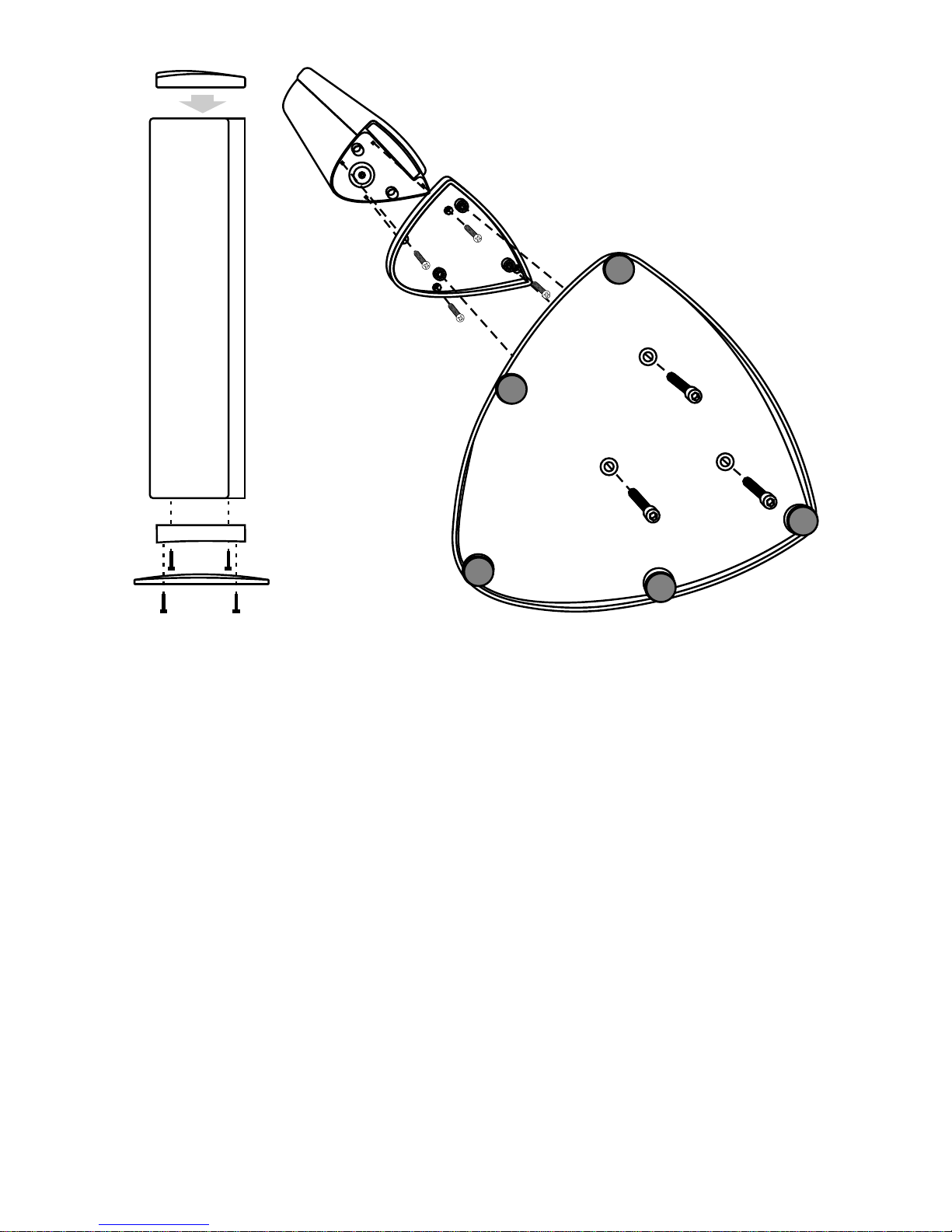
Of course, the VS300 is designed to be mounted on the wall with its included wall
mountingbracket. SeesectionVII.ResponseAdjustmentSwitchesforadiscussion
ofitsspecialfeaturewhenwallmounted.
Where you sit in relation to your speakers obviously makes a difference too. The
proportionsoftheparticulartriangleformedbyyourfrontleftandfrontrightspeakers
and you matter. (You may need to send more power to the more distant speaker to
compensate if you get much further from one speaker than the other.) The overall
distances involved also matter. As you get further from the speakers, more sound
reflected from your room's surfaces (in contrast to the sound coming directly from
thespeakers)reachesyourears,andtheoriginalspatialrelationshipsinarecording
are changed as your room “takes over.” Sometimes the result is a mellower, more
“integrated” sound. Other times, it's a more strident or annoyingly “echoey” – or
other–quality. Onceagain,the particulardimensionsandsurfacematerialsofyour
room play a part. And depending on what seems more realistic and/or enjoyable to
your ears, you may choose to sit at a great distance or have close-up, “near-field”
sound. Keep in mind that the right “toe-in,” the right speaker height, and a
reasonably symmetrical distance from the speakers all tend to work together to
deliverthebesthigh-frequencydefinitionandimaging.
6