1 Introduction
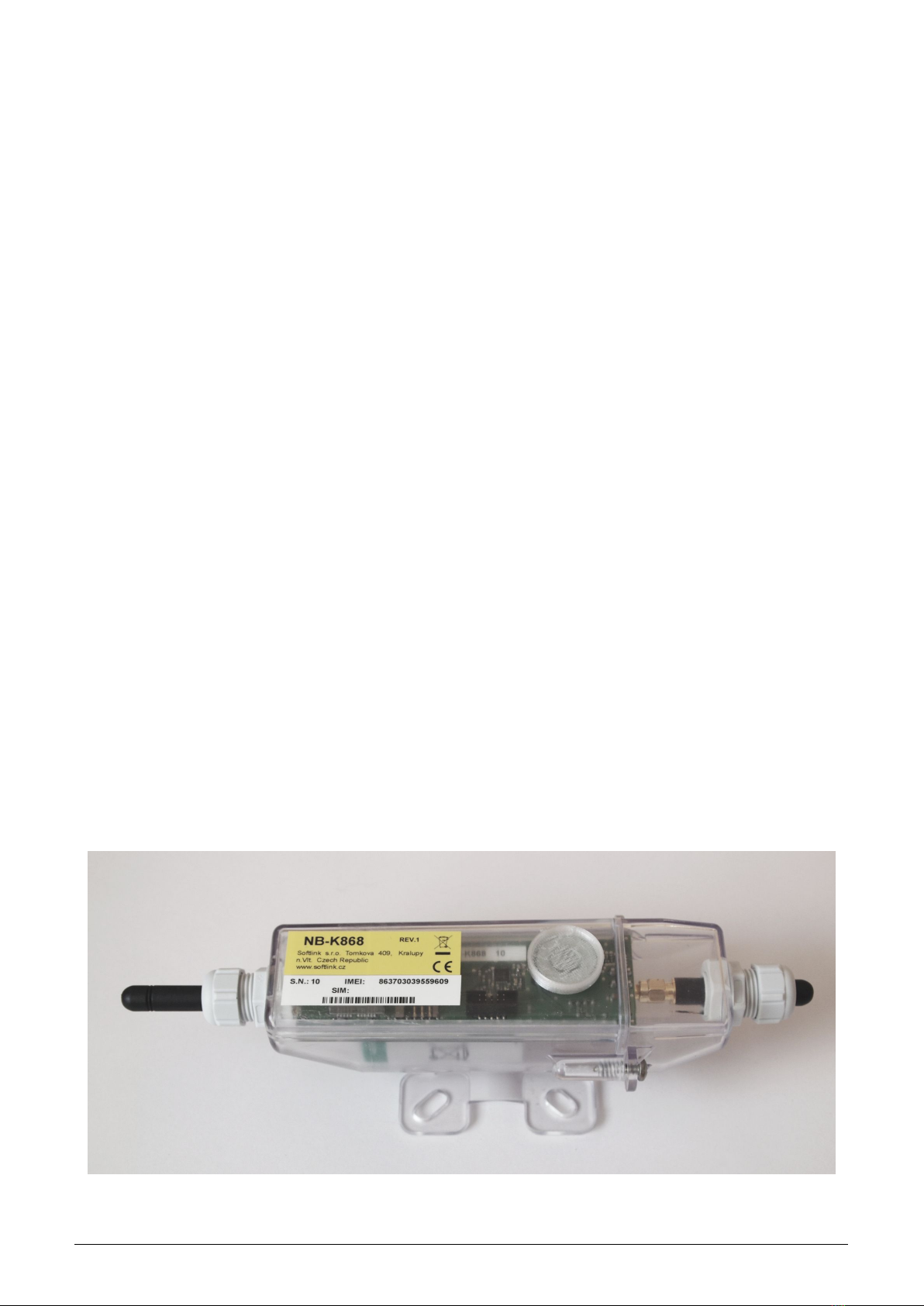
This document describes features, parameters and setting possibilities of the NB-K868 module, which is used
either for remote reading of iPERL series watermeters by Sensus equipped with 868 MHz data transmitter, or other
watermeters (*) of the ”smart” category, equipped with an 868 MHz transmitter working in Wireless M-Bus format.
The module receives messages from watermeters and broadcasts the read data to the superior Automatic Meter
Reading (AMR) system by using of NB-IoT services of the GSM operator.
(*) Although the module is primarily intended for reading watermeters, it can also be used for reading of any other
consumption meters or sensors that send messages in 868 MHz Wireless M-Bus format.
1.1 NB-IoT mobile data services
Mobile data services NB-IoT are global data services provided by some operators of GSM services. The
services are focused on the communication with a huge quantity of devices, that transfer only an extremely limited
volume of data. Networks with such purpose and features are commonly labeled as ”Internet of Things”, or by its
acronym ”IoT”. NB-IoT (”Narrow Band Internet of Things”) is an open standard developed by 3GPP organization
(3rd Generation Partnership Project) which is concerned with standardization in the GSM network development.
NB-IoT is a cellular technology based on the LTE, that was developed specially for wireless communication with
terminals of IoT category, that produces only limited volume of data, but they are miniature, inexpensive, with
a very low energy consumption and they are commonly installed in the places with high demands on the signal
coverage. Typical example of such device is a reading module of the water/gas/electro-meter installed in the
basement without electricity, that should be able to run reliably many years on the internal battery even in weak
signal conditions, where other services fail.
NB-IoT technology maximally utilizes technological infrastructure of LTE data services in licensed radio band.
Combination of narrow frequency band and the most advanced modulation techniques enable increasing of receiver
sensibility to the -135 dBm level, so that an existing infrastructure of mobile operator provides global coverage
with high signal penetration even in build-up urban areas. Thus, the service is available in the places, where IoT
category devices are typically installed - in shafts, distribution boards and cellars.
Terminal devices are identified in the network by standard SIM of GSM operator. Global system of SIM evidence and
single communication standard enable providing of international services (roaming). Bi-directional communication
is carried by standard Internet protocol with UDP transport layer. Messages are transferred from the GSM operator
network to the IoT-terminal operator through the designated data gateway (Access Point - AP) either to public
Internet, or to operator’s private IP network (i.e. same way as any similar mobile data services). Addressing and
routing details depend on the network configuration and policy of particular GSM operator. Typical example of
addressing and routing is a solution, when the GSM network automatically assigns private IP addresses to IoT
terminals, IP-packets with messages are routed through the private IP network to a single Access Point, where
they are re-addressed and resend through a single pre-arranged public IP-address to the public Internet. The IoT
terminal assigns packets by target server public IP-address, that is preset in its configuration. Target system can
identify original source of the message by using of device unique identifier (IMEI), which is a requisite part of the
message content.
1.2 Module usage
The NB-K868 module can be used as local communication gateway for remote reading of Sensus iPERL-series
watermeters, or other ”smart” watermeters with integrated Wireless M-Bus transmitters in the 868 MHz band. The
module receives regular radio messages with readings from watermeters in its radio-reach and stores the readings
to its memory. In pre-defined intervals the module broadcasts aggregate of received data to the superior remote
reading system (AMR) in form of radio-messages of NB-IoT service (”INFO” messages).
The NB-K868 module can by used for remote reading up to 20 watermeters placed in its radio-reach (that is
up to hundreds meters). Each watermeter transmits the messages with a short fixed period (e.g. iPERL every 15
seconds). The module receives data from watermeters in regular ”receiving windows”, that are opened with preset
”reading period” (e.g. every 120 minutes). Received data from each receiving window are stored into the module
memory. With pre-defined broadcasting period (e.g. 8 hours) the module broadcasts one NB-IoT message with
aggregate data from all receiving windows to the superior server. This way of communication is a highly effective,
as it is optimized from energy consumption point of view, as well as from point of view of NB-IoT services expenses.
The module can also work in on-line mode, when the data are broadcasted immediately after each receiving
window. This mode is suitable in situations, when a minimum information delay is required, or when the number
of meters read is so high that the amount of measured data fills the entire NB-IoT data packet anyway and it has
NB-K868 1