
Tinker & Rasor CS-10 Foglio di istruzioni

– 1 –
PRODUCT INSTRUCTIONS
Web: www.tinker-rasor.com E-mail: Info@tinker-rasor.com
Sponsoring members of NACE International, NACE Foundation
MODEL CS-10
PORTABLE - 10 AMP CURRENT SOURCE for Cathodic Protection Testing
NOTE: THIS UNIT IS NOT A RECTIFIER INTERRUPTER. THIS INSTRUMENT WILL
INTERRUPT ITS OWN POWER ONLY. NOT AN EXTERNAL SOURCE SUCH AS A
RECTIFIER.
Dimensions: 5-3/4” High, 12-1/4” Wide, 10” Long Weight: 8.0 pounds
FEATURES TESTS
2 Ranges Current Requirement
Internal Battery Short Identification
External Power Input Capability Insulator Location
Continuous/Interrupted Operation Short Location
Insulator Test Casing Tests
Fully adjustable current output 0 mA to 10 amps
BATTERIES ARE INCLUDED - (1) 12 volt LiFePO4 and (1) 9 volt (replaceable)
Warranty: 90 Days
NOT FOR USE IN AN EXPLOSIVE ATMOSPHERE
NOT FOR USE ON RECTIFIERS
CORROSION MITIGATION INSTRUMENTATION
2828 FM 758, NEW BRAUNFELS, TX 78130 TEL: (830) 253-5621

– 2 –
PRODUCT INSTRUCTIONS
Web: www.tinker-rasor.com E-mail: Info@tinker-rasor.com
Sponsoring members of NACE International, NACE Foundation
CS-10 PORTABLE CURRENT SUPPLY
GENERAL
The CS-10 Portable Current Supply is designed to be a convenient source of current in areas without rectifiers or
other power sources. The instrument output is selectable from zero to ten amperes. The range is selected by
adjusting the range switch. It is intended primarily for temporary drains in connection with the cathodic protection
of underground piping. It can also be a convenient source of current for testing insulating joints with a compass,
determining the extent of a CP area, locating shorts and testing casings.
PRECAUTIONS
The CS-10 can only be used in non-hazardous (unclassified) locations because it can supply current and
voltages above those allowed in hazardous (classified) locations.
LOAD LIMITING CIRCUITRY
The CS-10 is capable of supplying currents in excess of 10 Amps for very short periods of time, draining the batteries
rapidly, (less than 10 minutes). To keep the output at an acceptable level the CS-10 circuit incorporates a current
limiter for the protection of the regulating circuit and the batteries. A feature of the current limiter is the ability to
detect whether or not the CS-10 is limiting the current through the circuit or the load is limiting the current through
the circuit. In order to let the operator know when the CS-10 is limiting the current, the Limiting Indicator L.E.D. was
incorporated on the front panel. When the CS-10 is limiting the current through the load the Limiting Indicator L.E.D.
is off. When the load is limiting the current through the circuit, the Limiting Indicator L.E.D. is on continuously.
LOW VOLTAGE LOCK-OUT
The Limiting Indicator L.E.D. has a second duty. It is to warn when the internal battery of the CS-10 has fallen below
9-volts. Since the batteries in the CS-10 have an increasing chance of shorting when they are discharged beyond
a safe point, the Low Voltage Lock-out is activated to keep this from happening. When the Low Voltage Lock-out is
reached there are two things that occur. First, the power to the Output Terminals is cut. Second, the Limiting
Indicator L.E.D. is activated. In order to distinguish between a Current Limiting condition and the Low Voltage Lock-
Out condition, the Limiting Indicator L.E.D. will start flashing. The Low Voltage Lock-Out can only be reset when the
CS-10 is turned off for 15 seconds and turned back on. At this point in time, it is recommended that the batteries be
recharged immediately or use an external power source.
HEAT
This type of equipment, under high loads, will build up high temperatures rapidly. Caution should be used to prevent
damage to the CS-10. Operator should avoid direct contact with the panel after high output operation or after
prolonged use.
The CS-10 will heat up in hot weather when currents approaching 5 or more amperes are delivered to a load. The
transistor that controls the current is mounted on an aluminum heat sink. The panel of the CS-10 should face away
from the sun to reduce heat input. For more than short use, the interrupter can be used to further reduce the heat
effect if the current drain is high and extends the battery life.
The panel on the CS-10, gets hot and stays hot in the higher output ranges. USE CAUTION!
CORROSION MITIGATION INSTRUMENTATION
2828 FM 758, NEW BRAUNFELS, TX 78130 TEL: (830) 253-5621

– 3 –
PRODUCT INSTRUCTIONS
Web: www.tinker-rasor.com E-mail: Info@tinker-rasor.com
Sponsoring members of NACE International, NACE Foundation
INTERRUPTER
The interrupter will increase battery life and decrease heating of the case at higher currents. The timer is engaged
in or out of use by a 6-position rotary switch on the panel. Positions; 1. Continuous, 2. 0.2 off – 0.8 on, 3. 0.3 off –
0.7 on, 4. 1 off - 4 on, 5. 2 off - 8 on, 6. 6 off - 14 on (in seconds).
BATTERIES
The CS-10 comes with a 12-volt Lithium ion battery (LiFePO4) and can be operated with a 12-volt external power
source (eg, truck battery). The battery that controls the LCD is a standard 9 volt transistor battery. This 9v battery
is replaced by opening the battery holder on the panel, next to the LCD screen. The 9v battery voltage under load
should be above 7 volts. The 12 volt internal battery can be checked at the Battery test point on the Range Switch.
CHARGING
The Model CS-10 comes with an AC (wall) battery charger. The charger automatically recognizes and uses 110v
AC or 240v AC. The charger comes with the standard North American 110v wall plug. An adapter or different (local)
cable is required to use with 240v AC.
Input: AC100 – 240V, 50/60Hz
Output: DC14.4V, 1.5A
CONNECTION
To connect the CS-10 to increase the polarization of a structure, a temporary ground bed (metal structure with good
earth contact) is first connected to the “+” terminal; then connect the “-” terminal to the structure. Select either
“Continuous” or an interrupt cycle as desired. Once the CS-10 is connected, turn the “CURRENT ADJUST” slowly
clockwise until the desired current is indicated on the meter. If more current is needed, than the internal battery
can provide or a long operation is anticipated, an external battery must be used. Connect the CS-10 to the external
battery by the red and black binding posts marked “EXTERNAL POWER” and flip the power switch to the external
position. Attach the appropriate battery terminals to the proper binding posts. Whenever the CS-10 is not in use,
turn the “CURRENT ADJUST” fully counter clockwise.
The CS-10 can only be used in non-hazardous (unclassified) locations because it can supply currents and
voltages above those allowed in hazardous (classified) locations.
CURRENT REQUIREMENT TEST
During corrosion control work, it may be desirable to make tests to determine the amount of current required to
cathodically protect a new structure, or bring a buried structure back up to protection. This test consists of forcing
a direct current to flow from a temporary ground connection, to the target structure. Adjust the current output until
the protective level is reached, at the lowest P/S (pipe to soil) voltage location. Polarization of a structure will take
a period of time (up to weeks for bare structures). If instantaneous current vs. voltage readings are plotted, a
prediction of the final polarized current requirement may be made. The CS-10 should be operated in the continuous
mode for this test with the “positive” terminal connected to the temporary ground and the “negative” output
connected to the structure.
During this test, the location with the lowest Pipe to Soil reading can be determined if the protective current is to be
installed at the same point as the test is being conducted. The low Pipe to Soil point will be the best location for a
CORROSION MITIGATION INSTRUMENTATION
2828 FM 758, NEW BRAUNFELS, TX 78130 TEL: (830) 253-5621

– 4 –
PRODUCT INSTRUCTIONS
Web: www.tinker-rasor.com E-mail: Info@tinker-rasor.com
Sponsoring members of NACE International, NACE Foundation
test point to ensure that there is adequate cathodic protection current available to the system to meet protection
criteria.
SHORT IDENTIFICATION TEST
To determine if there is a short on the system, some knowledge of the CP area is required. Is the structure bare or
coated? How large is it? Has the protection level changed dramatically in a short time? When the CS-10 is
connected to the structure, as in the current requirement test, and current is applied in the continuous mode, does
it take more current than would be anticipated to increase the protective level? If so, there is a high probability that
there is a short (additional load connected) to the protected system.
SHORT LOCATION TEST
To locate the short(s) on a protected system, the CS-10 can be connected to the structure to increase polarization,
as in the current requirement test above, but operated in the interrupted mode. At various points on the protected
structure take both “off” and “on” Pipe to Soil readings. Subtract the “off” reading from the “on” reading and record
that difference (delta V) with the location. As you approach the short location, the delta V will decrease toward 0
and as you pass and leave the short location, the delta V will increase again. The lowest resistance short will
usually be identified first so another test for shorts should be performed to ensure that all shorts have been located
and cleared.
INSULATOR LOCATION TEST
To determine the location of buried insulator, hook the CS-10 to the structure and a temporary ground to increase
the structure polarization and switch to the interrupted mode as in the short location test above. Then take half cell
readings until there is dramatically reduced on/off switching. This will indicate that the location is beyond an
insulator. Pinpoint location can be completed with an Audio Frequency Locator such as Tinker & Rasor’s Models
PD or Mark V Ranger .
CASING TEST
Connect the CS-10 so that it will depolarize the casing to a temporary ground. Take initial half cell readings of the
pipe and the casing, apply a small amount of current (approx. 30 mA) and take another set of half cell readings. If
the pipe and casing are both less negative, there is probably a somewhat low resistance path between them.
However, if the pipe is slightly more negative and the casing less negative, there maybe no short. Apply a larger
amount of current (approx. 100 mA) and take another set of half cell readings. If the pipe and casing are still less
negative, a low resistant path is still indicated. If the pipe and casing keep the same reading as each other, the
path has low resistance. If the pipe is still a little more negative and the casing less negative, any short is of very
high resistance. Additional current steps will help determine if there is a high resistance (electrolyte) connection
between the pipe and the casing rather than a short.
TESTING INSULATION JOINTS WITH A COMPASS
A magnetic compass used as a “lay-on” ammeter is a valuable means of checking insulating joints such as insulating
unions and flanges. It will work on parallel flanges as in a manifold. The CS-10 makes this test simple.
The compass must not be liquid filled and its needle must not drag on the dial when the compass is laid on a steel
pipe. A machete or wrench is a handy steel surface to check it on. Because the compass reacts to a magnetic
field created when DC current flows, it will indicate whether or not a current is flowing through the insulator to be
tested.
CORROSION MITIGATION INSTRUMENTATION
2828 FM 758, NEW BRAUNFELS, TX 78130 TEL: (830) 253-5621
– 5 –
PRODUCT INSTRUCTIONS
Web: www.tinker-rasor.com E-mail: Info@tinker-rasor.com
Sponsoring members of NACE International, NACE Foundation
The most common set-up is to place the compass on the top of a straight run of pipe as close to the insulating joint
as practical. The needle must be free to swing, and should, more or less align itself with the pipe. When an attempt
is made to pass current through the insulating joint from a point on the other side of the compass from the pipe, the
needle should not move if the joint is insulated.
QUICK FIELD ACCURACY CHECK ON MODEL CS-10 METER
A quick check on the accuracy of the Model CS-10 can be valuable in troubleshooting a connection or application.
This would allow you to feel confident with the instrument, and focus on other possible areas of error, such as the
ground connection.
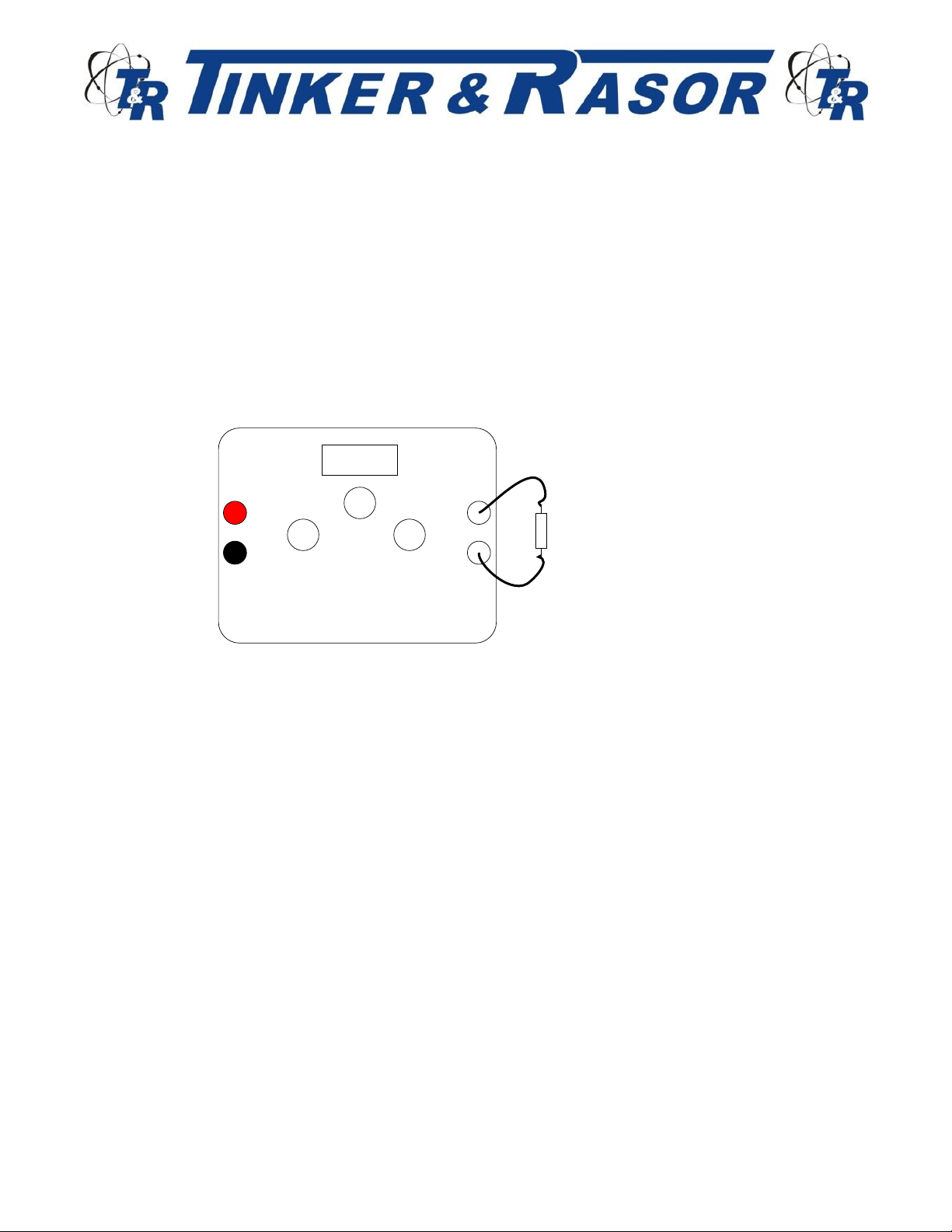
The simple way to check the CS-10 is to use any of the following shunt resistors: 200Ω, 510 Ω, 1K Ω.
200(+/- 5%) Ohm shunt:
1. Connect 200(+/-5%) Ohm 1W resistor across output terminals.
2. Set "RANGE" to 1A
3. Turn "CURRENT ADJUST" knob clockwise until maximum current has been reached or until LCD stops
changing (until LCD stops increasing.)
4. Verify that LCD display shows 0.062A (+/-5%) (0.059 to 0.066A)
510(+/-5%) Ohm shunt
1. Connect 510(+/-5%) Ohm 1W resistor across output terminals.
2. Set "RANGE" to 1A
3. Turn "CURRENT ADJUST" knob clockwise until maximum current has been reached or until LCD stops
changing (until LCD stops increasing.)
4. Verify that LCD display shows 0.025A +/-5% (0.023 to 0.026A)
1kOhm (+/- 5%) Ohm shunt:
1. Connect 1k(+/-5%) Ohm 1W resistor across output terminals.
2. Set "RANGE" to 1A
3. Turn "CURRENT ADJUST" knob clockwise until maximum current has been reached or until LCD stops
changing (until LCD stops increasing.)
4. Verify that LCD display shows 0.013A (+/-5%) (0.012 to 0.014A)
If measured current values are outside +/-5% range verify accuracy of the shunt resistors.
CORROSION MITIGATION INSTRUMENTATION
2828 FM 758, NEW BRAUNFELS, TX 78130 TEL: (830) 253-5621

– 6 –
Web: www.tinker-rasor.com E-mail: Info@tinker-rasor.com
Sponsoring members of NACE International, NACE Foundation
PRODUCT INSTRUCTIONS
REPAIR
Tinker & Rasor strongly suggest all repairs be performed by Tinker & Rasor. All warranty work must be
performed by Tinker & Rasor. Many of the CS-10 components may not be readily available to outside repair
agencies. All repairs are turned around in 24 hours.
Ship To:
Tinker & Rasor
ATTN: Repairs
2828 FM 758
New Braunfels, TX 78130
WARRANTY
Ninety-day warranty on Parts and Labor.
TECHNICAL SUPPORT
Should you require assistance with the CS-10 or any Tinker & Rasor product, please call
(830) 253-5621 Monday through Friday 7:30 am to 4:00 PM Central time.
APPENDIX A
Technical Specifications
Inputs
12v - 15v DC
Source, such as
vehicle battery
Direct connection
between battery
terminals and CS-10
Input terminals
(Toggle on
EXTERNAL)
Not to exceed 15v
DC
Battery Charging
A/C Charging
Using AC wall
charger connected
to DC IN jack on
panel
Used supplied
charger only.
p/n: 031-025
Outputs
Connection to
structure and ground
Direct connection
from Output
terminals on panel
Internal Batteries
12v rechargeable
Lithium Ion
(LiFePO4)
Powers the output
(toggle on
INTERNAL)
Used supplied
charger only.
p/n: 031-025
9v transistor
(replaceable)
Powers the LCD
screen
9v Battery drawer on
panel
102-067
CORROSION MITIGATION INSTRUMENTATION
2828 FM 758, NEW BRAUNFELS, TX 78130 TEL: (830) 253-5621
Indice
Altri manuali Tinker & Rasor Apparecchiature di prova


Manuali Apparecchiature di prova popolari di altre marche

SMART
SMART KANAAD SBT XTREME 3G Series Manuale utente

Agilent Technologies
Agilent Technologies BERT Serial Manuale utente

Agilent Technologies
Agilent Technologies N3280A Manuale utente

Vernier
Vernier Go Direct Voltage Manuale utente

Lifeloc
Lifeloc R.A.D.A.R. Manuale utente

Fluke
Fluke T5-600 Istruzioni per l'uso e l'installazione


