V2 FORTECO 2500-I Manuale utente

ATTUATORE ELETTROMECCAN CO 230V RREVERS B LE A
CREMAGL ERA PER CANCELL SCORREVOL F NO A 2500 KG
D PESO
230V ELECTRO-MECHAN CAL RREVERS BLE RACK
ACTUATOR FOR SL D NG GATES UP TO 2500 KG
OPERATEUR ELECTROMECAN QUE 230V RREVERS BLE A
CREMA LLERE POUR PORTA LS COUL SSANTS JUSQU'A
2500 KG DE PO DS
MOTOR ELECTROMECAN CO 230V RREVERS BLES A
CREMALLERA PARA PUERTAS CORREDERAS HASTA 2500 KG
DE PESO
GB
F
E
FORTECO 2500-
IL n. 372-1
EDIZ. 30/07/2013
V2 S.p.A.
Corso Principi di Piemonte, 65/67
12035 RACCONI I (CN) ITALY
tel. +39 01 72 81 24 11 - fax +39 01 72 84 050
[email protected] - www.v2home.com


ENGL SH
37
NDEX
1 - GENERAL SAFETY NFORMAT ON....................................................................................................................................38
1.1 - PRELIMINARY CHECKS AND IDENTIFICATION OF THE TYPE TO BE USED..................................................................39
1.2 - TECHNICAL ASSISTANCE SERVICE ..........................................................................................................................40
1.3 - EC DECLARATION OF INCORPORATION FOR PARTLY COMPLETED MACHINERY ......................................................40
2 - TECHN CAL DATA..............................................................................................................................................................41
3 - NSTALLAT ON OF THE MOTOR ......................................................................................................................................42
3.1 - POSITIONIN OF THE MOTOR ................................................................................................................................42
3.2 - MOUNTIN THE RACK............................................................................................................................................44
3.3 - FIXIN OF THE MOTOR ..........................................................................................................................................44
3.4 - INSTALLIN THE MA NETIC LIMIT SWITCHES ........................................................................................................45
3.5 - MOTOR OVERRIDIN SYSTEM ................................................................................................................................46
3.6 - INSTALLATION LAYOUT ..........................................................................................................................................46
4 - CONTROL UN T ................................................................................................................................................................47
4.1 - POWER SUPPLY ......................................................................................................................................................47
4.2 - FLASHIN LI HT ....................................................................................................................................................47
4.3 - COURTESY LI HTS..................................................................................................................................................47
4.4 - PHOTOCELLS ..........................................................................................................................................................48
4.5 - SAFETY RIBBONS ....................................................................................................................................................48
4.6 - STOP ......................................................................................................................................................................49
4.7 - ACTIVATION INPUTS................................................................................................................................................49
4.8 - EXTERNAL AERIAL ..................................................................................................................................................49
4.9 - PLU IN RECEIVER ..................................................................................................................................................50
4.10 - ADI INTERFACE......................................................................................................................................................50
4.11 - ELECTRICAL CONNECTION....................................................................................................................................51
5 - CONTROL PANEL ..............................................................................................................................................................52
5.1 - DISPLAY ..................................................................................................................................................................52
5.2 - USE OF THE KEYS FOR PRO RAMMIN ..................................................................................................................52
6 - ACCESS NG THE CONTROL UN T SETT NGS ....................................................................................................................53
7 - QU CK CONF GURAT ON ..................................................................................................................................................54
8 - LOAD NG THE DEFAULT PARAMETERS............................................................................................................................54
9 - SELF-LEARN NG OF WORK NG T MES..............................................................................................................................55
10 - OPERAT ON OF OBSTACLE SENSOR ..............................................................................................................................56
11 - NVERTER BOARD FUNCT ONAL TEST ..........................................................................................................................56
12 - READ NG OF CYCLE COUNTER ......................................................................................................................................57
13 - PROGRAMM NG THE CONTROL UN T ..........................................................................................................................58
13.1 - OPERATION DEFECTS ............................................................................................................................................67
13.2 - FUNCTION TABLE ..................................................................................................................................................68
14 - TEST NG AND START-UP ................................................................................................................................................70
15 - MA NTENANCE ..............................................................................................................................................................70
16 - D SPOSAL OF THE PRODUCT..........................................................................................................................................70

ENGL SH
38
AUTOMAT ON DEV CE NSTALLERS MANUAL
1 - GENERAL SAFETY NFORMAT ON
mPrior to proceeding with installation, it is essential the instructions be read in full, since they contain important
information regarding safety, installation, use and maintenance.
AUTOMATION MUST BE IMPLEMENTED IN COMPLIANCE WITH THE EUROPEAN RE ULATIONS IN FORCE:
EN 60204-1, EN 12445, EN 12453, EN 13241-1, EN 12635
• The installer must provide for a device (es. magnetotermical switch) ensuring the omnipolar sectioning of the equipment from the
power supply. The standards require a separation of the contacts of at least 3 mm in each pole (EN 60335-1).
• The plastic case has an IP44 insulation; to connect flexible or rigid pipes, use pipefittings having the same insulation level.
•Installation requires mechanical and electrical skills, therefore it shall be carried out by qualified personnel only, who can issue the
Compliance Certificate concerning the whole installation (Machine Directive 2006/42/CEE, Annex IIA).
• Also the automation upstream electric system shall comply with the laws and rules in force and be carried out workmanlike.
• We recommend to make use of an emergency button, to be installed by the automation (connected to the control unit STOP input) so
that the gate may be immediately stopped in case of danger.
• For correct installation of the system, we recommend following the instructions issued by UNAC very carefully, which can be consulted
at the following web site: www.v2home.com
• This instruction manual is only for qualified technicians, who specialize in installations and automations.
• The contents of this instruction manual do not concern the end user.
• Every programming and/or every maintenance service should be done only by qualified technicians.
• Anything not expressly described in these instructions is prohibited; unforeseen uses may be a source of danger to people and property.
• Do not install the product in explosive environments and atmospheres: the presence of inflammable gases or fumes is a serious safety
hazard.
• Do not make any modifications to any part of the automation device, or the accessories connected to it, unless described in this
manual.
• Any other modifications will void the warranty on the product.
• The installation steps should be conducted so as to avoid rainy weather, which can expose electronic circuits to dangerous water
seepage.
• All operations requiring the casing of the device to opened should be performed with the control unit disconnected from the electricity
supply and with a warning notice displayed, for example: ”CAUTION, MAINTENANCE IN PRO RESS”.
• Avoid exposing the device close to sources of heat and flame.
• In the event of interventions on automatic or differential breakers or fuses, it is essential that faults be identified and resolved prior to
resetting. In the case of faults that cannot be resolved using the information to be found in this manual, consult the V2 customer
assistance service.
• V2 declines all responsibility for failure to comply with good construction practice standards in addition to structural deformation of the
gate that might occur during use.
• V2 reserves the right to make modifications to the product without prior warning.
• Installation/maintenance personnel should wear individual protection devices (IPDs), such as overalls, safety helmets, boots and gloves.
• The ambient operating temperature should be that indicated in the technical characteristics table.
• The automation device should be shut down immediately in the event of any anomalous or hazardous situation; the fault or
malfunction should be immediately reported to the person responsible.
• All safety and hazard warnings on the machinery and equipment should be complied with.
• Electromechanical actuators for gates are not intended to be used by people (including children) with diminished physical, sensory or
mental capacity, or lacking in experience or knowledge, unless they are under supervision or have been instructed in use of the actuator
by a person responsible for safety.
V2 has the right to modify the product without previous notice; it also declines any responsibility to damage or injury to
people or things caused by improper use or wrong installation.

ENGL SH
39
1.1 - PREL M NARY CHECKS AND DENT F CAT ON OF THE TYPE TO BE USED
The automation device should not be used until installation, as specified in “Testing and start-up”, has been performed.
It should be remembered that the device does not compensate for defects caused by improper installation, or poor maintenance, thus,
prior to proceeding with installation, ensure that the structure is suitable and meets current standards and, if necessary, perform any
structural modifications aimed at the implementation of safety gaps and the protection or segregation of all crushing, shearing and transit
zones, and verify that:
• The gate has no friction points, either during closing or opening.
• The gate is well balanced, i.e. there is no tendency to move spontaneously when stopped in any position.
• The position identified for fixing the motor reducer allows easy and safe manual manoeuvring, compatible with the size of the motor
reducer itself.
• The support on which the automation device will be fixed is solid and durable.
• The mains power supply to which the automation device is connected has a dedicated safety earthing system and differential breaker
with tripping current less than or equal to 30 mA (the breaker gap distance should be greater than or equal to 3 mm).
Warning: The minimum safety level depends on the type of use; please refer to the following outline:
Group 1 - Only a limited number of people are authorised for use, and closure is not in a public area. Examples of this type are gates inside
business premises, where the sole users are employees, or a part of them who have been suitably informed.
Group 2 - Only a limited number of people are authorised for use, but in this case, closure is in a public area. An example of this may be a
company gate that accesses onto a public street, and which is only used by employees.
Group 3 - Anyone can use the automated closure, which is thus located on public land. For example the access gate to a supermarket or an
office, or a hospital.
Protection A - Closure is activated by means of a control button with the person present, i.e. with maintained action.
Protection B - With the person present, closure is activated by a command controlled by means of a key-switch or the like, in order to
prevent use by unauthorised persons.
Protection C - Restricts the force of the leaf of the door or gate. I.e., in the case of the gate striking an obstacle, the impact force must fall
within a curve established by the regulations.
Protection D - Devices, such as photocells, capable of detecting the presence of people or obstacles. They may be active on just one side or
on both sides of the door or gate.
Protection E - Sensitive devices, such as footboards or immaterial barriers, capable of detecting the presence of a person, and installed in
such a way that the latter cannot be struck in any way by a moving leaf or panel. These devices should be active within the entire “danger
zone” of the gate. The Machinery Directive defines “Danger Zone” as any zone surrounding and/or near machinery where the presence of
an exposed person constitutes a risk to the health and safety of that person.
The risk analysis should take into consideration all danger zones for the automation device, which should be appropriately
protected and marked.
n a clearly visible area, apply a sign with information identifying the motorised door or gate.
The installer should provide the user with all the information relating to automatic operation, emergency opening and
maintenance of the motorised door or gate.
Closure use type
Type of activation commands
Group 1
Informed people
(use in private area)
Group 2
Informed people
(use in public area)
Group 3
Informed people
(unlimited use)
Man-present command A B Not possible
Remote control and closure in view
(e.g. infrared) Cor E C or E C and Dor E
Remote control and closure not in view
(e.g. radio) Cor E C and Dor E C and Dor E
Automatic control
(e.g. timed closure control) Cand Dor E C and Dor E C and Dor E

ENGL SH
40
1.2 - TECHN CAL ASS STANCE SERV CE
For any installation problem please contact our Customer Service at the number +39-0172.812411 operating Monday to Friday
from 8:30 to 12:30 and from 14:00 to 18:00.
1.3 - EC DECLARAT ON OF NCORPORAT ON FOR PARTLY COMPLETED MACH NERY
(D RECT VE 2006/42/EC, ANNEX -B)
The manufacturer V2 S.p.A., headquarters in Corso Principi di Piemonte 65, 12035, Racconigi (CN), Italy
Under its sole responsibility hereby declares that:
the partly completed machinery model(s):
FORTECO2500-I
Identification number and year of manufacturing: typed on nameplate
Description: electromechanical actuator for sliding gates
• is intended to be installed on sliding gates, to create a machine according to the provisions of the Directive 2006/42/EC.
The machinery must not be put into service until the final machinery into which it has to be incorporated has been declared in conformity
with the provisions of the Directive 2006/42/EC (annex II-A).
• is compliant with the applicable essential safety requirements of the following Directives:
Machinery Directive 2006/42/EC (annex I, chapter 1)
Low Voltage Directive 2006/95/EC
Electromagnetic Compatibility Directive 2004/108/EC
Radio Directive 99/05/EC
RoHS2 2011/65/CE Directive
The relevant technical documentation is available at the national authorities’ request after justifiable request to:
V2 S.p.A., Corso Principi di Piemonte 65, 12035, Racconigi (CN), Italy
The person empowered to draw up the declaration and to provide the technical documentation:
Cosimo De Falco
Legal representative of V2 S.p.A.
Racconigi, 05/04/2012

ENGL SH
41
ate maximum weight 2500 Kg
Power supply 230VAC / 50Hz
Maximum power 650 W
Idling current 0,5 A
Full load current 3,7 A
ate speed 0,06 ÷ 0,25 m/s
Maximum thrust 1660 N
Duty cycle 50
Pinion M4 - Z18
Working temperature -20°C ÷ +55°C
Motor weight 19 Kg
Protection degree IP44
Maximum load on 24 Vac accessories 10W
Protection fuses F1 = 8A
2 - TECHN CAL DATA

ENGL SH
42
3 - NSTALLAT ON OF THE MOTOR
PREPARATORY STEPS
CAREFULLY OBSERVE EUROPEAN RE ULATIONS EN12445 AND EN12453 (WHICH REPLACE UNI 8612).
Always check the following:
• Your gate should have a strong and suitable build; no wickets should be present on the sliding gate.
• The sliding gate should not tilt excessively during its entire run.
• The gate should be able to slide freely on its guiding surface without an excessive friction.
• Install both closing and opening limit switches, in order to prevent the gate going off the guiding surface.
• Remove any manual locks.
• Bring power cable ducts near the bottom of the gate (diameter 20 / 30 mm) and of the external devices
(photocells, flasher, key selector).
3.1 - POS T ON NG OF THE MOTOR
To fix FORTECO, follow the instructions below:
1. use the measurements indicated in the drawing for the foundations
2. Arrange for one or two pipes for the passage of electric cables
3. Assemble the 4 clamps on the anchoring plate and fix them with the 4 bolts issued with the motor

ENGL SH
43
4. Pour the concrete and position the anchoring plate
mWARN NG: check that the plate be on a perfectly levelled surface and parallel to the gate
5. Wait for the complete setting of the concrete
6. Unscrew the bolts fixing the base to the clamps and put the motor on the plate
7. Insert the 4 grains with their nuts in the proper place. Adjust the 4 grains to make the motor be perfectly levelled
8. Control that the motor is perfectly parallel to the gate, then insert the 4 washers Rand lightly screw the 4 bolts D
mWARN NG: put the washer Ginto the hole for the passing of the cables as shown in the picture. Pierce the washer to let the cable
to be connected to the control unit pass, paying attention to the dimensions in order to avoid the entrance of insects and other small
animals.

ENGL SH
44
3.3 - F X NG OF THE MOTOR
Check the following points:
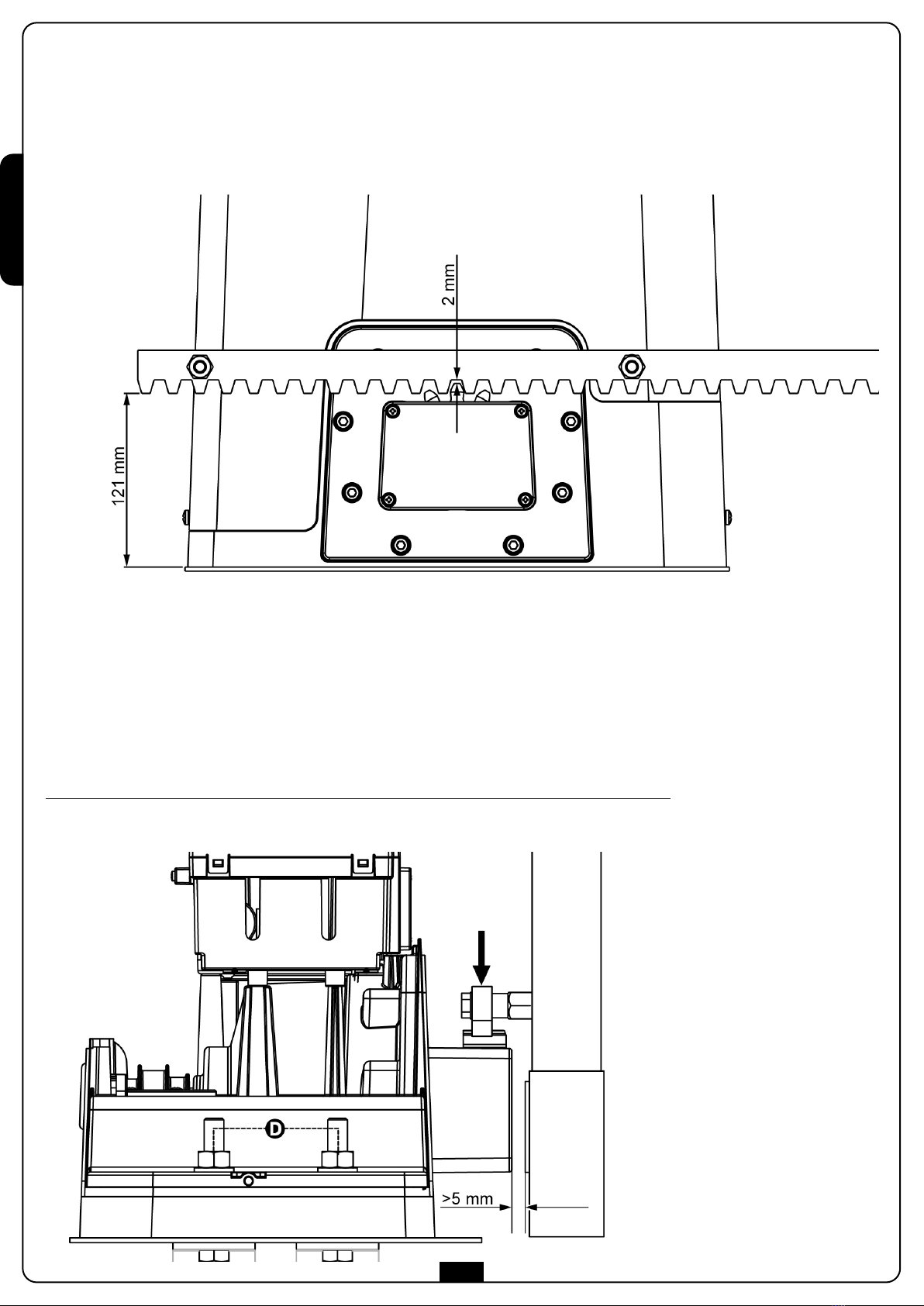
1. the motor must be on a levelled surface and perfectly parallel to the gate
2. the distance between pinion and rack must be 1 or 2 mm. If needed, adjust the 4 grains
3. the rack must be trued up with the pinion of the motor
4. the minimum distance between the maximum overall of the gate and the case of the pinion of the motor must be of at least 5 mm
Check the above indicated conditions and proceed fixing the 4 bolts D anchoring the motor to the plate.
3.2 - MOUNT NG THE RACK
Release the motor and turn the gate completely open. Fix all the rack elements to the gate, making sure that they stand at the same
height than the motor pinion. The rack MUST BE positioned 1 or 2 mm over the pinion of the motor all the gate length.
mWARN NG: f the gate is very heavy we suggest to use an M4 22x22 rack (code. 162324)
Altri manuali per FORTECO 2500-I
1
Indice
Altri manuali V2 Controllori

V2
V2 STARK6 Manuale utente

V2
V2 ZARISS Series Manuale utente

V2
V2 ZARISS-M Manuale utente

V2
V2 TORQ-D Manuale utente

V2
V2 CALYPSO Series Manuale utente

V2
V2 AYROS-230V Manuale utente

V2
V2 PESO-230V Manuale utente

V2
V2 STARK3-230V Manuale utente

V2
V2 CALYPSO Series Manuale utente

V2
V2 AYROS1500-I Manuale utente