Vexve BFS400W1 Manuale utente

Butterfly valves
Installation, operation and maintenance manual

2 3
www.vexve.com
Contents
1. General 4
2. Valve identification 5
3. Unloading and storage 6
4. Valve installation 8
4.1 Valve location in the pipeline 10
4.2 Installation positions of the valve 11
4.2.1 Installation in a horizontal pipeline 12
4.3 Pipeline supports and pipeline reducers 13
4.4 Installation at end of pipeline 14
4.5 Welding procedures 15
4.5.1 Installation in a vertical pipeline 16
4.5.2 Welding with connection pipes (recommended method) 16
4.6 Installation of valve with flanged connections 17
4.7 Before commissioning 18
4.8 Flushing 18
4.9 Commissioning 19
4.10 Pressure test 19
5. Actuator disassembly and installation 20
5.1 Removing the actuator 20
5.2 Changing the actuator installation position 21
5.3 Actuator installation 21
5.4 Electric actuator 21
5.5 Hydraulic actuator 21
5.6 Actuator installation positions 22
6. Maintenance 24
6.1 Replacing the stem O-ring seal (BFS/BRS valves) 25
6.2 Replacing the stem graphite packing (BFC/BRC model) 26
7. Appendices 27
7.1 Parts list for BFS/BRS models 27
7.2 Parts list for BFC/BRC models 28
7.3 Type code 29
7.4 Coupling dimensions, BFS/BRS models 30
7.5 Coupling dimensions, BFC/BRC models 31

2 3
www.vexve.com www.vexve.com
NOTE:
This manual must be read and its instructions must be followed when installing,
operating and/or performing maintenance on the valve as well as its manual gear or
actuator.
These instructions are of general nature and do not cover all possible operating scenarios. For more spe-
cific guidance on the installation, operation and maintenance of the valve or its suitability for an intended
use, please contact the manufacturer.
Vexve Oy reserves the right to make alterations to these instructions.
Vexve Oy is not responsible for damages caused by incorrect transportation, handling, installation, opera-
tion or maintenance. Furthermore, Vexve Oy is not responsible for damage caused by foreign objects or
impurities.
Warranty
Warranty according to Vexve Oy’s “General terms and conditions of sale”.
The warranty covers manufacturing and material faults. The warranty does not apply to damages caused
by inappropriate installation, operation, maintenance, or storage ie. these instructions must be followed
for the warranty to apply. Vexve Oy requires that any faulty products under warranty are to be returned to
the factory for inspection. Only after the product has been found faulty, Vexve Oy can grant compensa-
tion.
Please refer to Vexve Oy’s “General terms and conditions of sale” for detailed warranty clauses.
The document is available from the manufacturer
Warnings and symbols
Ignoring the warnings and symbols may lead to serious injury or equipment damage. Persons
authorized to use the equipment must be familiar with the warnings and instructions.
Appropriate transportation, storage and installation as well as careful commissioning are essential to
ensure faultless and stable operation.
The following symbols are used in this manual to draw attention to actions essential to ensure the proper
use and safety of the device.
Meaning of the symbol: NOTE
The NOTE symbol is used for actions and functions that are essential for the proper use
of the device. Ignoring this symbol may have harmful consequences.
Meaning of the symbol: WARNING
The WARNING symbol is used for actions and functions that, if carried out incorrectly,
may lead to injury or equipment damage.
© 2020 Vexve Oy - All product names, trademarks and registered trademarks are property of Vexve Oy.

4 5
www.vexve.com
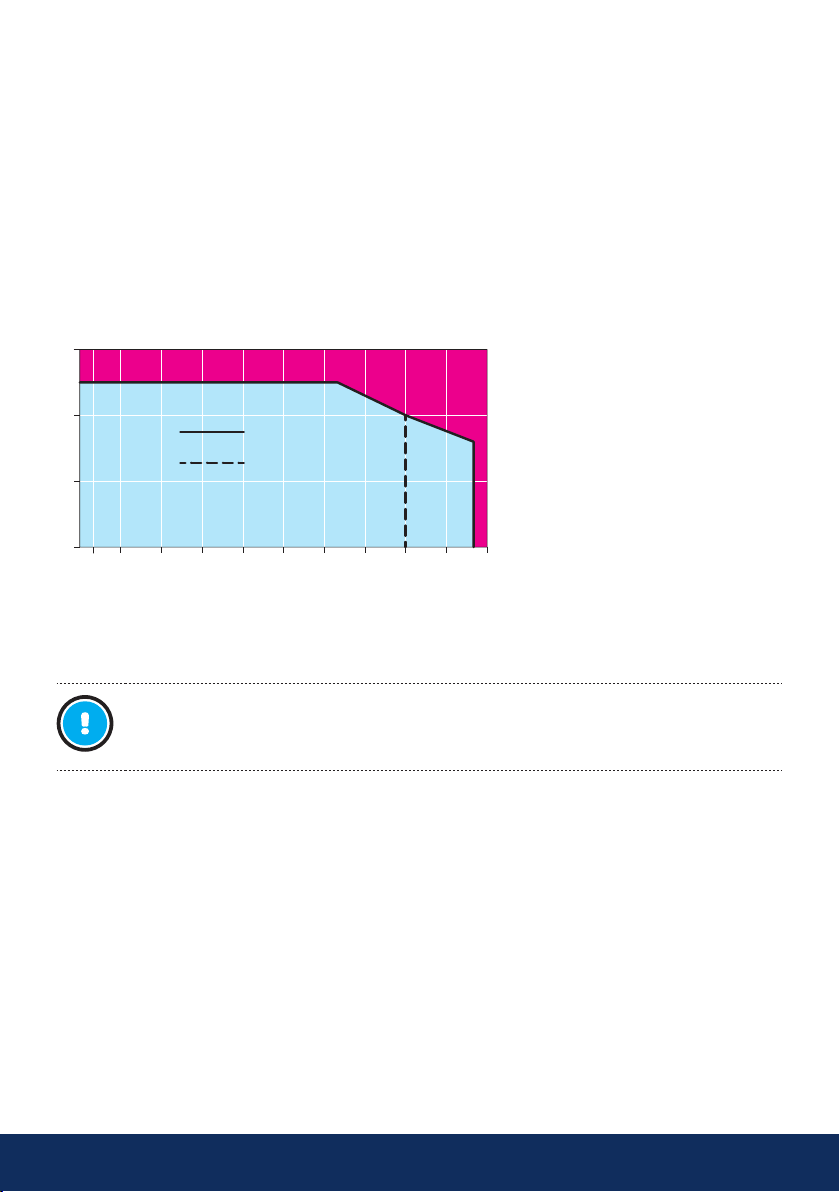
-40 ºC260230200170140110805020-10
MPa
3
2
1
0
BFC / BRC
BFS / BRS
1. General
Vexve Oy’s butterfly valves are high performance, metal seated, triple oset type butterfly valves designed
especially for district heating and district cooling applications. Vexve’s high quality butterfly valves with to-
tal bi-directional tightness can be used for shut-o (on/o) and control purposes. Vexve provides models
BFS and BRS for shut-o and models BFC and BRC for control purposes.
Vexve’s butterfly valve can be used within the following temperature-pressure range. Please note that the
maximum allowable working pressure is dependent on the operating temperature.
Chart 1. Pressure-temperature chart.
Note!
DN 1200–1600 temperature
range -20…+200 °C
The maximum allowable work-
ing pressure is dependent on
the operating temperature
NOTE:
When intending to use the valve for other media or applications please consult Vexve to
ensure its suitability.
The Parts list for Vexve’s butterfly valves is presented in Appendix 7.1. and 7.2.
For detailed technical information including dimensions and weights, torques, Kv-values etc please refer
to Vexve’s Product catalogue or data sheets (www.vexve.com) for the valve in question.

4 5
www.vexve.com www.vexve.com
BRS1000W
0101001 2015
25 200
-40
25
1 2 3 4 567 8
9 10 11 12 13 14
2. Valve identification
The type code for Vexve’s butterly valves is presented in Appendix 7.3.
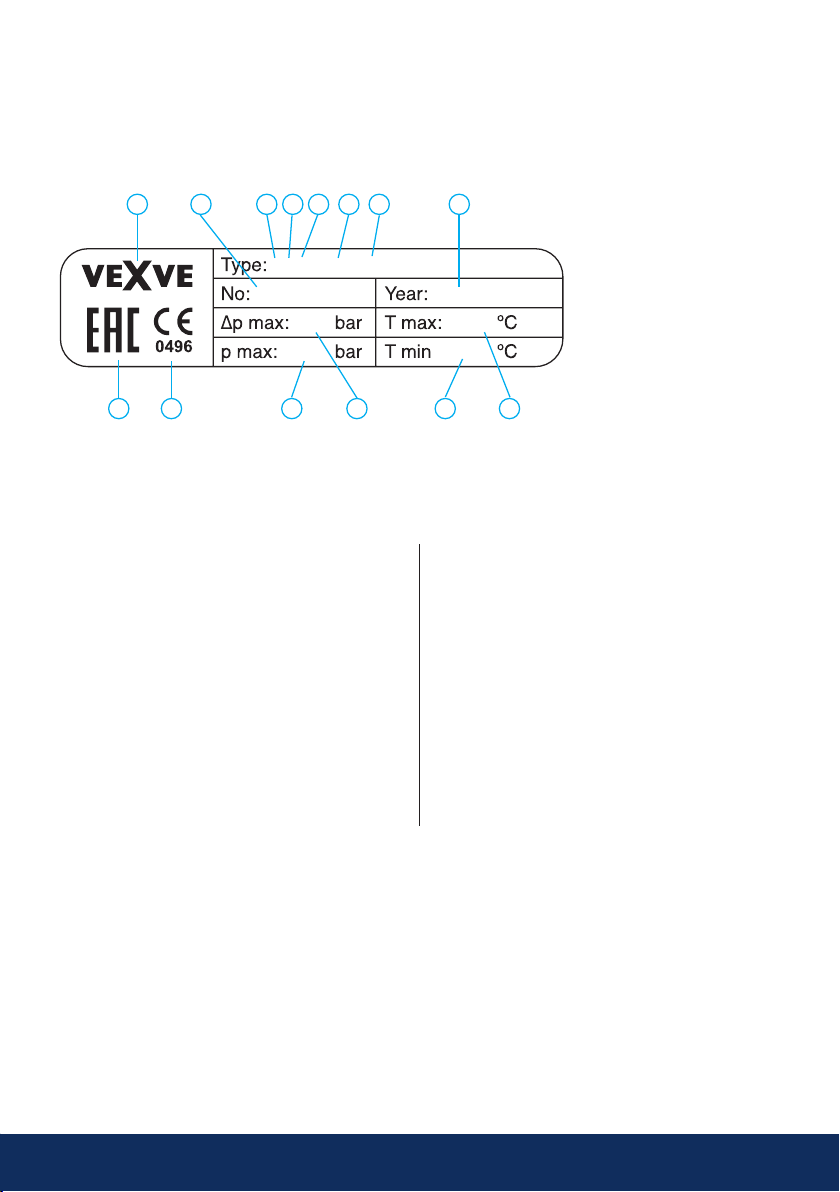
The valve-specific serial number can be found on the identification plate
on the side of the actuator connection (see Figure 1).
Figure 1. Identification plate.
The markings on the identification plate are as follows:
1. Valve manufacturer
2. Valve product number, which is individual
valve number
3. Valve type:
B = butterfly valve
4. Product group:
F = full bore
R = reduced bore
5. Valve use
S = shut-o valve
C = control valve
6. Valve size (DN)
7. Connection to the pipeline:
W = welding ends
F = flanged ends
8. Manufacturing year
9. Eurasian Conformity Valve Certification
10. CE marking and ID of the notified body
11. Pressure class
12. Maximum pressure dierence when
the valve is closed
13. Minimum operating temperature
14. Maximum operating temperature

6 7
www.vexve.com
3. Unloading and storage
Check that the contents of the delivery is as
ordered. Check that the valve and related equip-
ment have not been damaged during transpor-
tation.
Store the valve carefully before installation, pref-
erably in a well-ventilated, dry space,
on a shelf or a wooden grid to protect it from
rising damp (see figure 5).
Protect bare metal surfaces, shaft parts,
and flange surfaces with anti-corrosive agent
before storage.
The valve must be transported to the installation
site in a sturdy package. Do not remove the flow
port protectors before installation. Protect the
valve from sand, dust, and other impurities.
The valve must always be lifted by its lifting lugs
and upper neck (see Figures 3 and 4). The valve
or valve assembly must not be lifted from the
actuator (see Figure 2). Even light knocks may
damage the actuator or aect the actuator and
valve adjustments.
NOTE:
Take the weight of the valve into
account when handling it.
When delivered, the valve will be in the closed
position. During storage, the valve must be
lightly closed.
Maximum recommended storage time is two
years. If the valve is stored for more than two
years, it should be operated and cleaned yearly.
Packaging:
Vexve’s products are protected during transpor-
tation with special packaging. The packaging
consists of environmentally friendly materials that
are easy to sort and recycle.
Recycling the packaging materials at designated
waste collection points is recommended.
The following packaging materials are used:
wood, cardboard, paper, and polyethylene
sheets.
Recycling and disposal
Nearly all parts of the valve are made of recy-
clable material. The material type is marked on
most parts. The valve is delivered with a material
list, and separate recycling and disposal instruc-
tions are available from the manufacturer. The
valve can also be returned to the manufacturer
for recycling and disposal against a fee.
Figure 2. Do not lift the valve by the actuator.

6 7
www.vexve.com www.vexve.com
Figure 4. Lifting a valve equipped with 4 lifting lugs.
Figure 3. Lifting a valve equipped with 2 lifting lugs.
Figure 5. Storage.

8 9
www.vexve.com
WARNING:
Incorrect installation may result in serious personal injury and it may damage or cause
malfunction of the equipment. These instructions must therefore be followed carefully
when installing the valve.
These general instructions do not cover all possible operating scenarios. For more
specific guidance on the use of the valve or its suitability for an intended use, please
contact the manufacturer.
· Do not remove the flow port protectors before installation. Keep the valve protected from sand,
dust and other impurities.
· If the valve was delivered with the actuator installed, avoid removing the actuator during installation.
· Incorrect re-installation or adjustment of the actuator will result in a high risk of damage and leakage.
· Exercise extreme caution when testing the valve before installation in the pipeline.
· The valve or valve assembly must not be lifted by the actuator. If the valve is equipped with lifting lugs,
use the lugs (see Figures 3 and 4). Dropping or incorrect lifting of the valve can result in personal injury
or equipment damage.
· Use one of the allowed lifting methods shown in Figures 3 and 4.
4. Valve installation
Figure 6. Do not remove the actuator. Figure 7. Do not change factory settings.

8 9
www.vexve.com www.vexve.com
Prior to installation:
· Remove the flow port protectors
· Clean the pipes and the valve, see Figure 8
· Close the valve fully before welding or installing it in the pipeline.
The valve must remain closed for the entire installation procedure!
WARNING:
Pipeline and valve shall be carefully cleaned prior to installation as any welding debris or
other impurities can damage the valve.
Valve installation:
· Check the instructions for the correct location of valve in the pipeline, see chapter 4.1
· Install the valve in an allowed position, see chapter 4.2
· See chapter 4.5 for installation instructions of valve with welding ends
· See chapter 4.6 for installation instructions of valve with flanges
NOTE:
The valve must be used only in applications for which it is intended.
Figure 8. Clean the pipes and the valve before installation.

10 11
www.vexve.com
5D
3D
3D
1
2
2
3
4.1 Valve location in the pipeline
Valve should be installed as far as possible from
the components causing turbulence, such as
pumps, pipe bends and pipe connections.
Minimum installation distances shown in figure 9
should be followed.
1Pipe bend axis
2Stem axis
3Pump shaft axis
Figure 9. Minimum distances, D = pipeline diameter
Figure 10. Valve location
NOTE:
Valve should not be installed
in such sections in the pipeline
where impurities can easily be
piled. For example lowest sections
of the pipeline should be avoided
(see figure 10).
Questo manuale è adatto per i seguenti modelli
23
Indice
Altri manuali Vexve Unità di controllo
Manuali Unità di controllo popolari di altre marche

Festo
Festo Compact Performance CP-FB6-E Manuale elenco delle parti

Elo TouchSystems
Elo TouchSystems DMS-SA19P-EXTME Manuale utente

JS Automation
JS Automation MPC3034A Manuale utente

JAUDT
JAUDT SW GII 6406 Series Guida rapida

Spektrum
Spektrum Air Module System Manuale utente

BOC Edwards
BOC Edwards Q Series Manuale utente