
Wilson Benesch Precision Series Manuale utente

PRECISION SERIES
User Manual

Dear Valued Customer,
To the cognoscenti of British high-performance audio, the Wilson Benesch marque is recognised as one of the world’s leading loudspeaker design and manufacturing
companies. We are honoured that you have chosen a Precision Series loudspeaker for your audio system. Our team of engineers, craftspeople and designers have devoted
every effort to manufacture this series of loudspeakers and we are extremely proud to present it to you. Our products are engineered to last a lifetime and we wish you
many hours of enjoyment from your personal music collection with the Precision Series loudspeakers installed in your personal system.
Before starting your journey, we encourage you to pay special attention to the information contained in this manual. In order to extract maximum performance from the
product, it is critical that it is setup correctly. Should you have any questions or require assistance, please do not hesitate to contact your authorised dealer or distributor.
On behalf of all the Team at Wilson Benesch,
Craig Milnes, Design Director Christina Milnes, Managing Director

1.0 Product Registration - P4
1.1 Unpacking: Important points before setup - P4
1.2 Removing the Tweeter Protector - P4
1.3 What’s in the Box - P5
2.0 The Subject of Room Acoustics - P6
2.1 Standing Waves - P6
2.2 Reection, Absorption, Diffusion - P7
2.3 Loudspeaker and Listening Position - P8
2.4 Speaker Toe-in - P9
2.5 Spikes & Speaker Rake Angle - P9
2.6 Loudspeaker Clearance and the Bass Port - P9
3.0 Terminals - P10
3.1 Precision Series loudspeaker Terminal Wiring - P10
4.0 Stable Listening Room Environment - P11
4.1 Running-in (168-hours) - P11
4.2 Partnering Products - P11
4.3 Magnet Precautions - P12
5.0 Limited Warranty - P13
5.1 Conditions - P13
5.2 Remedy - P14
5.3 Warranty Limited to Original Purchaser - P14
5.4 Demonstration Equipment - P14
Table of Contents

PRECISION SERIES MANUAL REV 1.3
4
1.0 Product Registration
Please register your product using the Warranty Registration Card provided in the product packaging within 30-days of reciept of your Wilson Benesch product. Return
within 30-days of reciept will validate a full 5-year warranty provided all conditions detailed in section ‘5.0 - Limited Warranty’ are satised. Please refer to our terms and
conditions at the back of this product manual for more information.
1.1 Unpacking: Important points before setup
On the outside of the shipping carton you will nd a QR code which will automatically load an unpacking video on your device. It is possible to unpack the Precision Series
products alone, but we recommend at least 2-people work together to avoid damage to the product or personal injury. Please observe normal procedures for lifting and
correct posture when handling the speakers. It is strongly recommended that all watches and jewellery be removed prior to unpacking and gloves worn to allow better
grip of the product and protection to the surface nish. Patient and careful setup is essential to obtain the maximum performance from this system.
Special care and attention must be taken to ensure that no pressure is applied to the drivers and in particular, the tweeter dome, when handling or moving the product
from the packaging.
Once both speakers have been stood in an upright position on their spikes the bags can be removed and the packaging stored for future use. This packaging is essential
for safe shipment of the loudspeaker. It is designed and tested specically for use with the Precision Series. Due to the bespoke nature of the packaging, replacement
costs are not insignicant and it is highly recommended therefore, that the packaging is retained for any potential later use.
1.2 Removing the Tweeter Protector
All Precision Series products come with a tweeter protector installed. The P1.0 tweeter protector is slightly different from the P2.0/P3.0. But the removal of the protector is
the same in each instance. Place two ngers from one hand on the faceplate and hold it in place, whilst using the other hand to pull the mounts away from the faceplate
freeing the protector. This is shown in the unpacking lm.

PRECISION SERIES MANUAL REV 1.3
5
1.3 What’s in the Box
Your Precision Series loudspeakers are supplied with carefully designed packaging that allow for the loudspeaker to be installed with a minimal amount of lifting. Please
use the QR code on the exterior of the shipping carton which shows an instructional video for unpacking the Precision Series products.
Also contained within the shipping container should be the following items:
- 1x Precision Series Manual
- 1x Wilson Benesch Spanner with a 13mm / 22mm end
- A full set of spikes that are pre-installed on each loudspeaker
- A tweeter protection brace which should be removed prior to listening

PRECISION SERIES MANUAL REV 1.3
6
2.0 The Subject of Room Acoustics
Acoustics is a complex subject and this text should be treated for what it is, a simple but informative guide. For a deeper understanding, we would recommend seeking out
a range of texts on the subject in conjunction with the purchase and use of basic measurement equipment.
It is important to have a strong appreciation of the huge role played by the room and surroundings on the overall sound of the audio system. The air contained within
the room is the link between the output of the loudspeaker and your ear. How this air behaves is dependent upon the attributes or characteristics of the room. It follows
that a better understanding of basic acoustics will assist in making decisions about the way in which the room and subsequently the system can be initially installed and
ultimately improved.
Room types fall between two extremes. A room can be ‘dead’ on the one hand - being full of highly acoustic energy absorbent materials - or very ‘lively’ on the other hand
with a high proportion of non-absorbent, hard, reective surfaces. A combination of materials with different characteristics to achieve a balance between these extremes is,
of course, preferable to either extreme where performance and accuracy will suffer.
The contents of a room will impact on its overall acoustic character. As you would expect harder surfaces like glass and concrete tend to reect and/or diffuse a broad
bandwidth of acoustic energy. Complimentary materials that are soft and thick in section such as heavy natural bre curtains will tend to absorb a broad band of
frequencies.
2.1 Standing waves
When sound waves reect between two parallel surfaces, the distance apart being equal to half the wavelength or less, dependent upon wave size, resonance modes
referred to as ‘standing waves’ are created. The standing waves in your room will distort the frequency response of your system sympathetically boosting or cancelling
certain frequencies. If a certain standing wave frequency is acoustically isolated from its modal neighbours its effect is more likely to be audible and problematic. This can
compromise the accuracy of any loudspeaker.

PRECISION SERIES MANUAL REV 1.3
7
2.2 Reection, Absorption, Diffusion
The upper-range of frequencies is generally affected more by room contents than room shape. The surfaces and how they reect, absorb or diffuse acoustic energy will tend
to describe the ‘sound’ of a room. As is the case with all forms of energy, acoustic energy cannot be destroyed it can only be converted or reected. The shape, thickness and
material type of a surface will determine how the sound is reected, how much of it is reected and also how much is absorbed and converted into heat or kinetic energy.
Depending on the frequencies in question, the thickness, density and material of the surface or boundary, some energy may pass through entirely. This behaviour is
commonly observed in the lower range of frequencies, being comprised of larger wavelengths that can pass through wall or ceiling boundaries and into an adjacent room,
while the upper frequencies are either absorbed or reected back inside the listening room.
Diffusion occurs when acoustic energy is reected by a surface and dispersed in a random and/or disordered fashion. Usually, diffusion will occur when the acoustic energy
meets a non-uniform or uneven surface. A tightly packed bookshelf with books of different sizes and proles is one example of a commonly found listening room boundary
which can result in diffusion of the upper frequencies.
Diffusion of sound energy at key areas of the listening room is often less damaging to system accuracy and therefore preferable to orderly reection. In the case of reection,
the quantity of indirect sound reaching the listening position will be greater and therefore more inuential. This mixing of indirect and direct sound at the listening position
can result in audible inaccuracies and artefacts.
It should be appreciated that sound waves behave in much the same way as light waves or ‘rays’. To imagine the loudspeaker driver as a oodlight can be helpful in
determining which areas of the listening space are critical to the performance and accuracy of the system. The key “rst points of reection” can be roughly identied by
having an assistant hold a mirror on each side wall while you are positioned in the listening chair. Once the speaker drivers can be seen in the mirror from the listening
position the impact of this identied area should be considered in light of the above basic principles. By the same token, the rst reection point on the ceiling can also be
considered for its inuence as the rst point of reection.
Although many listening rooms are unsuitable for professional acoustic treatment products due to their dual role as a living and listening space, it can still be possible to
make small but appreciable improvements by rearranging furniture, system components and of course the listening position. Consider the changeability of rooms; if the
room is dressed with heavy curtains simply changing the curtains position can alter the balance of the system. It is the goal that is the guide and the owner is the pivot in
this subtle balancing act.

PRECISION SERIES MANUAL REV 1.3
8
2.3 Loudspeaker and Listening Position
The system, comprised of different components, installed in a room with a unique acoustic character and every listener’s individual taste, should be appreciated as
a unique sum comprised of a great many variables. It should be considered that in this balancing act experimentation is critical to getting the best from the system
and more importantly, tuning to the listener’s own satisfaction. There is no one simple set of rules for speaker placement that will t for every scenario within which
a Precision Series loudspeaker is installed. It is for this reason that no minimum or maximum parameters are stated for the positioning of each product. The listening
position should also be evaluated in the same manner.
The distance between the speakers in relation to the distance from each speaker to the listening position will impact on the size of the sound stage presented.
Additionally, if the listening position is moved closer to the speakers, the proportion of reected sound to direct sound will decrease. A great many recommendations
describe an equilateral triangle, whereby the distance between each speaker and the listening chair are the same, but again, experimentation is the key. A larger distance
between the speakers can result in a larger and more engaging presentation. The distance between the speaker and rear and side walls should also be considered. Bass
performance, in particular, will often suffer wherever a speaker is too close to one of these boundaries, resulting in “boomy” or over-bloated bass and/ or cancellations.
This effect is more pronounced still when placing the speaker into a corner where two boundaries meet.
The most valuable commodity in this process is time. Be prepared to make small changes over long periods of time. Positioning the loudspeakers in approximate position
that you anticipate will work best and then wiring the loudspeakers up and commencing the burn-in period is advisable. During this burn-in period, the speaker will more
than likely sound somewhat forward and etched, critical appraisal of the sound at this stage should always be avoided.
Once the 168-hour running in period has elapsed, it is time to choose a rough nal position for the loudspeakers before making the nal adjustments to toe and rake
angles.
We would recommend selecting four musical passages as outlined below in helping you evaluate the various speaker positioning parameters and the effects of changing
these.
- Select one with a distinctive and easily heard human voice. Spoken voice is ideal.
- Select one passage with a full orchestra like The Pines of Rome.
- Select one that is very emotional for you.
- Select one that has a strong rhythm and a good portion of bass content, as found in a typical dance music track for example.

PRECISION SERIES MANUAL REV 1.3
9
2.4 Speaker Toe-in
The amount of speaker toe-in will dene a sharper centre image at the expense of image width. The upper frequencies will become more pronounced as you bring
the tweeters on axis with your ear at the listening position. While we generally recommend at least some speaker toe-in, the amount is not a precise or xed value.
Experimenting here is advisable and evaluation at the listening position, while an assistant makes toe-in adjustments, is one method to achieve the best balance.
2.5 Spikes & Speaker Rake Angle
The position of the tweeter has been designed to function best for listeners seated in conventional relaxed seating positions. However, the rake angle of the speaker can
be changed by adjusting the installed speaker spikes. Tilting the speaker back slightly will have the effect of projecting the perceived sound stage a little higher. This can
also change the perceived balance of the upper frequencies, as the tweeter will be most prominent when it is on axis with your ear at the listening position. All the spikes
in your Precision Series loudspeaker are adjustable to allow you to alter the loudspeaker rake angle.
2.6 Loudspeaker Clearance and the Bass Port
Both P2.0 and P3.0 loudspeakers feature a bass port on the underside of its foot that is in close proximity to the oor. The low-frequency augmentation of these two
loudspeakers will behave in much the same way that it would should you place the loudspeakers next to a wall. That is to say, adjustments in the overall clearance of the
P2.0 and P3.0 from the oor will change the overall balance in the system. Generally, it can be observed that a smaller clearance and closer placement to the oor will
result in a more augmented low- frequency characteristic to the loudspeaker presentation, where a larger clearance between the oor and the bass port will result in a
less augmented low-frequency characteristic to the presentation. This is a critical step in the loudspeaker setup procedure and in many cases, the balance of the system
will change considerably as this parameter is adjusted.
PRECISION SERIES MANUAL REV 1.3
10
3.0 Terminals
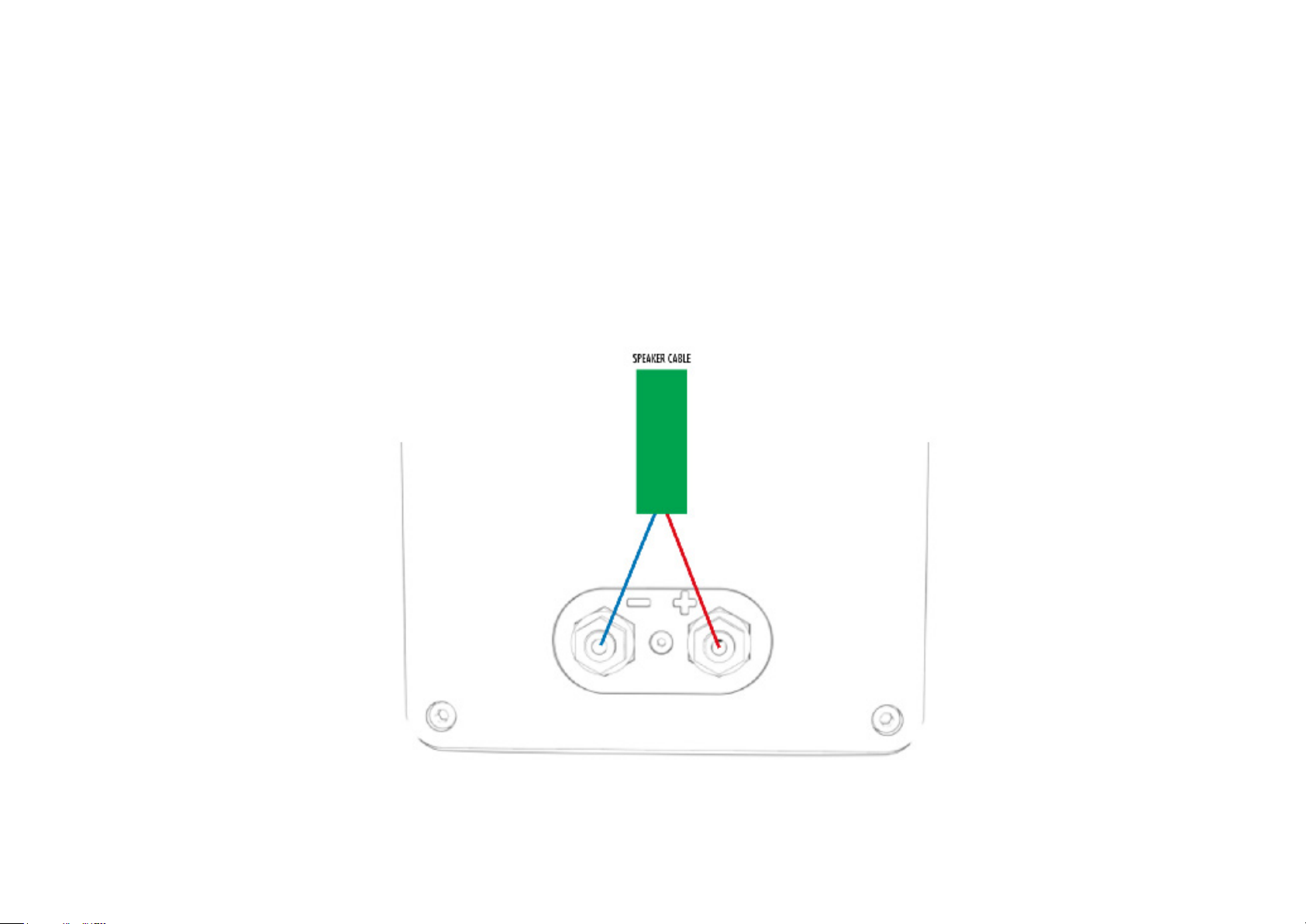
Wilson Benesch recommends the use of 8mm ring or spade connector cable terminations. A spanner is provided to tighten up the rhodium plated nuts. A light pinch of the
end of the supplied spanner is more than sufcient to tighten the nuts. Please be careful to not over tighten the terminals as this could result in damage to the terminal
plate or snapping of the terminal. The terminals will also accept 4mm banana plugs.
3.1 Precision Series loudspeaker Terminal Wiring
All Precision Series loudspeakers have one terminal losenge that is positioned at the rear loudspeaker. A single loudspeaker cable can be used to wire the Precision Series
to your amplier. As shown in the diagram below:
Altri manuali per Precision Series
1
Indice
Altri manuali Wilson Benesch Altoparlanti

Wilson Benesch
Wilson Benesch Square One Manuale utente

Wilson Benesch
Wilson Benesch Arc Manuale utente

Wilson Benesch
Wilson Benesch Bishop Manuale utente

Wilson Benesch
Wilson Benesch Square One Series ii Manuale utente

Wilson Benesch
Wilson Benesch FIBONACCI Series Manuale utente

Wilson Benesch
Wilson Benesch Orator Loudspeaker Manuale utente

Wilson Benesch
Wilson Benesch The Actor Manuale utente

Wilson Benesch
Wilson Benesch Vertex Manuale utente

Wilson Benesch
Wilson Benesch A.C.T C60 Manuale utente

Wilson Benesch
Wilson Benesch Precision Series Manuale utente


