DFI P5BV3+/e Manuale utente

P5BV3+/e
Rev. A+
System Board
Users Manual
36400830

Copyright
This publication contains information that is protected by copyright. No
part of it may be reproduced in any form or by any means or used to
make any transformation/adaptation without the prior written permission
from the copyright holders.
This publication is provided for informational purposes only. The
manufacturer makes no representations or warranties with respect to
the contents or use of this manual and specifically disclaims any express
or implied warranties of merchantability or fitness for any particular purpose.
The user will assume the entire risk of the use or the results of the use of
this document.Further,the manufacturer reserves the right to revise this
publication and make changes to its contents at any time, without obligation
to notify any person or entity of such revisions or changes.
All Rights Reserved. © 1998
Trademarks
Microsoft®MS-DOS®, WindowsTM and Windows®95 are registered
trademarks of Microsoft Corporation. Intel and Pentium are registered
trademarks of Intel Corporation.Cyrix 6x86MX and M II are registered
trademarks of Cyrix Corporation. AMD K6 and K6-2 are registered
trademarks ofAdvanced Micro Devices,Inc. IBM is a registered trademark
of International Business Machine Corporation.IDT C6 andWINCHIP2
are registered trademarks of IDT Corporation. Award is a registered
trademark of Award Software, Inc. Other trademarks and registered
trademarks of products appearing in this manual are the properties of
their respective holders.
Caution:
Danger of explosion if battery incorrectly replaced.
Replace only with the same or equivalent type recommended by the
manufacturer.
Dispose of used batteries according to the battery manufacturers
instructions.

FCC and DOC Statement on Class B
This equipment has been tested and found to comply with the limits
for a Class B digital device, pursuant to Part 15 of the FCC rules.
These limits are designed to provide reasonable protection against
harmful interference when the equipment is operated in a residential
installation. This equipment generates, uses and can radiate radio
frequency energy and, if not installed and used in accordance with
the instruction manual, may cause harmful interference to radio
communications. However, there is no guarantee that interference
will not occur in a particular installation. If this equipment does cause
harmful interference to radio or television reception, which can be
determined by turning the equipment off and on, the user is
encouraged to try to correct the interference by one or more of the
following measures:
Reorient or relocate the receiving antenna.
Increase the separation between the equipment and the receiver.
Connect the equipment into an outlet on a circuit different from
that to which the receiver is connected.
Consult the dealer or an experienced radio TV technician for
help.
Notice:
1. The changes or modifications not expressly approved by the
party responsible for compliance could void the user's authority
to operate the equipment.
2. Shielded interface cables must be used in order to comply with
the emission limits.

Table of Contents
Chapter 1 - Introduction
1.1 Features and Specifications......................................................................
1.2 Package Checklist .........................................................................................
Chapter 2 - Hardware Installation
2.1 System Board Layout .................................................................................
2.2 System Memory .............................................................................................
2.3 DIP Switch Settings of the Processors ............................................
2.4 Jumper Settings for Clearing CMOS Data. ...................................
2.5 Jumper Settings for SDRAM Clock (DIMM) ................................
2.6 Connecting the Ribbon Cables and Wires of the Ports
and Connectors .............................................................................................
Chapter 3 - Award BIOS Setup Utility
3.1 The Basic Input/Output System ...........................................................
3.1.1 Standard CMOS Setup .............................................................
3.1.2 BIOS Features Setup ..................................................................
3.1.3 Chipset Features Setup .............................................................
3.1.4 Power Management Setup ......................................................
3.1.5 PNP/PCI Configuration .............................................................
3.1.6 Load Fail-Safe Settings ...............................................................
3.1.7 Load Optimal Settings ..............................................................
3.1.8 Integrated Peripherals .................................................................
3.1.9 Supervisor Password ..................................................................
3.1.10 User Password ...............................................................................
3.1.11 IDE HDD Auto Detection .....................................................
3.1.12 Save & Exit Setup ........................................................................
3.1.13 Exit Without Saving .....................................................................
6
9
25
25
28
32
33
35
37
37
38
41
42
42
43
43
10
11
11
15
16
17

50
50
52
Chapter 4 - Supported Softwares
4.1 Desktop Management Interface .........................................................
4.2 Drivers ...............................................................................................................
Appendix A - Identifying Processors
A.1 Intel Processors .............................................................................................
A.2 Cyrix Processors ..........................................................................................
A.3 IBM Processors .............................................................................................
A.4 AMD Processors .........................................................................................
A.5 IDT Processors .............................................................................................
Appendix B - System Error Messages
B.1 POST Beep .....................................................................................................
B.2 Error Messages ..............................................................................................
Appendix C - Troubleshooting
C.1 Troubleshooting Checklist ........................................................................
44
47
48
48
49
49
49

6
1.1 Features and Specifications
1.1.1 Features
Chipset
VIAApollo 598MVP AGP system chipset
Processor
The system board is equipped with a switching voltage regulator
that supports 2.0V to 3.5V core voltage for various processors.
Intel Pentiumprocessor with MMXTM technology-166/200/
233MHz
Cyrix®6x86MX-PR200/PR233/PR266 and M II-300/333/350/
400
IBM® 6x86MX-PR200/PR233/PR266/PR300/PR333
AMD®K6-200/233/266/300 and K6-2/250/266/300/333/350/
400
IDT®C6-180/200/225/240 and WINCHIP2-200/225/240/266/
300
System Memory
The system board supports 8MB to 256MB of memory. It is
equipped with two DIMM sockets. The 168-pin DIMM sockets use
x64 EDO (60/70ns), SDRAM (10/12/13ns) or PC SDRAM (PC-
100 SDRAM for 100MHz external system bus clock processors),
3.3V.
Chapter 1 - Introduction
DIMMs
1MBx64
2MBx64
4MBx64
8MBx64
16MBx64
Memory Size
8MB
16MB
32MB
64MB
128MB

7
1
Introduction
Level 2 Cache Memory
512KB pipeline burst, direct map write-back cache installed on
the system board.
Expansion Slots
The system board is equipped with 1 dedicated AGP slot, 2
dedicated PCI slots, 1 dedicated 16-bit ISA slot and 1 shared PCI/
ISA slot. All PCI and ISA slots are bus masters.
Desktop Management Interface (DMI)
The system board comes with a DMI 2.0 built into the BIOS. The
DMI utility in the BIOS automatically records various information
about your system configuration and stores these information in the
DMI pool, which is a part of the system board's Plug and Play
BIOS. DMI, along with the appropriately networked software, is
designed to make inventory, maintenance and troubleshooting of
computer systems easier. Refer to Chapter 4 for instructions on
using the DMI utility.
Connectors
2 connectors for external USB ports
1 connector for IrDA interface
2 serial ports
1 parallel port
2 IDE connectors
1 floppy connector
1 PS/2 mouse port
1 PS/2 or AT keyboard port
1 12-pin standard AT power supply connector
PCI Bus Master IDE Controller
Two PCI IDE interfaces support up to four IDE devices
Ultra DMA/33 supported (Synchronous Ultra DMA mode -
data transfer rate up to a maximum of 33MB/sec.)
PIO Mode 3 and Mode 4 Enhanced IDE (data transfer rate up
to 16.6MB/sec.)
Bus mastering reduces CPU utilization during disk transfer
ATAPI CD-ROM, LS-120 and ZIP supported

8
Introduction
1
IrDA Interface
The system board is equipped with an IrDA connector for wireless
connectivity between your computer and peripheral devices. It
supports infrared peripheral devices that meet the ASKIR or HPSIR
standard.
USB Ports
The system board is equipped with two connectors for external
USB ports. USB allows data exchange between your computer and
a wide range of simultaneously accessible external Plug and Play
peripherals.
BIOS
Award BIOS, Windows95 Plug and Play compatible
Flash EPROM for easy BIOS upgrades
1.1.2 Intelligence
Virus Protection
Most viruses today destroy data stored in hard drives. The system
board is designed to protect the boot sector and partition table of
your hard disk drive.

9
1
Introduction
1.2 Package Checklist
The system board package contains the following items:
þThe system board
þA users manual
þSerial, mouse and printer port cables
Option 1:
- One card-edge bracket with a 9-pin and 25-pin serial port
cables
- One card-edge bracket with a 25-pin printer port cable and
a PS/2 mouse port cable
Option 2:
- One card-edge bracket with two 9-pin serial port cables
and a PS/2 mouse port cable
- One 25-pin printer port cable for chassis mounting
þOne 40-pin IDE hard disk cable
þOne 34-pin floppy disk drive cable
þOne CD
¨One card-edge bracket with two USB ports (optional)
If any of these items are missing or damaged, please contact your
dealer or sales representative for assistance.

10
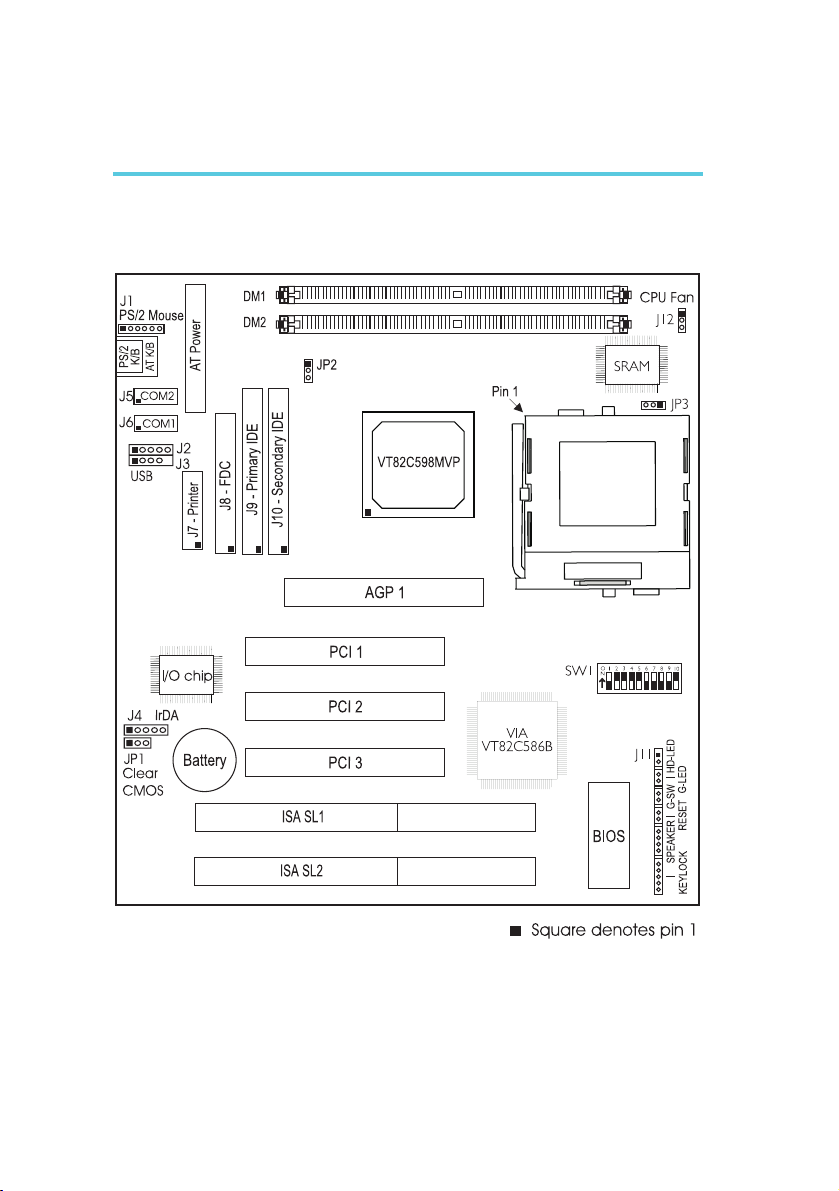
2.1 System Board Layout
Chapter 2 - Hardware Installation
Altri manuali per P5BV3+/e
2
Indice
Altri manuali DFI Scheda madre

DFI
DFI CS620-H310 Manuale utente

DFI
DFI AM36-EC Manuale utente

DFI
DFI SD330 Manuale utente

DFI
DFI NB72-SC Manuale utente

DFI
DFI SB332-C Manuale utente

DFI
DFI LanParty 925X-T2 Manuale utente

DFI
DFI HD630-H81 Manuale utente

DFI
DFI PS82-BC/BL Manuale utente

DFI
DFI FS053 Manuale utente

DFI
DFI G7S620-N Manuale utente
Manuali Scheda madre popolari di altre marche

Gigabyte
Gigabyte GA-9IVDT Manuale utente

Texas Instruments
Texas Instruments ADS8372EVM Manuale utente

Commell
Commell MS-C73 Manuale utente

IBT Technologies
IBT Technologies MB860 Manuale utente

Nvidia
Nvidia TEGRA DG-04927-001_V01 Manuale utente

Biostar
Biostar M7VIT Bravo Istruzioni per l'uso e l'installazione