Hach POLYMETRON 8810 ORP Manuale rapido

DOC024.98.93053
POLYMETRON Model
8810 ORP Analyzer
07/2017, Edition 11
Basic User Manual
Allgemeines Benutzerhandbuch
Manuel d'utilisation de base
Manual básico del usuario
Manuale di base per l'utente
Grundlæggende brugervejledning
Podstawowa instrukcja obsługi
Alapvető felhasználói kézikönyv
Manual de utilizare de bază

English..............................................................................................................................3
Deutsch.......................................................................................................................... 27
Français......................................................................................................................... 52
Español.......................................................................................................................... 77
Italiano.......................................................................................................................... 103
Dansk............................................................................................................................128
Polski............................................................................................................................ 152
Magyar......................................................................................................................... 177
Română....................................................................................................................... 202
2

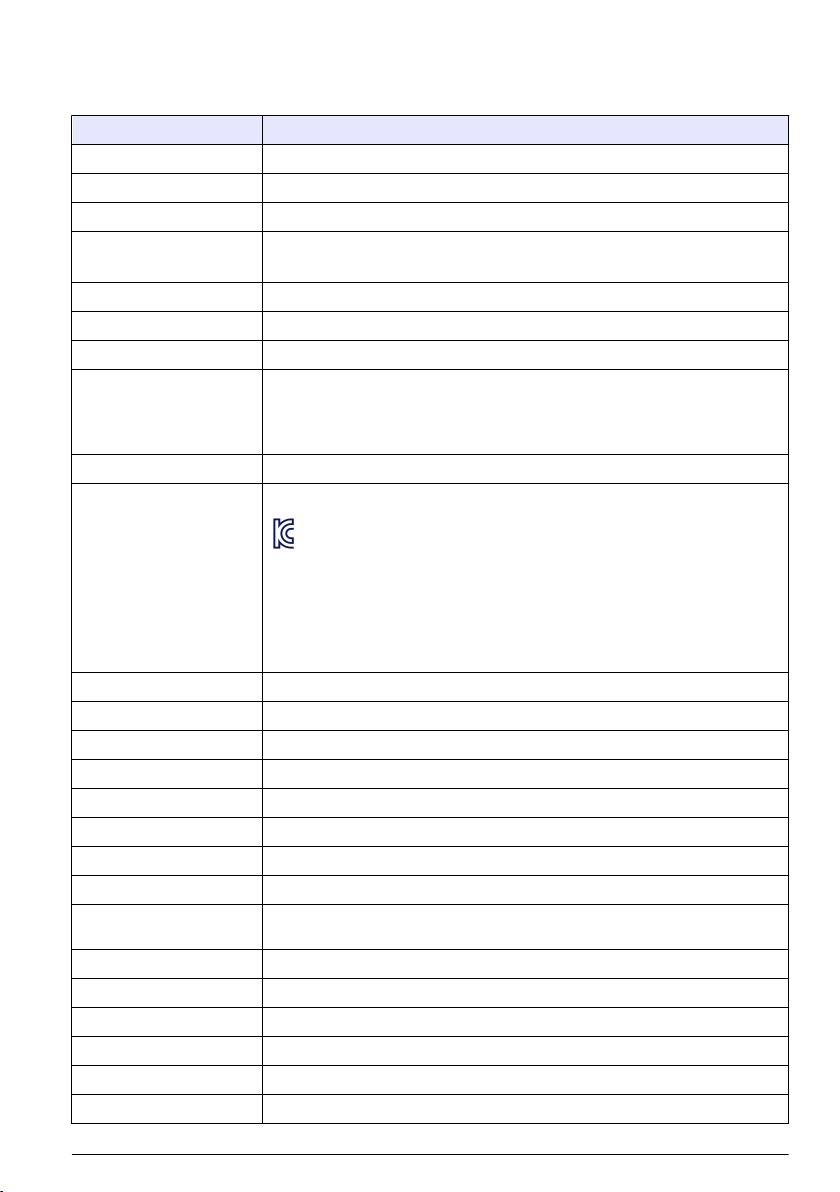
Specifications
Specifications are subject to change without notice.
Specification Details
Ambient temperature 5 - 40 °C (41 - 104 °F)
Relative humidity 10 to 80%
Operating altitude From 0 to 2,000 m. (6,550 ft.) above sea level
Mains power supply 110/220/240 VAC, 50/60 Hz, ± 10%
Fuses: 110 to 120V, T630mAL250V; 220V to 240V, T1.25AL250V
Max. consumption 110 VA
Overvoltage category 2 (according to standard EN 61010-1)
Pollution degree 2
CE compliance EN61326-1: EMC Directive
Note: This is a Class A product. In a domestic environment this product may cause radio
interference in which case the user may be required to take adequate measures.
EN61010-1: LVD Directive
ETL approved ETL, conforming to UL 61010-1 and CSA 22.2 No. 61010-1
Korean certification User Guidance for EMC Class A Equipment
업무용을 위한 EMC 등급 A 장치에 대한
사용자 지침
사용자안내문
A 급 기기 ( 업무용 방송통신기자재 )
이 기기는 업무용 (A 급 ) 전자파적합기기로서 판매자 또는 사용자는 이 점을 주의
하시기 바라며 , 가정외의 지역에서 사용하는 것을 목적으로 합니다.
Compressed air 4 - 7 bar, filtered and dried
Rinse water pressure 0.5 - 6 bar
Reagents 10 liter storage canister (supplied)
Analog outputs Number: 2; 0 - 20 or 4 - 20 linear programmable
Alarms 2 x Relay (concentration); 1 x Warning or System alarm
Exchangeable sensors ORP (Pt, Ag or selective electrode) + reference electrode
Temperature compensation Pt100
Level control Sample; Reagents; Calibration solution; Chemical cleaning
Pumps Peristaltic, micro piston, pulse or volumetric pumps for calibration and conditioning
reagents
Tubing Tygon®; Polyethylene
Reagent consumption Application specific
Titration time Application specific
Cycle time Programmable up to 999 minutes
Accuracy < ± 2 to 4% (application specific)
Reproducibility < ± 2 to 4% (application specific)
English 3

Specification Details
Sample lines 1
Sample temperature 0 - 50 °C (32 - 122 °F)
Sample pressure 0.5 - 6 bar
Sample flow rate 40 - 300 liters/hour
Sample volume/cycle 200 - 1000 mL (adjustable)
Panel mount 743 x 482 x 122 mm (H x W x D); < 20 kg
Cabinet (IP 54) 1900 x 600 x 400 mm (H x W x D); < 100 kg
Maximum sound power level ≤ 80 dBA
Additional information
Additional information is available on the manufacturer's website.
General information
In no event will the manufacturer be liable for direct, indirect, special, incidental or consequential
damages resulting from any defect or omission in this manual. The manufacturer reserves the right to
make changes in this manual and the products it describes at any time, without notice or obligation.
Revised editions are found on the manufacturer’s website.
Safety information
N O T I C E
The manufacturer is not responsible for any damages due to misapplication or misuse of this product including,
without limitation, direct, incidental and consequential damages, and disclaims such damages to the full extent
permitted under applicable law. The user is solely responsible to identify critical application risks and install
appropriate mechanisms to protect processes during a possible equipment malfunction.
Please read this entire manual before unpacking, setting up or operating this equipment. Pay
attention to all danger and caution statements. Failure to do so could result in serious injury to the
operator or damage to the equipment.
Make sure that the protection provided by this equipment is not impaired. Do not use or install this
equipment in any manner other than that specified in this manual.
Use of hazard information
D A N G E R
Indicates a potentially or imminently hazardous situation which, if not avoided, will result in death or serious injury.
WARNING
Indicates a potentially or imminently hazardous situation which, if not avoided, could result in death or serious
injury.
CAUTION
Indicates a potentially hazardous situation that may result in minor or moderate injury.
N O T I C E
Indicates a situation which, if not avoided, may cause damage to the instrument. Information that requires special
emphasis.
4 English

Precautionary labels
Read all labels and tags attached to the product. Personal injury or damage to the product could
occur if not observed. A symbol on the instrument is referenced in the manual with a precautionary
statement.
This symbol, when noted on a product, indicates a potential hazard which could cause serious
personal injury and/or death. The user should reference this instruction manual for operation and/or
safety information.
This symbol, when noted on a product enclosure or barrier, indicates that a risk of electrical shock
and/or electrocution exists and indicates that only individuals qualified to work with hazardous
voltages should open the enclosure or remove the barrier.
This symbol identifies the presence of a strong corrosive or other hazardous substance and a risk of
chemical harm. Only individuals qualified and trained to work with chemicals should handle
chemicals or perform maintenance on chemical delivery systems associated with the equipment.
Products marked with this symbol indicates a risk of finger pinch.
This symbol, when noted on the product, indicates the presence of devices sensitive to electrostatic
discharge and indicates that care must be taken to prevent damage to them.
This symbol, when noted on a product, indicates the instrument is connected to alternate current.
Electrical equipment marked with this symbol may not be disposed of in European domestic or
public disposal systems. Return old or end-of-life equipment to the manufacturer for disposal at no
charge to the user.
Products marked with this symbol indicates that the product contains toxic or hazardous substances
or elements. The number inside the symbol indicates the environmental protection use period in
years.
Products marked with this symbol indicates that the product conforms to relevant South Korean
EMC standards.
This symbol, if noted on the product, indicates the need for protective eye wear.
This symbol indicates the need for protective hand wear
Analyzer overview
The analyzer POLYMETRON Model 8810 ISE is a modular system used for ISE measurements in a
wide range of industrial on–line applications. The analyzer automatically collects on–line samples,
adds the applicable chemicals (such as reagents, buffers, masking agents) and completes the
analysis. The analyzer applies for heavy–duty, industrial on–line environments.
There is a standard panel-mounted version. A wall–mounted polyester cabinet and a free–standing
cabinet to house the analyzer with the necessary reagents are also available. Liquid modules are
installed below the electronic control unit for protection, easy access and service tasks. The hinged
panel tilts forward to access to the rear. Refer to Figure 1 for product overview.
English 5

Figure 1 Front and rear view (panel mount illustrated)
1 Electronic unit 7 Space for additional pump 13 Power supply connection
2 Measurement chamber (see
Figure 2 on page 7)
8 Input/Output connections 14 Rinse valve
3 19 inch panel 9 Reagent pump cover 15 Sample valve
4 Main switch 10 Compressed air valve 16 Reagent canister
5 Peristaltic pump 11 Electronic unit (rear) 17 Level detector
6 Micro piston pump 12 Power supply box 18 Tube weight
Measurement chamber
Refer to Figure 2 for measurement chamber components.
6 English

Figure 2 Measurement chamber components
1 Stirrer motor 4 Electrode cable 7 Drain tubing
2 Measurement chamber cover 5 Siphon 8 Overflow pipe
3 Electrode 6 Drain valve 9 Threaded fittings
Installation
D A N G E R
Multiple hazards. Only qualified personnel must conduct the tasks described in this section of the document.
Mains power should only be connected once installation has been completed and checked.
Mechanical installation
CAUTION
Multiple hazards. Only qualified personnel must conduct the tasks described in this section of the document.
Mounting the analyzer
N O T I C E
The analyzer should be mounted as near as possible to the sample inlet, and should be located in an easily
accessible area to facilitate periodic checking of the sample flow rate, and for regular maintenance. In an
environmental enclosure that supplies protection from precipitation and direct sunlight, good ventilation and
temperature control if installed outdoors. Wherever the analyzer is to be mounted, it is important to note that it
must be placed in an upright position with the electronic unit (No. 1 in Figure 1 on page 6) at the top. It is
recommended to use a spirit level to ensure that the analyzer is correctly positioned and not leaning to one side
or forward. This is essential to guarantee the accuracy of the analyzer.
Panel mounting
This model is designed as a 19 inch (48.26 cm) rack system. Delivery includes six M6 screws for
mounting the panel onto a rack. All internal connections are factory prepared. Canisters for reagents
can be fitted onto an optional storage tray.
Wall mounting
All internal connections are factory prepared. Cables and tubing are threaded through the cable
glands located on the bottom right side of the cabinet. Canisters for reagents can be fitted onto an
optional storage tray.
English 7

To open the cabinet, push the handle lid upwards, press the lock button, then open the door with a
45° left turn of the handle. To access the cabinet interior, remove the knurled screw on the right side
of the panel and carefully turn the panel sideways to the left taking care not to squeeze any tubing.
Hydraulic connections
D A N G E R
Chemical or biological hazards. If this instrument is used to monitor a treatment process and/or chemical
feed system for which there are regulatory limits and monitoring requirements related to public health,
public safety, food or beverage manufacture or processing, it is the responsibility of the user of this
instrument to know and abide by any applicable regulation and to have sufficient and appropriate
mechanisms in place for compliance with applicable regulations in the event of malfunction of the
instrument.
Sample
The sample enters the analyzer through a 12/14 mm hose (No. 15 in Figure 1 on page 6). Flow rate
should be between 40 and 300 liters/hour under a pressure of 0.5 to 6 bar.
Rinse water
The rinse water enters the analyzer through a 6/8 mm hose (No. 14 in Figure 1 on page 6). Water
pressure must be between 1 and 6 bar.
Reagents
The reagent containers are connected to the pumps according to the instructions corresponding to
the application.
Drain
The analyzed sample is drained at atmospheric pressure through a 12 mm hose (No. 7 in Figure 2
on page 7) delivered with the analyzer for initial startup. Make sure that no backflow occurs in this
tube or the other two drainage tubes (overflow No. 8 in Figure 2 on page 7 and siphon No. 5 in
Figure 2 on page 7).
Note: With the cabinet model, all three tubes drain into a receptacle with a 50 mm outlet.
Compressed air connection
The analyzer requires dry and filtered compressed air at a pressure of 4 to 7 bar. It should be
supplied to the valve (No. 10 in Figure 1 on page 6) using a suitable plastic tube of 4/6 mm diameter.
Electrical installation
D A N G E R
Multiple hazards. Only qualified personnel must conduct the tasks described in this section of the document.
D A N G E R
Electrocution hazard. Always make sure the analyzer is turned off and power is disconnected before making
electrical connections.
D A N G E R
Electrocution hazard. Protective Earth Ground (PE) connection is required.
Wiring procedures and cable preparation
The following procedure must be followed for all cables connecting peripherals (e.g. pumps, level
detectors, alarms, etc.) with the electronic unit (No. 11 in Figure 1 on page 6). Some cables will be
supplied ready for use. Other cables which are supplied locally by the user must be prepared
according to the procedure explained in Cable preparation on page 9 before connecting to the
electronic unit.
8 English

Cable preparation
WARNING
To conform with security standards and to respect the EMC compliancy of the analyzer, this procedure must be
followed for all user supplied cables before connecting them to the electronic unit of the analyzer.
Materials required:
• Shielded cable (diameter minimum 4.5 mm - maximum 6 mm) with 2 or 3 wires depending on
function (RS232 = 3 wires, Alarm = 2 wires, etc.)
• Metal cable gland
• Grounding ferrule
• 2 or 3 protective plugs for the exposed wires
• Clamp for the grounding ferrule
• Crimping pliers for the protective plugs
English 9

1. Place the nut and metal seal of
the cable gland onto the shielded
cable.
2. Remove 8 cm of the outer
cabling to reveal the braided
shielding.
3. Remove all but 12 mm of the
shielding to reveal the interior
wires, then roll the remainder of
the shielding back over the cable.
4. Insert the grounding ferrule over
the shielding.
5. Use the clamp to fix the ferrule
securely to the cable.
6. Remove 5 mm of the external
insulation of the wires.
7. Use the crimping pliers to attach
the protective plugs to the wires.
8. Bring the metal shield up over
the ferrule and lock the two
together making sure the ferrule is
not exposed at the cable end of
the shield. Bring up the nut to
cover the shield.
9. Pass the threaded part of the
cable gland over the wires and
screw into the nut on the cable.
The cable is now ready to be
connected following the procedure
described in Connecting
peripherals on page 10.
Connecting peripherals
WARNING
To conform with security standards and to respect the EMC compliancy of the analyzer, this procedure must be
followed for connecting all peripherals to the electronic unit of the analyzer.
10 English
Indice
Lingue:
Altri manuali Hach Strumento di misura

Hach
Hach ANATEL PAT700 Manuale utente

Hach
Hach Accu4 Manuale utente

Hach
Hach orbisphere C1100 Manuale utente

Hach
Hach HQ11d Manuale utente

Hach
Hach PAT700 DS Manuale rapido

Hach
Hach CLF10sc Manuale utente

Hach
Hach CA610 Manuale utente

Hach
Hach POLYMETRON 9125 Manuale utente

Hach
Hach Polymetron 9610sc Istruzioni operative

Hach
Hach DR300 Manuale utente

Hach
Hach ORBISPHERE 3654 Manuale utente

Hach
Hach DR/2010 Manuale utente

Hach
Hach DR 1900 Manuale rapido

Hach
Hach sensION3 Manuale utente

Hach
Hach DR 1900 Manuale rapido

Hach
Hach LDO10101 Manuale utente

Hach
Hach lange dr 1900 Manuale utente

Hach
Hach LANGE Pocket Colorimeter II Manuale utente

Hach
Hach DR 2800 Manuale utente

Hach
Hach TL2350 Manuale rapido