HBM AED9101C-Z2/22 Aggiornamento firmware

A2967−1.0 en/de/fr
Digital transducer
Electronics
Digitale Aufnehmer-
elektronik
Électronique numérique
de capteur
AED9101C-Z2/22
Safety Instructions
Sicherheitshinweise
Consignes de sécurité

English Page 3 −18. . . . . . . . . . . . . . . . . . . . . . . . . . . . . . . . . . . . . . . . . . . . . . . . .
Deutsch Seite 19 −34. . . . . . . . . . . . . . . . . . . . . . . . . . . . . . . . . . . . . . . . . . . . . . .
Français Page 35 −49. . . . . . . . . . . . . . . . . . . . . . . . . . . . . . . . . . . . . . . . . . . . . . .

3
AED9101C-Z2/22
A2967−1.0 en/de/fr HBM
Contents Page
English
1 Introduction 4. . . . . . . . . . . . . . . . . . . . . . . . . . . . . . . . . . . . . . . . . . . . . . . . .
2 Warnings and symbols used 7. . . . . . . . . . . . . . . . . . . . . . . . . . . . . . . . . .
3 Special features 8. . . . . . . . . . . . . . . . . . . . . . . . . . . . . . . . . . . . . . . . . . . . . .
4 Field of application 8. . . . . . . . . . . . . . . . . . . . . . . . . . . . . . . . . . . . . . . . . . .
5 Mechanical construction 9. . . . . . . . . . . . . . . . . . . . . . . . . . . . . . . . . . . . . .
6 Mounting 10. . . . . . . . . . . . . . . . . . . . . . . . . . . . . . . . . . . . . . . . . . . . . . . . . . . .
7 Preparing the cables 12. . . . . . . . . . . . . . . . . . . . . . . . . . . . . . . . . . . . . . . . .
8 Connection 13. . . . . . . . . . . . . . . . . . . . . . . . . . . . . . . . . . . . . . . . . . . . . . . . . .
9 Specifications 15. . . . . . . . . . . . . . . . . . . . . . . . . . . . . . . . . . . . . . . . . . . . . . .
10 Declaration of Conformity 16. . . . . . . . . . . . . . . . . . . . . . . . . . . . . . . . . . . .
Further information can be found in the AED9101C documentation.

AED9101C-Z2/22
4
A2967−1.0 en/de/frHBM
1 Introduction
Designated use
The AED9101C-Z2 / 22 digital transducer electronics module comprises the
AED9101C basic device and the AD103C amplifier board.
The electronics are a resource that can be used in the potentially explosive
atmospheres of either Zone 2 or Zone 22 −but not in both zones simultan-
eously −for connecting strain gage load cells with a total bridge resist-
ancew80 Wand for connecting a digital processing device with an RS-232,
RS-422 or RS-485 interface. The degree of protection is “nA” per EN
60079-15 or “tD” per EN 61241-1, and is based on the IP65 sealing protec-
tion of the housing.
The device must be protected against mechanical damage.
In the interests of safety, the transducer electronics should only be operated
as described in the Mounting Instructions. It is also essential to comply with
the legal and safety requirements for the application concerned during use.
The same applies to the use of accessories.
If applicable, follow the national legal and safety requirements for using elec-
tronics in potentially explosive atmospheres.
Transducer electronics are not a safety element within the meaning of desig-
nated use. For safe and trouble-free operation, these transducer electronics
must not only be correctly transported and expertly stored, sited and installed
but must also be carefully operated and maintained.
Notes for installation and operation
The amplifier board must only be operated in an enclosed housing. To main-
tain the IP65 degree of protection, all unused cable glands must be sealed
with the plugs provided. The associated swivel nuts must also be tightened, to
prevent moisture and dust penetration.
Use only cables that fall within the 5 mm to 9 mm diameter range stated by
the manufacturer of the M16 x 1.5 screwed cable glands.
The housing should only be opened once it is certain that the atmosphere is
not potentially explosive, or if the electrical equipment inside the housing has
been disconnected from the mains for at least five minutes and is
voltage-free.
Make sure that the rated voltage of the equipment does not exceed 30 V DC,
and that the rated voltage is not exceeded by more than 40% by the effect of
transients. Transducer electronics should be included in local potential equal-
ization.

5
AED9101C-Z2/22
A2967−1.0 en/de/fr HBM
Maintenance and servicing
The provisions of EN60079-17 must be met for maintenance and servicing or
inspection. It is particularly important to maintain the components pivotal to
the type of protection.
The housing should only be opened for maintenance once it is certain that the
atmosphere is not potentially explosive, or if the electrical equipment inside
the housing has been disconnected from the supply voltage and is
voltage-free.
Regularly check the condition of the seals. When replacing cable entries and
vent plugs, make sure that they are properly sealed.
Changes or modifications must not be made to devices intended for use in
potentially explosive atmospheres.
Should it no longer be possible to guarantee risk-free operation, disconnect
the device from the operating voltage and secure it to prevent further use.
General dangers of failing to follow the safety instructions
The transducer electronics are state of the art and reliable. Electronics can
give rise to residual dangers if they are inappropriately installed and operated
by untrained personnel.
Everyone involved with the installation, commissioning, maintenance or repair
of these transducer electronics must have read and understood the Operating
Manual and in particular the technical safety instructions.
Residual dangers
The scope of supply and performance of the transducer electronics covers only
a small area of connection technique. In addition, equipment planners, installers
and operators should plan, implement and respond to the safety engineering
considerations of the connection technique in such a way as to minimize
remaining dangers. On-site regulations must be complied with at all times.
There must be reference to the residual dangers associated with the connec-
tion technique.
Qualified personnel
Qualified personnel means persons entrusted with siting, mounting, starting up
and operating the product, who possess the appropriate qualifications for their
function.
Transducer electronics are only to be deployed by qualified personnel strictly in
accordance with the technical data and with the safety rules and regulations
which follow. The same applies to the use of accessories.

AED9101C-Z2/22
6
A2967−1.0 en/de/frHBM
Conditions at the place of installation
Do not allow the transducer electronics to become dirty or damp.
Maintenance
Transducer electronics are implemented in degree of protection IP65
(dust-tight, protected against water jets). Make regular checks to ensure the
tightness and efficiency of the rubber cover seal and the screw fittings.
Material-related application limitations
Note whether in your field of application there are certain substances that on
their own or in combination with other substances, can also attack aluminum
alloys or plastics. If this is the case, the operator must provide adequate
means of protection. The additional means of protection must be verified by
regularly checking their effectiveness.
Accident prevention
The prevailing accident prevention regulations must be observed.
Unauthorized conversions and modifications are prohibited
The device must not be modified from the design or safety engineering point
of view without HBM’s express agreement. Any modification shall exclude all
liability by HBM for any damage resulting therefrom.
It is strictly forbidden to carry out any repairs and soldering work on the
motherboards or to replace any components. Repairs must only be under-
taken by persons who are authorized to do so by HBM.
During installation and when connecting the cables, take action to prevent
electrostatic discharge as this may damage the connected electronics.
All the interconnecting cables must be shielded cables. The shield must be
connected extensively to ground on both sides.

7
AED9101C-Z2/22
A2967−1.0 en/de/fr HBM
2 Warnings and symbols used
This manual uses the symbols described below to draw attention to residual
dangers.
The marking below draws your attention to a potentially dangerous situation in
which failure to comply with safety requirements could result in slight or
moderate physical injury.
CAUTION
Description of a potentially dangerous situation.
Measures to avoid/avert the danger.
The marking below draws your attention to a situation in which failure to
comply with safety requirements could lead to damage to property.
NOTE
Description of a situation that could lead to damage to property.
The marking below draws your attention to important information about the
product or about handling the product.
Important
Important information
The marking below contains application tips or other information that is useful
to you.

AED9101C-Z2/22
8
A2967−1.0 en/de/frHBM
3 Special features
Equipment group II, equipment category 3
−Connecting load cells in parallel in a six-wire circuit with a minimum parallel
bridge resistance of y80 Ω.
−HBM’s shielding design provides EMC-proofing as per EN 45 501
−Degree of protection IP65 per EN 60 529
Transducer electronics also allow the shielding to be connected convention-
ally by means of the screen strands. With this method, EMC-proofing under
EN 45 501 is restricted, which could lead to measurement errors when there
are electromagnetic interference fields.
4 Field of application
Transducer electronics can be deployed in Zone 2 or in Zone 22:
Permissible ambient temperature range −20 °C pTap40 °C
Zone 2: II 3 G Ex nA II C T4
Type of protection: “protected by the housing”
Zone 22: II 3 D Ex tD A22 IP65 T 52 5C
(air/dust mixtures with non-conductive dust)
Type of protection: “protected by the housing”

9
AED9101C-Z2/22
A2967−1.0 en/de/fr HBM
5 Mechanical construction
The basic device extends the functionality of AD amplifier boards and
provides:
•mechanical protection (IP65)
•the voltage supply for the amplifier motherboard and transducer excitation
•a total transducer bridge resistance y80 Ω
•a choice of RS-422, RS-485 and RS-232 serial interfaces
•an EMC-tested module
The amplifier motherboard is designed as a plug-in board that is plugged into
the motherboard of the basic device via a 25-pin D-connector. The basic
device contains the terminals for the transducer, power supply and PC
connections, the slide switch for interface selection and the voltage stabilizer.
The connection cables exit the housing via PG cable glands on the side.
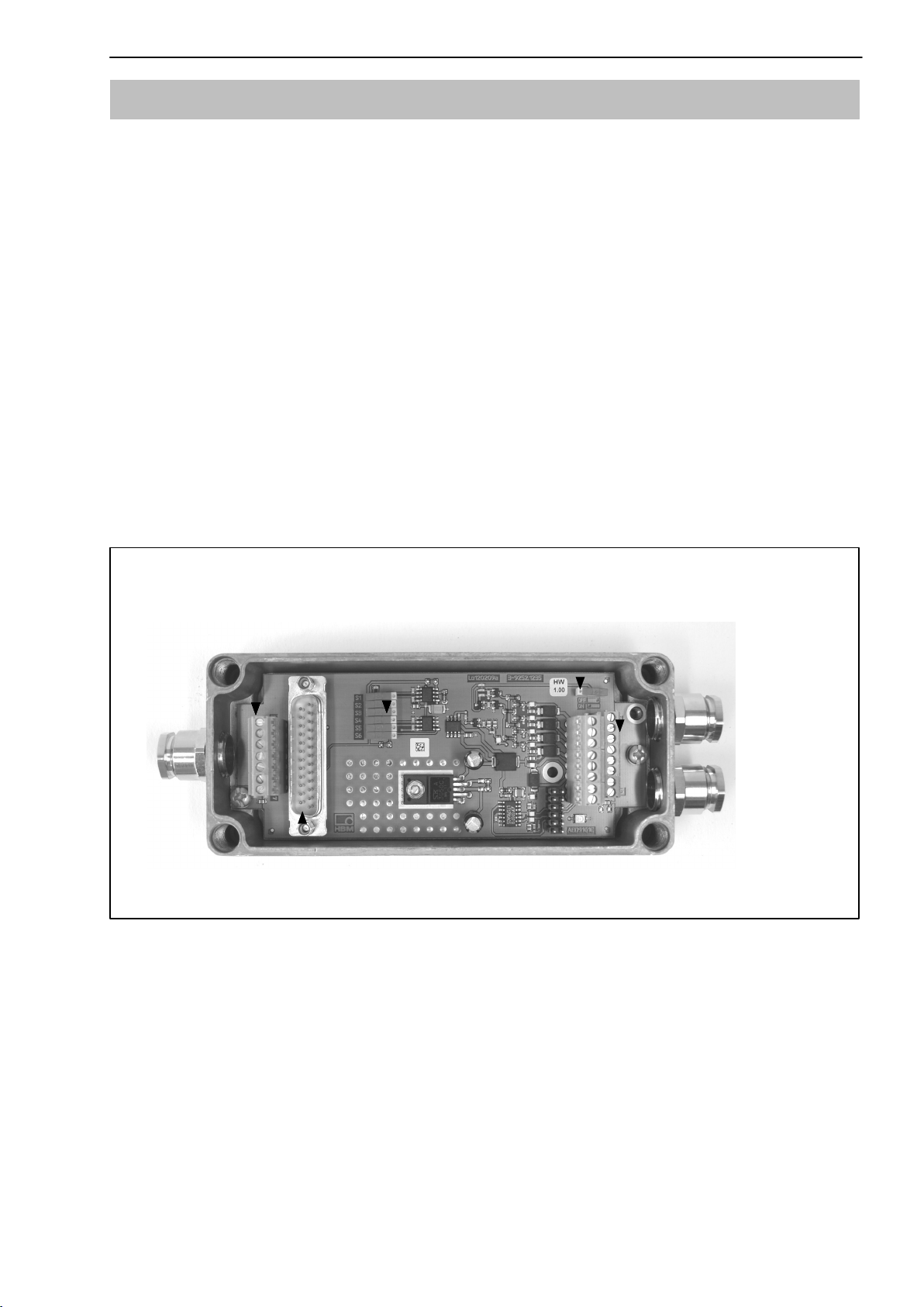
Transducer
connection Interface
settings
RS-485
bus termination
Interface, voltage supply,
trigger input, diagnosis
AD103C amplifier connection
Fig. 5.1: Mechanical construction (AED9101C housing without amplifier board)

AED9101C-Z2/22
10
A2967−1.0 en/de/frHBM
6 Mounting
In the preferred mounting position, there is a downward loop to the cables
(drip loop) before they enter the transducer electronics. This makes it more
difficult for moisture to get in.
Transducer electronics Moisture
Connection cable
Fig. 6.1: Installing the connection cable
CAUTION
If the mounting screws in the cover are not correctly tightened (not
enough or too much), the specified IP degree of protection and EMC
protection are at risk, and as a result, explosion protection may be lost,
or there may be measurement errors.
Tighten the screws with a torque of 3 N@m in the sequence described in
Fig. 6.2.
Indice
Lingue:
Altri manuali HBM Trasduttore