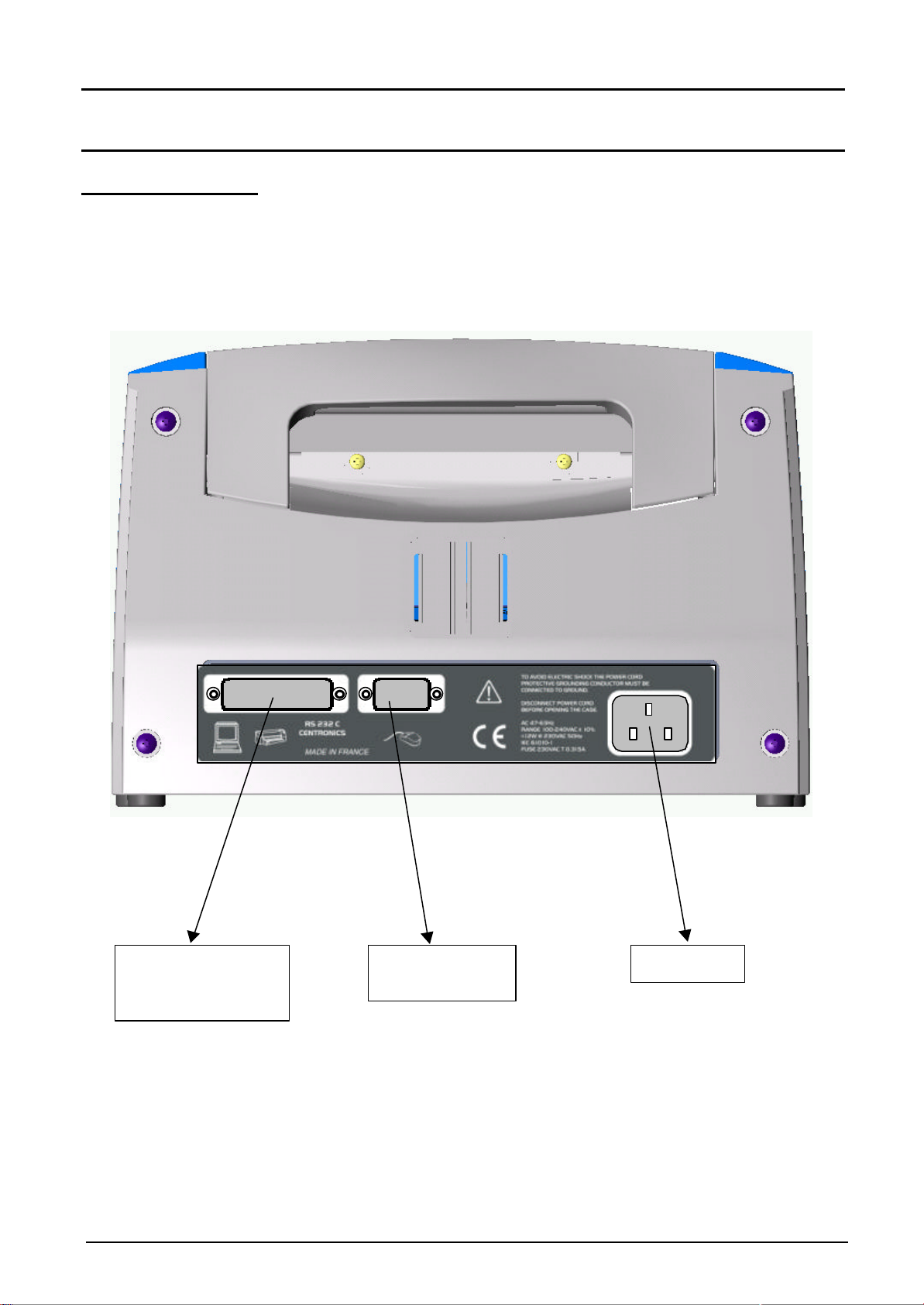
General instructions
I - 4Two-channel digital oscilloscope
General instructions
Introduction You have just acquired a two-channel digital oscilloscope. It also features a
«harmonic analyser» mode and a « recorder» mode (pending).
Congratulations for your choice and thank you for your trust in the quality of
our products.
This instrument conforms to safety standard NF EN 61010-1 (2001), single
insulation, relative to electronic measurement instruments.
To obtain optimum service, read these instructions with care and comply with
the precautions for use.
Failure to comply with these warnings and/or user instructions is liable to
cause damage to the equipment and/or its components. This could be
dangerous to the user.
Precautions and
safety measures •This instrument has been designed for use:
- indoors,
- in a pollution degree 2 environment,
- at an altitude of less than 2000 m,
- at a temperature included between 0°C and 40°C
- with relative humidity of less than 80% to 40°C.
It can be used for measurements on circuits at 150V CAT II (300V CAT I, 300V
CAT II), relative to ground and can be supplied by a 240V CAT II network.
definition of
installation
categories
(cf. IEC 664-1)
CAT I: CAT I circuits are protected by devices designed to minimize transient
overvoltages at a low level.
E.g.: protected electronic circuits
CAT II : CAT II circuits are domestic or similar equipment power supply circuits
that can include average value transient overvoltages.
E.g.: power supply to domestic appliances and portable tools.
CAT III : CAT III circuits are circuits for power equipment power supplies which
may include high transient overvoltages.
E.g.: machine or industrial apparatus power supply.
CAT IV : CAT IV circuits are circuits that can include very high transient
overvoltages.
E.g.: energy inputs
before use •Comply with environment storage conditions.
•Make sure that the three-wire phase/neutral/ground power supply cord
supplied with the unit is in suitable condition. It conforms to standard NF
EN 61010-1 (2001) and must be connected to the instrument on the one
hand, and to the network on the other (variation from 100 to 240 VAC).
during
use •Read carefully all the notes preceded by the symbol .
•Connect the instrument to an outlet with a ground pin.
•The instrument power supply has automatically reset electric protection
operating after the fault has been eliminated.
•Be sure not to obstruct the aeration points.
•As a safety measure, use only suitable cords and accessories supplied with
the instrument or type approved by the manufacturer.
•When the instrument is connected to the measurement circuits, never
touch an unused terminal.