1-1.
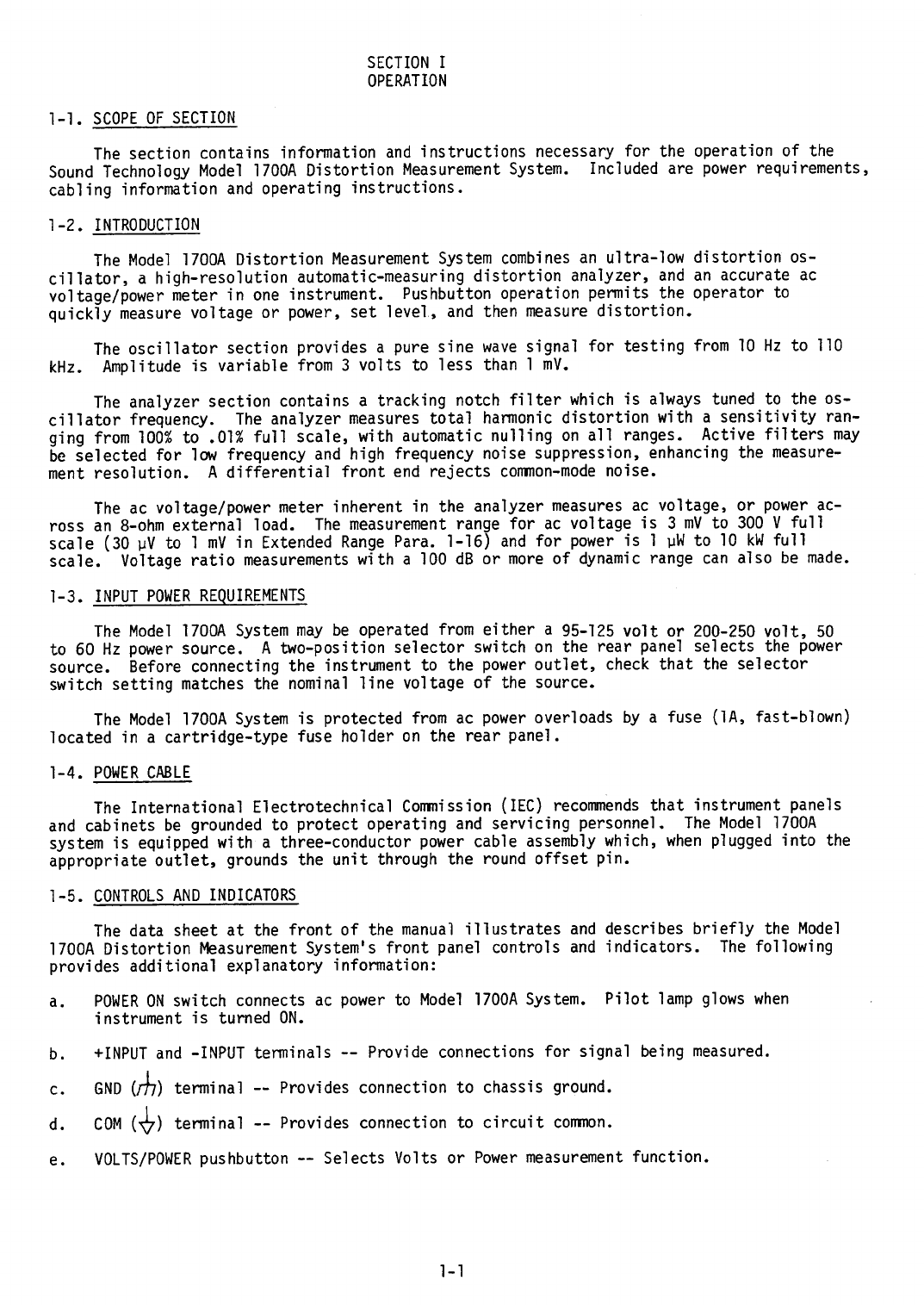
SCOPE
OF
SECTION
SECTION
I
OPERATION
The
section contains information
and
instructions
necessary for the operation of the
Sound
Technology
Model
1700A
Distortion
Measurement
System. Included are
power
requirements,
cabling information
and
operating
instructions.
1-2.
INTRODUCTION
The
Model
1700A
Distortion
Measurement
System
combines
an
ultra-low
distortion
os-
cillator,
a high-resolution automatic-measuring
distortion
analyzer,
and
an
accurate
ac
voltage/power meter in
one
instrument. Pushbutton operation permits the operator to
quickly
measure
voltage
or
power,
set
level,
and
then
measure
distortion.
The
oscillator
section provides a pure
sine
wave
signal for
testing
from
10
Hz
to
110
kHz.
Amplitude
is
variable
from
3 volts to
less
than 1
mV.
The
analyzer section contains a tracking notch
filter
which
is
always tuned to the os-
cillator
frequency.
The
analyzer measures
total
harmonic
distortion
with a
sensitivity
ran-
ging
from
100%
to
.01%
full
scale,
with automatic nulling
on
all
ranges. Active
filters
may
be
selected
for
low
frequency
and
high frequency noise suppression, enhancing the measure-
ment
resolution.
A
differential
front
end
rejects
common-mode
noise.
The
ac
voltage/power meter inherent in the analyzer measures
ac
voltage,
or
power
ac-
ross
an
8-ohm
external load.
The
measurement
range for
ac
voltage
is
3
mV
to
300
V
full
scale
(30
~V
to 1
mV
in Extended
Range
Para. 1-16)
and
for
power
is
1
~W
to
10
kW
full
scale.
Voltage
ratio
measurements with a
100
dB
or
more
of
dynamic
range
can
also
be
made.
1-3.
INPUT
POWER
REQUIREMENTS
The
Model
1700A
System
may
be
operated
from
either
a 95-125
volt
or
200-250
volt
50
to 60Hz
power
source. A two-position
selector
switch
on
the
rear
panel
selects
the
power
source. Before connecting the instrument to the
power
outlet,
check
that
the
selector
switch
setting
matches the
nominal
line
voltage
of
the source.
The
Model
1700A
System
is
protected
from
ac
power
overloads
by
a fuse (lA, fast-blown)
located in a
cartridge-type
fuse holder
on
the
rear
panel.
1-4.
POWER
CABLE
The
International Electrotechnical
Commission
(IEC)
recommends
that
instrument panels
and
cabinets
be
grounded to
protect
operating
and
servicing personnel.
The
Model
1700A
system
is
equipped with a three-conductor
power
cable assembly which,
when
plugged into the
appropriate
outlet,
grounds the
unit
through the
round
offset
pin.
1-5.
CONTROLS
AND
INDICATORS
The
data sheet
at
the
front
of
the
manual
illustrates
and
describes
briefly
the
Model
1700A
Distortion
Measurement
System's front panel controls
and
indicators.
The
following
provides additional explanatory information:
a.
POWER
ON
switch connects
ac
power
to
Model
1700A
System.
Pilot
lamp
glows
when
instrument
is
turned
ON.
b.
+INPUT
and
-INPUT
terminals
--
Provide connections
for
signal being measured.
c.
GND
(rfJ)
terminal Provides connection
to
chassis ground.
d.
c~
(~)
terminal Provides connection to
circuit
common.
e.
VOLTS/POWER
pushbutton--
Selects Volts
or
Power
measurement
function.
1-1