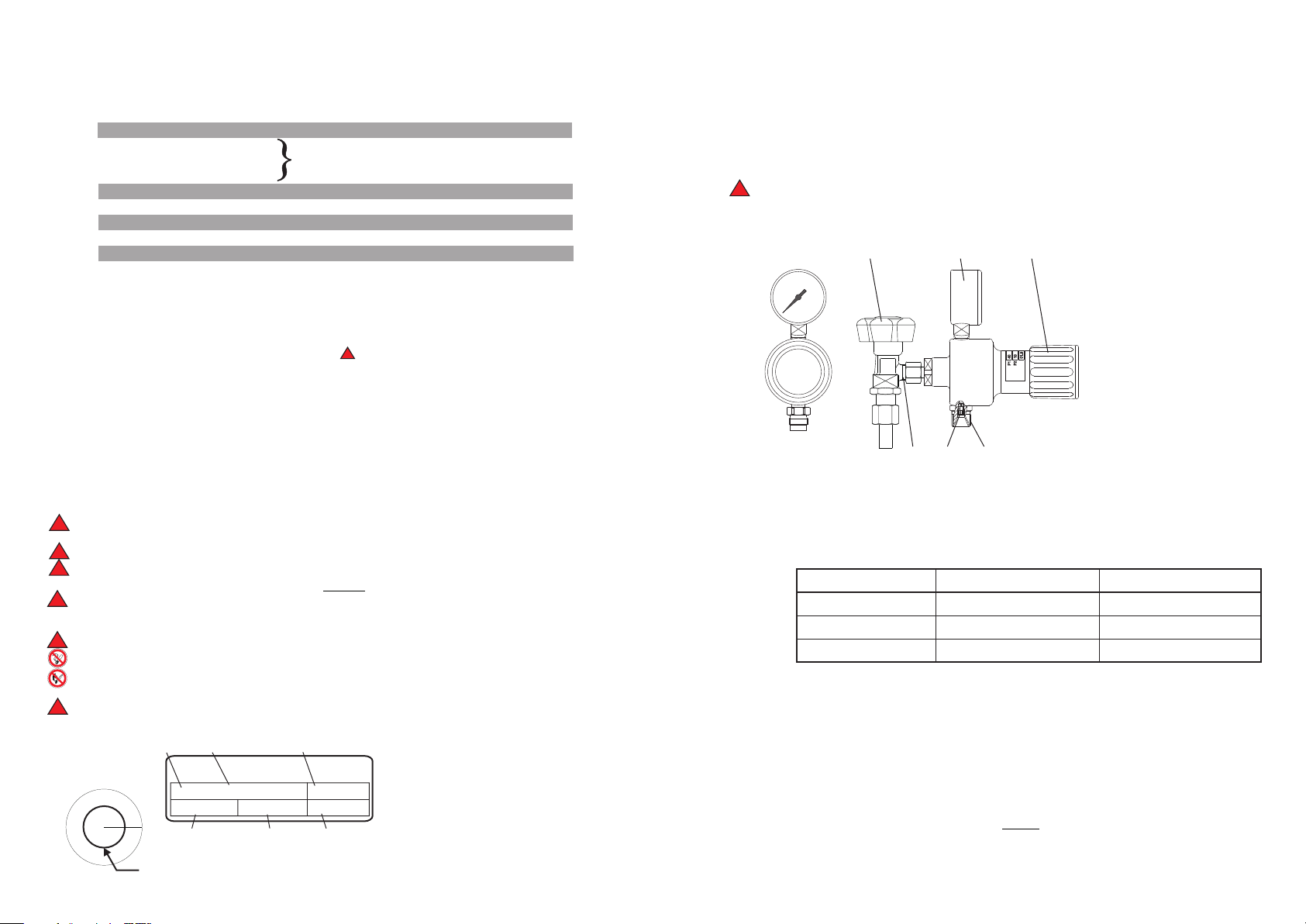
3. Labelling
4.3 Connect the pressure regulator to the closed gas cylinder valve (1). Tighten it gas-tight
with a suitable spanner.
4.4 Corresponddence between flow rate and orifice-diameter:
Inspection stamp confirming successfully passed test
1 Pressuere regulator for tapping
points TORNADO 2000
2 Gas type
3 Ordering-no.
4 Max. inlet pressure
5 Flow rate indication
6 Date of manufacture
ET 2000 - Ar
P1: 40 bar P2: 16 l/min
717. …
0500
1 2 3
456
!
1 3 4
25
6
1.3 Technical data
Indication range [l/min] Gas type Orifice diameter [mm]
up to 16
up to 30
up to 50
Argon, CO2
Mitrogen-hydrogen 80/20
0,55
0,75
0,85
Argon, Co2
The pressure regulator TORNADO 2000 conforms to the latest standard DIN/EN/ISO 2503
For special versions, this standard is taken into account as appropriate.
4. Start-up
4.1 Before starting read the specifications of this instruction for use and observe it while
working.
4.2 Check, that the cylinder valve thread, the pressure regulator connector and the
connection seals are without any damage (blow through if nessesary).
Do not use the pressure regulator if damaged.
1 Shut-off valve
2 Shut-off valve
connection
3 Pressure gauge
conform
to DIN/EN 562
4 Hand knob
5 Hose tail conform to
DIN/EN 560
6 Throttle/ orifice plate
4.5 The pressure regulator for gas cylinder contains an inserted orifice plate (6). Check if
an other orifice plate is installed in your system. In this case it has to be removed,
because this orifice plate isn’t adapted to the pressure regulator.
4.6 Adjustment of flow rate
Release the positioning spring with hand knob (4); first close shut-off valve at the
consumer unit; open shut-off valve (1) slowly (High pressure gauge 3 indicate cylinder
pressure); adjust required outlet pressure with hand knob (4). Open slightly shut-off
valve at the consumer unit. Correct pressure setting in case of a decrease of pressure.
2. Safety instructions
Do not connect the pressure regulators for tapping points to a gas cylinder.
2.1 All items of informations marked with are valid as special safety instructions.
2.2 These pressure regulators adhere to state-of-the-art technology and
to the demands of the exsiting standards and regulations.
2.3 Changes or modifications are not allowed to be made to the pressure regulator
without the prior consent of the manufacturer.
2.4 The equipment must be operated by suitable trained personnel only.
2.5 The result of improper handling and improper use as intended can involve risks
for the user and other persons as well as damage to the device.
2.6 Regulations to be adhered to:
- BGV A1 (VBG 1), “General Specifications”
- BGV D1 (VBG 15), “Welding, Cutting and Related Procedures “
Special attention has to be paid to the country specific laws, regulations and
procedures concerning the use of this type of equipment.
2.7 Use only for gas types the pressure regulator is labelled for (see item 3).
2.8 Do not use at temperatures below -30°C or above +60°C.
2.9 The valve has always to be opened slowly!
2.10 All parts coming into contact with oxygen must be kept in oil-free and grease-
free condition.
Fire or explosion hazard!
2.11 Smoking or open fire (e.g. candles) in the vicinity of the gas supply system is
strictly prohibited.
Fire and explosion hazard!
2.12
2.13 Protect gas cylinder against falling.
!
!
!
!
!
!
!
Inlet pressure: max. 40 bar
Indicating range: 16 l/min
s. name plate
30 l/min
Materials: - Body: Brass
- Diaphragms: EPDM
- Seat sealing: EPDM
Weight: 1,6 kg
Tightness: inside and outside:
1 x 10⁻³ mbar l/sec
-2- -3-


