
Tecfluid FLOMID Series Manuale utente
R-MI-FIMX4 Rev.: 2 English version
Series FLOMID
Sensor FLOMID-FX
Converter MX4
Instructions manual
The art of measuring

2
Thank you for choosing a product from Tecfluid S.A.
This instruction manual allows the installation, configuration,
programming and maintenance. It is recommended to read it before
using the equipment.
• This document shall not be copied or disclosed in whole or in any
part by any means, without the written permission of Tecfluid S.A.
• Tecfluid S.A. reserve the right to make changes as deemed
necessary at any time and without notice, in order to improve the
quality and safety, with no obligation to update this manual.
• Make sure this manual goes to the end user.
• Keep this manual in a place where you can find it when you need
it.
• In case of loss, ask for a new manual or download it directly from
our website www.tecfluid.com Downloads section.
• Any deviation from the procedures described in this instruction
manual, may cause user safety risks, damage of the unit or cause
errors in the equipment performance.
• Do not modify the equipment without permission. Tecfluid S.A. are
not responsible for any problems caused by a change not
allowed. If you need to modify the equipment for any reason,
please contact us in advance.
PREFACE
WARNINGS

3
TABLE OF CONTENTS
FLOMID-FX SENSOR
1 WORKING PRINCIPLE ................................................................... 6
2 RECEPTION .................................................................................. 6
2.1 Unpacking .......................................................................... 6
2.2 Storage temperatures ......................................................... 6
3 HANDLING ................................................................................... 7
4 INSTALLATION ............................................................................. 7
4.1 Sensor position .................................................................. 8
4.2 Straight pipe sections .......................................................... 8
4.2.1 Mixtures ................................................................ 9
4.3 Valves ............................................................................... 9
4.4 Pumps ................................................................................ 9
4.5 Aeration ............................................................................. 10
4.6 Reduction of DN ................................................................. 10
4.7 Vibrations ............................................................................ 10
4.8 Magnetic fields ................................................................... 11
4.9 Temperature ...................................................................... 11
5 MOUNTING .................................................................................. 12
5.1 Parallelism .......................................................................... 12
5.2 Gasket position .................................................................. 12
5.3 Sensor earth connection ...................................................... 13
5.4 Tightening torque ................................................................ 14
6 MAINTENANCE ............................................................................ 14
MX4 CONVERTER
1 INTRODUCTION ........................................................................... 15
2 INSTALLATION .............................................................................. 15
2.1 Sensor connection .............................................................. 15
2.1.1 Compact converter ................................................ 15
2.1.2 Remote converter ................................................... 16
2.2 Electrical connection ............................................................ 16
2.2.1 Power supply wiring ................................................ 17
2.2.2 Relay output wiring ................................................. 17
2.2.3 Remote reset input wiring ....................................... 18

4
2.2.4 Analog output wiring ................................................ 19
2.2.5 Pulse output wiring ................................................. 20
3 REMOTE SENSOR ......................................................................... 21
3.1 Preparing the cable ............................................................ 21
3.2 Cable installation ................................................................. 23
3.3 Cable connection to sensor .................................................. 23
3.4 Cable connection to converter .............................................. 24
3.5 Cable specifications ............................................................ 25
4 CONVERTER INTERFACE .............................................................. 26
5 MAIN MENU .................................................................................. 27
5.1 Passwords to access the menus .......................................... 27
6 INSTALLATION PARAMETERS ....................................................... 29
6.1 Language ........................................................................... 30
6.2 Sensor factor ...................................................................... 30
6.3 Converter factor .................................................................. 30
6.4 Nominal diameter ................................................................ 30
6.5 Diagnosis ........................................................................... 30
6.5.1 Parameters ............................................................ 31
6.5.2 Simulator ............................................................... 31
6.5.3 Mains frequency .................................................... 32
6.5.4 Coil current ............................................................ 32
7 CONVERTER PROGRAMMING ...................................................... 33
7.1 Language ........................................................................... 33
7.2 Units .................................................................................. 34
7.3 Flow rate decimals .............................................................. 34
7.4 Flow rate ............................................................................. 35
7.4.1 Empty pipe ............................................................. 35
7.4.2 Cut off .................................................................... 35
7.4.3 Reversal flow rate ................................................... 36
7.4.4 Damping ............................................................... 36
7.4.5 Offset .................................................................... 37
7.5 Outputs ............................................................................. 37
7.5.1 Relay 1 and relay 2 ................................................ 37

5
7.5.1.1 Alarm ...................................................... 38
7.5.1.2 Empty pipe ............................................... 38
7.5.1.3 Negative flow ............................................ 38
7.5.2 Pulse output ........................................................... 38
7.5.2.1 Pulse output configuration ......................... 38
7.5.2.2 Units ....................................................... 39
7.5.2.3 Pulses ..................................................... 39
7.5.2.4 Duty cycle ............................................... 39
7.5.3 Analog output ......................................................... 39
7.5.3.1 4-20 mA output configuration ................... 40
7.5.3.2 Programming of the 4-20 mA output .......... 40
7.5.3.3 Current calibration for 4 and 20 mA .......... 40
7.6 Working screen ................................................................... 40
7.7 Totalizer ............................................................................. 41
7.8 Modbus ............................................................................. 42
8 SERIAL NUMBER ......................................................................... 42
9 SOFTWARE VERSION .................................................................... 42
10 WORKING SCREEN ....................................................................... 42
11 STARTING CURRENT ................................................................... 43
12 MAINTENANCE ............................................................................ 43
12.1 Fuse .................................................................................. 43
13 ASSOCIATED SOFTWARE WINSMETER MX4 ................................ 44
13.1 USB cable connection and drivers installation ...................... 44
13.2 Port connection ................................................................... 45
13.3 Access to installation and programming ................................ 46
13.4 Datalogger ......................................................................... 49
13.5 Visualization ....................................................................... 51
13.6 Firmware updates ............................................................... 52
14 TECHNICAL CHARACTERISTICS .................................................... 53
15 SAFETY INSTRUCTIONS ............................................................... 55
15.1 Pressure equipment directive .............................................. 55
15.2 Certificate of conformity TR CU (EAC marking) ..................... 55
16 DIMENSIONS ............................................................................... 56
17 TROUBLESHOOTING .................................................................... 69
ANNEX A Flow rate diagram ................................................................. 70

6
1 WORKING PRINCIPLE
The FLOMID electromagnetic flowmeters are based on Faraday’s induction law.
When an electrically conductive liquid flows through a magnetic field, perpendicular to the
flow direction, it induces a voltage Vm proportional to the liquid velocity.
Two electrodes in contact with the liquid and positioned perpendicularly to the magnetic
field, sense this voltage V.
2 RECEPTION
The FLOMID electromagnetic flowmeters are supplied conveniently packaged for
transportation together with their instruction manual for installation and operation.
All the flowmeters have been verified in our calibration rigs to obtain the Fc factor for each
sensor.
2.1 Unpacking
Unpack the instrument carefully, removing any remains of the packing from the inside of the
sensor. Do not remove the grease from the neck that couples to the electronics housing.
2.2 Storage temperatures
Sensors linings of : PTFE and PVDF -20ºC ...... +60ºC
PP and EBONITE -5ºC ...... +50ºC
V = B·vm·D
Where:
V = Measured voltage in the electrodes
B = Magnetic field
vm= Average liquid velocity
D = Pipe diameter

7
4 INSTALLATION
This should be made in a point that guarantees that the pipe is always completely full.
Avoid high points of the pipes where air pockets usually form, or pipes with falling flow where
vacuums can form.
Partially full pipes can produce important reading errors.
Flow rate measurement with open discharge makes it necessary to install the flowmeter in a
pipe section with a siphon which avoids stagnation of air in the sensor.
3 HANDLING
It should always be done with care and without knocks.
The large diameter sensors have rings for holding the elevation elements. If the flowmeter is
held using slings, these should hold on the sensor and not on the electronics housing (see
drawing).
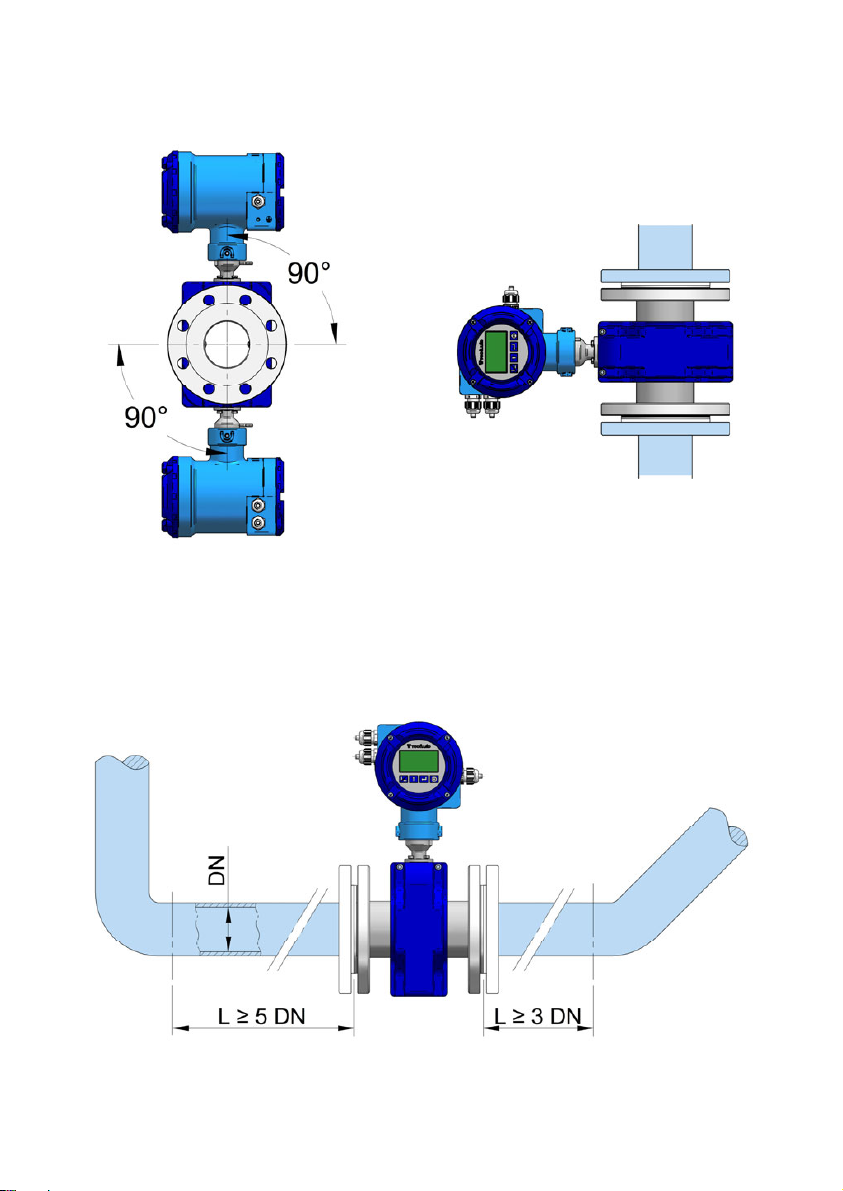
8
4.2 Straight pipe sections
They are necessary before and after the sensor. The minimum distances are the following:
Upstream 5 DN
Downstream 3 DN
In installations with turbulent flow it may be necessary to increase these distances.
4.1 Sensor position
The most adequate position is with the electrodes in a horizontal plane. In this way,
deposits of particles on the electrodes are avoided.
9
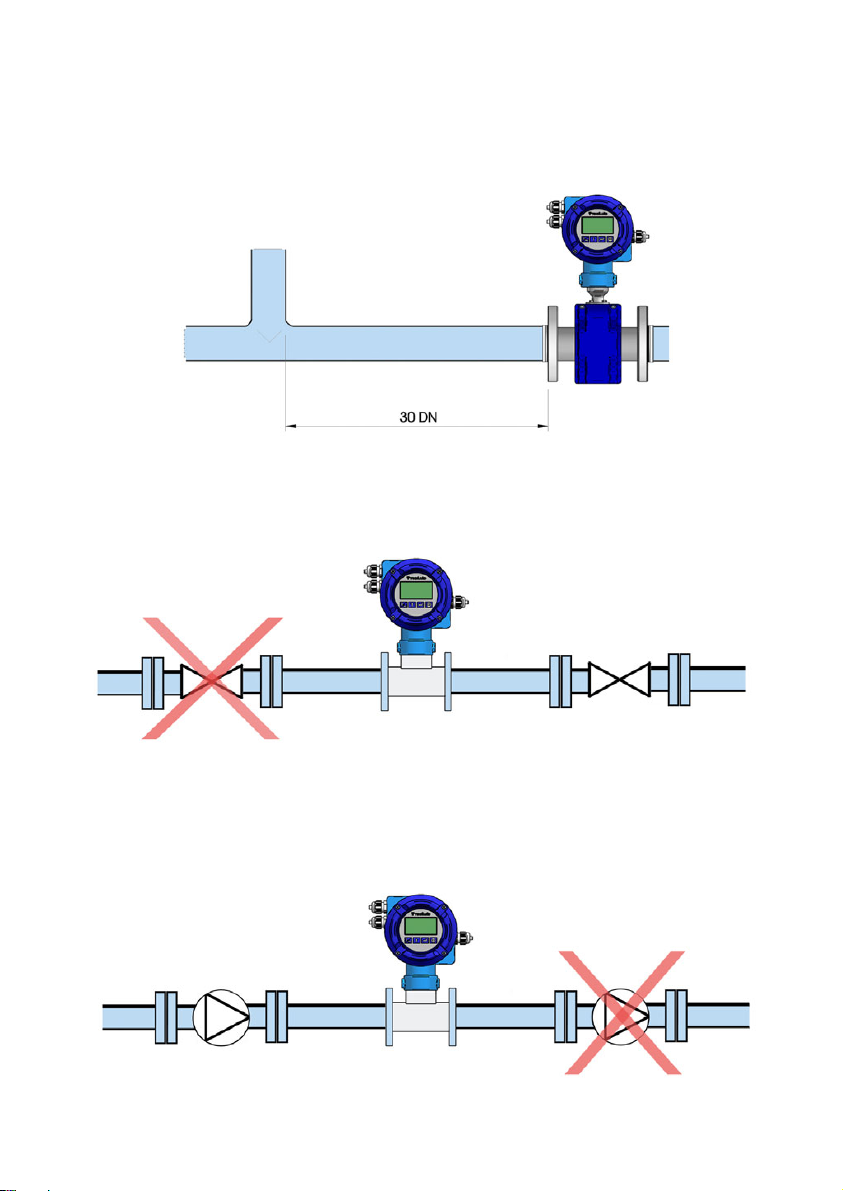
4.2.1 Mixtures
If liquids of different conductivities are mixed it is necessary to install the sensor a minimum
of 30 DN from the point of mixture in order to obtain a uniform conductivity of the liquid and
stabilize the readings.
If this distance is shorter, readings may be unstable.
4.4 Pumps
Pumps should be mounted upstream from the sensor to avoid the suction of the pump
(vacuum) that could damage the sensor liner.
4.3 Valves
Control valves or shut-off valves should always be installed downstream from the sensor to
assure that the pipe is always full of liquid.

10
4.5 Aeration
If there is a point where the difference in level is higher than 5 m an air inlet valve should be
installed after the sensor to avoid a vacuum effect that could damage the sensor liner.
4.6 Reduction of DN
In installations where, due to reasons of the flow rate to be measured, a sensor of a smaller
DN than the pipe DN must be mounted, the reduction must be done with an angle smaller
than 4º to avoid turbulences that can give false readings.
If the angle cannot be so small, straight pipe sections indicated in point 4.2 must be kept.
4.7 Vibrations
Vibrations of the pipes should be avoided by anchoring the pipe before and after the sensor.
The vibration level should be less than 2.2 g in the range of 20-150 Hz according to IEC 068-
2-34.
Altri manuali per FLOMID Series
2
Questo manuale è adatto per i seguenti modelli
2
Indice
Altri manuali Tecfluid Strumento di misura

Tecfluid
Tecfluid LS Series Manuale utente

Tecfluid
Tecfluid FLOMAT Series Manuale utente

Tecfluid
Tecfluid 60 M-1 Series Manuale utente

Tecfluid
Tecfluid 2100 Series Manuale utente

Tecfluid
Tecfluid AD Series Manuale utente

Tecfluid
Tecfluid M21 Manuale utente

Tecfluid
Tecfluid LTDR series Manuale utente

Tecfluid
Tecfluid FLOMID Series Manuale utente

Tecfluid
Tecfluid FLOMAT FX FlomatFX Manuale utente

Tecfluid
Tecfluid CU Series Manuale utente


