
TIS E237 Manuale utente

TIS E237 & E247
Clamp-on Multimeter Series

1
1) SAFETY
This manual contains information and warnings that must be followed for operating the
instrument safely and maintaining the instrument in a safe operating condition. If the
instrument is used in a manner not specified by the manufacturer, the protection
provided by the instrument may be impaired.
The meter protection rating, against the users, is double insulation per
UL/IEC/EN61010-1 Ed. 3.0, IEC/EN61010-2-033 Ed. 1.0, CAN/CSA C22.2 No. 61010-
1 Ed. 3.0, UL/IEC/EN61010-2-032 Ed. 3.0 & UL/IEC/EN61010-031 Ed. 1.1:
Measurement Category III 600V & Category IV 300V AC & DC.
Per IEC61010-1 (2010) OVERVOLTAGE CATEGORY
OVERVOLTAGE CATEGORY ll (CAT II) is for equipment intended to be supplied
from the building wiring. It applies both to plug-connected equipment and to
PERMANENTLY CONNECTED EQUIPMENT.
OVERVOLTAGE CATEGORY lll (CAT III) is for equipment intended to form part of a
building wiring installation. Such equipment includes socket outlets, fuse panels, and
some MAINS installation control equipment.
OVERVOLTAGE CATEGORY lV (CAT IV) is for equipment installed at or near the
origin of the electrical supply to a building, between the building entrance and the main
distribution board. Such equipment may include electricity tariff meters and primary
overcurrent protection devices.
TERMS IN THIS MANUAL
WARNING identifies conditions and actions that could result in serious injury or even
death to the user.
CAUTION identifies conditions and actions that could cause damage or malfunction
in the instrument.
WARNING
To reduce the risk of fire or electric shock, do not expose this product to rain or
moisture. The meter is intended only for indoor use.
To avoid electrical shock hazard, observe the proper safety precautions when working

2
with voltages above 60 VDC or 30 VAC rms. These voltage levels pose a potential
shock hazard to the user. Before and after hazardous voltage measurements, test the
voltage function on a known source such as line voltage to determine proper meter
functioning.
Keep your hands/fingers behind the hand/finger barriers (of the meter and the test
leads) that indicate the limits of safe access of the hand-held part during measurement.
Inspect test leads, connectors, and probes for damaged insulation or exposed metal
before using the instrument. If any defects are found, replace them immediately. Only
use the test lead provided with the equipment or UL Listed Probe Assembly rated CAT
III 600V or better.
This Clamp-on meter is designed to apply around or remove from uninsulated
hazardous live conductors. But still, individual protective equipment must be used if
hazardous live parts in the installation where measurement is to be carried out could
be accessible.
CAUTION
Disconnect the test leads from the test points before changing meter functions.
INTERNATIONAL ELECTRICAL SYMBOLS
! Caution ! Refer to the explanation in this Manual
Caution ! Risk of electric shock
Earth (Ground)
Double Insulation or Reinforced insulation
Fuse
AC--Alternating Current
DC--Direct Current
Application around and removal from hazardous live conductors is permitted
2) CENELEC Directives
The instruments conform to CENELEC Low-voltage directive 2014/35/EC,
Electromagnetic compatibility directive 2014/30/EU and RoHS directive 2011/65/EU.
3) PRODUCT DESCRIPTION
This user's manual uses only representative model(s) for illustrations. Please refer
specification details for function availability to each model.

3
1) Antenna area for Non-Contact
EF-Detection
2) Jaw center indicator (with DCA
polarity for TIS E247 only), at
where best current accuracy is
specified
3) Rotary Selector to turn the
power ON/OFF and Select a
function
4) 3-5/6 digits 6000 counts numeric
LCD display
5) Additional input Jack for Phase
Rotation function only
6) Input Jack for all functions
EXCEPT non-invasive DCA,
DC+ACA, or ACA current
functions
7) Common (Ground reference)
Input Jack for all functions
EXCEPT non-invasive DCA,
DC+ACA, or ACA current functions
8) Push-buttons for special
functions & features.
9) Jaw trigger for opening the
clamp jaw
10) Hand/Finger Barrier to indicate
the limits of safe access of the
meter
11) Clamp Jaw for DC or AC
current magnetic field pick up
12) Additional center indicator for AmpTipTM Low-current function, at where best
AmpTipTM current accuracy is specified

4
4) OPERATION
WARNING: Before and after hazardous voltage measurements, test the voltage
function on a known source such as line voltage to determine proper meter functioning.
ACV, DCV, DC+ACV (Model TIS E247 only), Line-level Hz, & EF (NCV) functions
Inputs, other than that of EF as described below, are made through the test lead
terminals COM/+. Defaults at ACV* Function. Press SELECT button momentarily to
select DCV, DC+ACV, Line-level Hz or EF (NCV) function in sequence.
Note:
*ACV (and hence AC+DCV & Line-level Hz) function is equipped with digital low-pass
filter, and is capable of dealing with VFD (Variable Frequency Drives) signals. It also
improves ACV reading stability in noisy electrical environments.

5
Electric Field EF-Detection
The meter displays “EF” when it is ready. Signal strength is indicated as a series of
bar-graph segments on the display together with variable beep tones.
●Non-Contact EF-Detection: An antenna is located along the top-right end of the
stationary clamp jaw, which detects electric field surrounds energized conductors. It is
ideal for tracing live wiring connections, locating wiring breakage and to distinguish
between live or earth connections.
●Probe-Contact EF-Detection: For more precise indication of live wires, such as
distinguishing between Live and Ground connections, use one single probe to test via
terminal COM for direct contact EF-Detection with best sensitivity.

6
CAUTION & WARNING for Non-Invasive (Clamp-on) Current Measurements:
CAUTION
(Application and Removal of the Clamp-on Jaws) For non-invasive current
measurements, press the jaw trigger and clamp the jaws around conductor(s) of only
one single pole of a circuit for load current measurement. Make sure the jaws are
completely closed, or else it will introduce measurement errors. Enclosing conductor(s)
of more than one pole of a circuit may result in differential current (like identifying
leakage current) measurement. Align the conductor(s) to the Jaws center indicators
(Regular or AmpTip™ indicators where applicable) as much as possible to get the best
measuring accuracy. For removal, press the jaw trigger and remove the jaws from the
conductor(s).
Adjacent current-carrying devices such as transformers, motors and conductor wires
may affect measurement accuracy. Keep the jaws away from them as much as
possible to minimize influence.
WARNING
Do not use the meter to measure currents above the rated frequency (400Hz).
Circulating currents may cause the magnetic circuits of the Jaws reach a hazardous
temperature.

7
Non-Invasive AmpTipTM Low-Current Functions:
ACA, DCA (Model TIS E247 only), DC+ACA (Model TIS E247 only), & Hz
Input is made via the clamp jaws with best accuracy specified near the jaw tip area for
small conductors low-current measurements. Defaults at ACA function. Press SELECT
button momentarily to select the subject functions in sequence.

8
Non-Invasive Regular Current Functions:
ACA, DCA (Model TIS E247 only), DC+ACA (Model TIS E247 only), & Hz
Input is made via the clamp jaws with best accuracy specified at the jaw center for
regular current measurements. Press SELECT button momentarily to select the
subject functions in sequence.
9
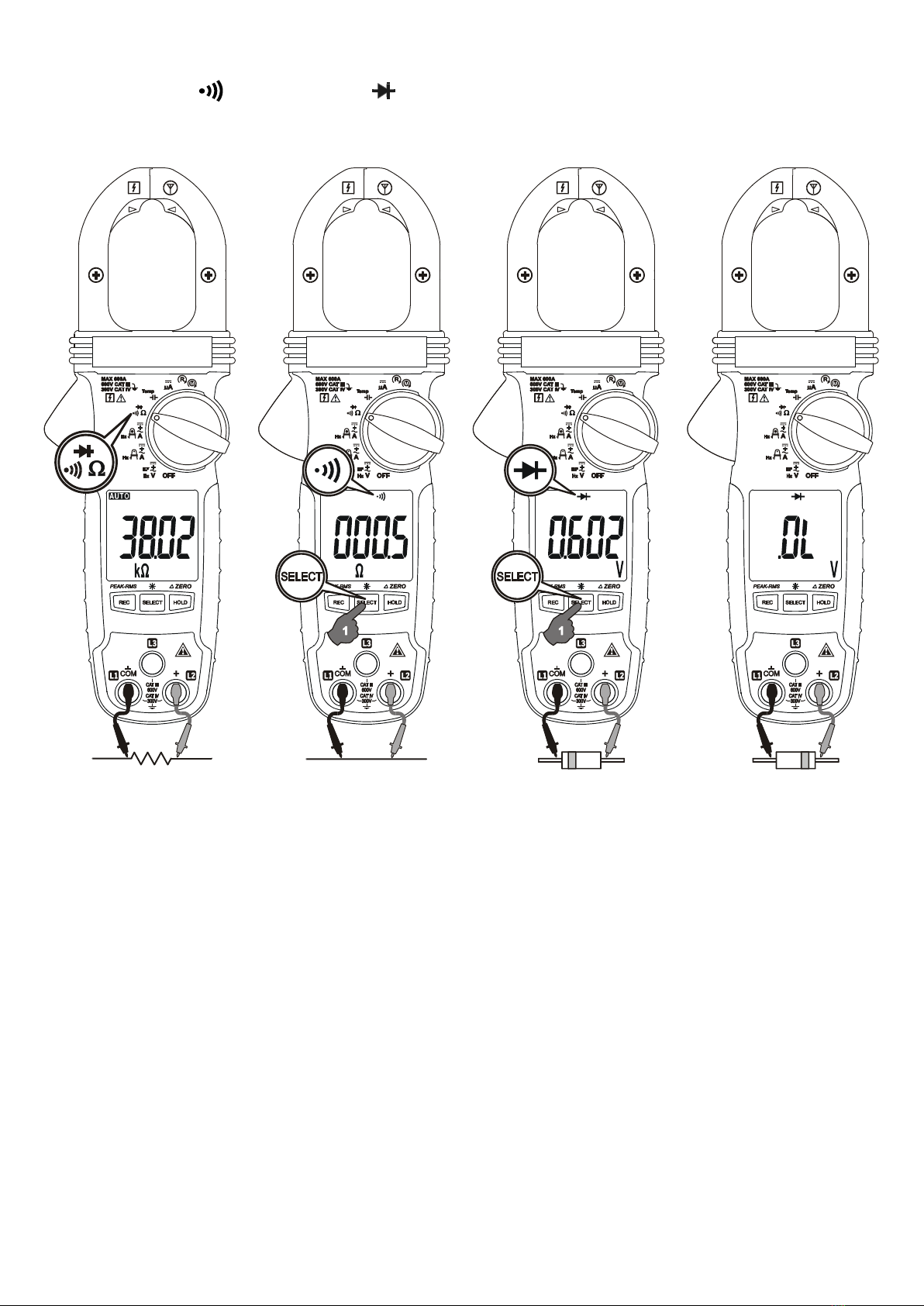
Resistance, Continuity, & Diode functions
Inputs are made through the test lead terminals COM/+. Defaults at Resistance.
Press SELECT button momentarily to select the subject functions in sequence.
Note
When using Diode test function, normal forward voltage drop (forward biased) for a
good silicon diode is between 0.400V to 0.900V. A reading higher than that indicates a
leaky diode (defective). A zero reading indicates a shorted diode (defective). An OL
indicates an open diode (defective). Reverse the test leads connections (reverse
biased) across the diode. The digital display shows OL if the diode is good. Any other
readings indicate the diode is resistive or shorted (defective).
CAUTION
Using Resistance, Continuity or Diode function in a live circuit will produce false results
and may damage the meter. In many cases, the suspected component(s) must be
disconnected from the circuit to obtain an accurate measurement reading.
Questo manuale è adatto per i seguenti modelli
1
Indice
Altri manuali TIS Apparecchiature di prova


Manuali Apparecchiature di prova popolari di altre marche

SMART
SMART KANAAD SBT XTREME 3G Series Manuale utente

Agilent Technologies
Agilent Technologies BERT Serial Manuale utente

Agilent Technologies
Agilent Technologies N3280A Manuale utente

Vernier
Vernier Go Direct Voltage Manuale utente

Lifeloc
Lifeloc R.A.D.A.R. Manuale utente

Fluke
Fluke T5-600 Istruzioni per l'uso e l'installazione


