Wilcoxon Sensing Technologies t: 301-330-8811
8435 Progress Drive, Frederick, MD 21701 f: 301-330-8873
Amphenol (Maryland) d/b/a Wilcoxon Sensing Technologies www.wilcoxon.com
91220 Rev. F 08/2020 Page 6of 14
displacement is 1 micron per 1,000 volts input, then a 1,000 volt, peak, sine wave will produce
an acceleration of 4g, peak, at 1 kHz or 100g, peak at 5 kHz. The acceleration of the table is
proportional to the square of the frequency times displacement.
Above the fundamental resonance frequency the output is force controlled. The force generated
by the piezoelectric shakers can be up to 2,000 Newton, peak (800 Vrms) by the F7 model or 50
Newton, peak (800 Vrms) by the F7-1 model.
The output of the shaker with a typical test specimen attached to the shaker or table is
dependent on the mechanical impedance of the specimen. At anti-resonances (maximum
impedance) the displacement of the shaker is at a minimum, but the specified force is delivered,
provided that the impedance of the base mass is sufficiently high. At the resonances (minimum
impedance) the shaker acceleration must be limited to the maximum specified levels for the
individual shakers. The blocked force output curves refer to the force developed against a mass
of infinite impedance. The graphs on the product data sheets for the shakers show typical
frequency response and may vary between shakers. Matching of shakers to a common first
resonance frequency is available on special order. Wide fluctuations in force output are present
at very high frequencies; however, these shakers can be used as a source of structural
excitation above 60,000 Hz.
Piezoelectric shakers present a capacitive (reactive) load to power amplifiers, therefore the
electrical impedance decreases with increasing frequency. A large power amplifier is required to
drive a shaker at maximum voltage to its maximum frequency. Smaller amplifiers may be used
to drive the shaker at maximum output at lower frequencies. Optimum operation over a range of
frequencies requires the proper impedance matching network between the power amplifier and
piezoelectric shaker.
2.1 Piezoelectric reaction shakers
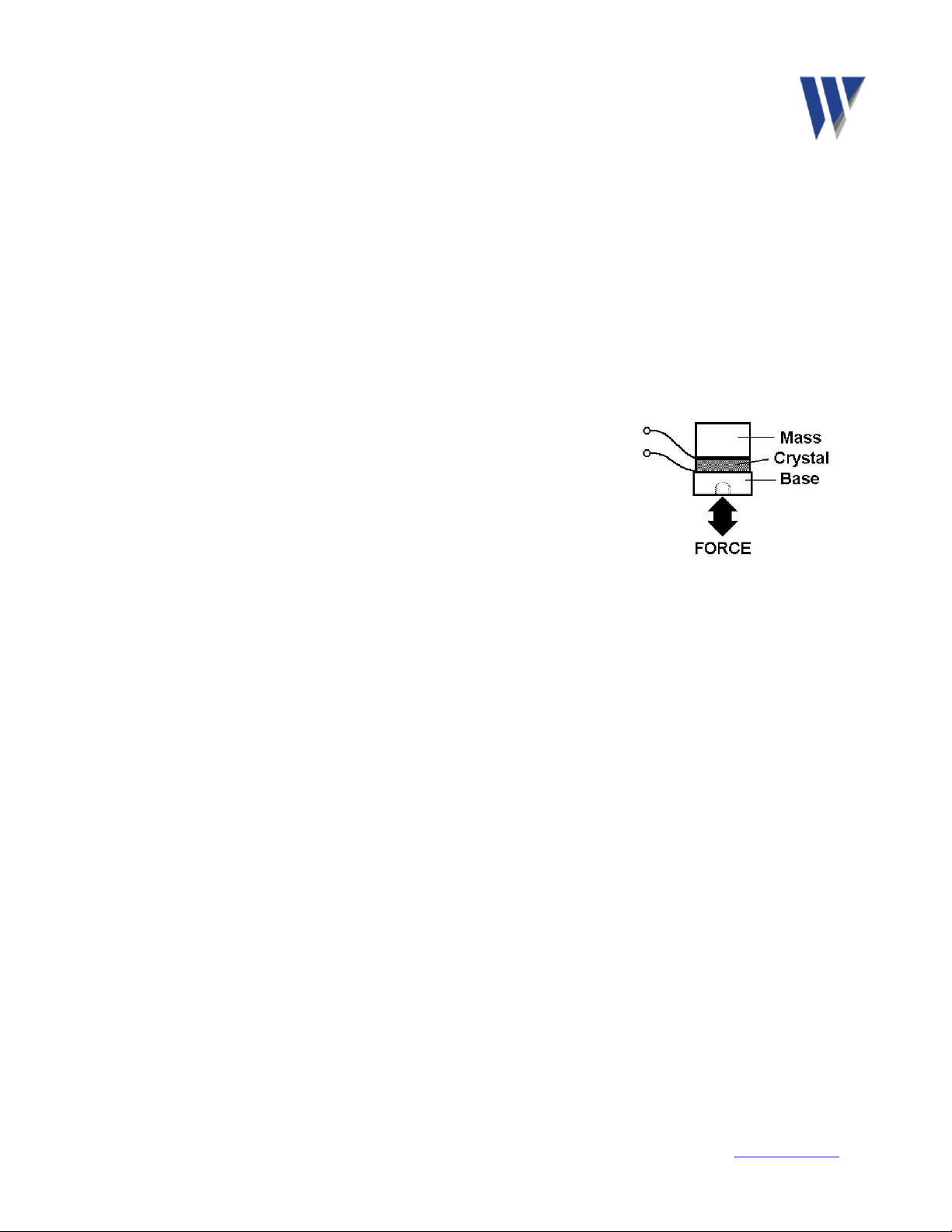
Piezoelectric reaction shakers are compact, lightweight shakers that utilize the
expansion/contraction properties of piezoelectric crystals for sonic and ultrasonic structural
excitation. These portable reaction-type shakers generate large dynamic forces to very high
frequencies for structural excitation in vibration research and testing. The reactive principle of
operation combined with a lightweight and compact configuration allows these generators to be
stud-mounted in any position, directly to structures, without external support or critical shaft
alignment problems. The F7 piezoelectric vibration generator is designed to mate with the F4
electromagnetic vibration generator to extend the frequency range down to low frequencies (see
the specification sheet for model F4/F7 for details).
A transducer base is located on the model F7 and has a transducer containing a force gage and
an accelerometer. These transducers are built into the attachment point of the F7 and measure
the force applied to the structure (force gage) and the resulting vibratory motion
(accelerometer). The transducer signals can be fed into either the read-out equipment or into
signal conditioners. During the design of this base, particular attention was given to yield a
minimum mass below the force gage.