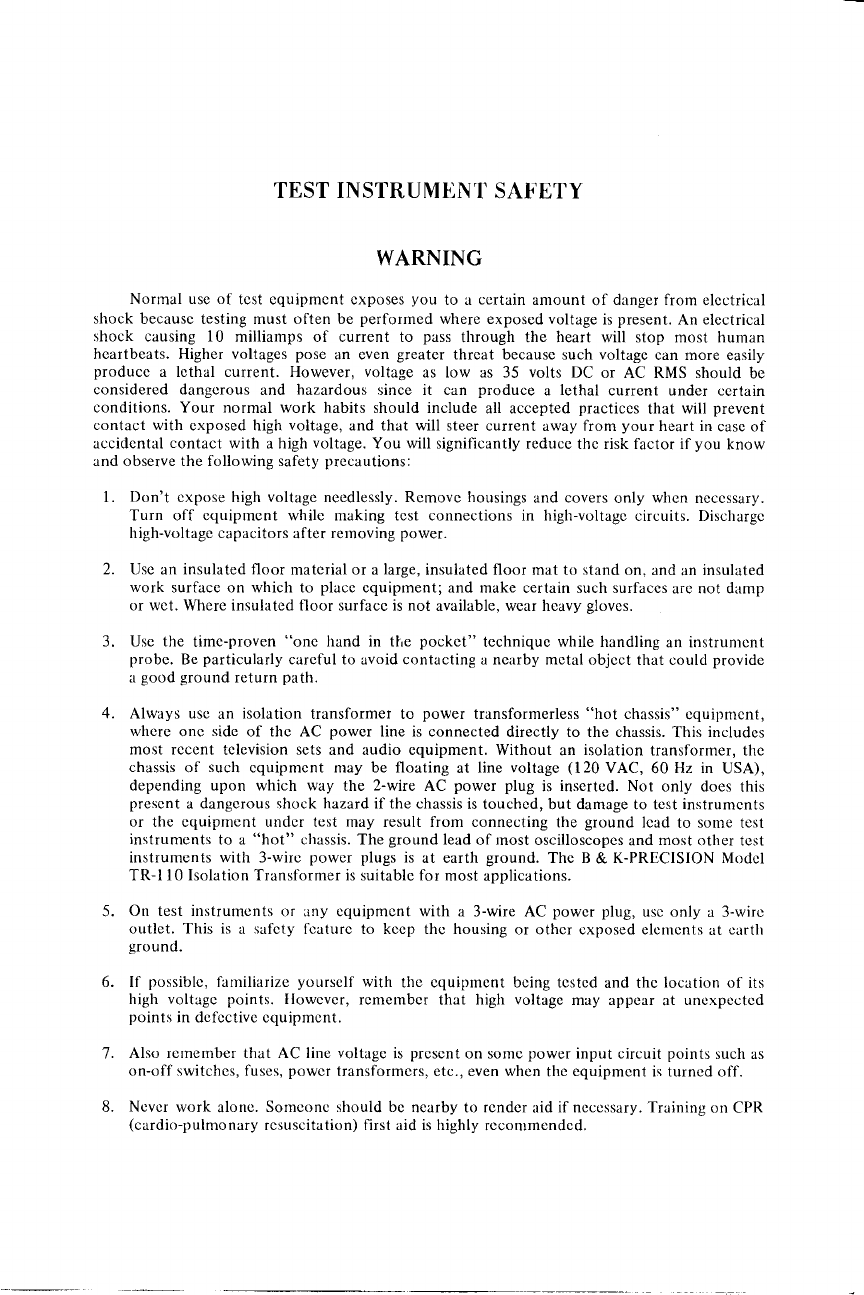
TESTINSTRUMI]NT
SAI.'ETY
WARNING
Normal useof tcst cquipmcnt cxposes
you to a ccrtainamount of dangerfiom elcctrical
shock becausctesting must often be performed where exposedvoltageis present.
An electrical
shock causing 10 milliamps of ourrent to passthrough the heart will stop most human
hcartbeats. Higher voltages pose an even greatcr thrcat becausesuch voltage can more easily
producc a lcthal current. However, voltage as low as 35 volts DC or AC RMS should be
considered dangcrous
and hazardoussince it can produce a lcthal current under ccrtain
conditions. Your normal work habits should include all accepted
practices
that will prevcnt
contaot with cxposedhigh voltage,
and that will steer
current away
from your heartin cascof
accidental
contact with ahigh
voltage.
You will significantly
reduccthc risk factorif you know
and observethe following safety precautions:
1. Don't cxposehigh voltageneedlessly.Removc housings
and covers
only whcn ncccssary.
Turn off cquipmcnt while making tcst connectionsin liigh-voltagc
circuits.Dischargc
high-voltagccapacitorsafter removing power.
2. Use
an insulatedfloor materialor alarge,
insulatedfloor mat to stand
on, and
aninsulated
work surfaccon which to placc
cquipment;and make certainsuchsurfaces
arenot damp
or wet. Whereinsulated floor surfaocis not available,wcar hcavy gloves.
3. Use the timc-proven "one hand in the pocket" tcchniqucwhile handling
an instrunrcnt
probc. Be
particularly
carcfulto avoidcontactingancarbymctal
objcct that could provide
agoodgroundreturnpath.
4. Always usean isolation transformerto power transformerless
"hot chassis"
equipntcnt,
wherc onc side of thc AC power line is connected directly to the chassis.
This includes
most recent tclevision
sctsand audio cquipment. Without an isolation
transformer,the
chassis
of such cquipmcnt may be floating at line voltage(120 VAC, 60 Hz in USA),
dependingupon which way the 2-wire AC power plug is inserted.Not only does this
prescnt
a dangcrousshockhazardif the chassis
istouchcd,
but damage
to test
instrumcnts
or the cquipment undcr test may result from connectingthe ground lcad to some
test
instruments
to a "hot" chassis.Thegroundlead
of rnostoscilloscopcs
andmostother tost
instrumcntswith 3-wire power plugsis at earth ground. Thc B & K-PRECISIONModel
TR-l l0 IsolationTransfbrmerissuitablcfor mostapplications.
5. On test instruments
or any equipmcnt with a 3-wire AC power plug, usconly a 3-wirc
outlet. This is a safcty fcaturc to kccp tho housing
or othcr cxposedelcmcnts
at oarth
ground.
6. If possiblc,
larniliarize
yoursclf with the cquipmcnt bcing tcstcd
and thc location of its
high voltagc points. Ilowcvcr, rcmembcr that high voltagcmay appear
at uncxpcctcd
points
in defcctivccquipmcnt.
7. Also rcmemberthat AC line voltagc
is prcscnt
on somc
powerinput circuit points
suchas
on-offswitchcs,fuses,
powcr transformcrs,etc.,evenwhentheequipment
isturnedoff.
8. Ncvcr work alone.
Someoncshouldbc ncarbyto rcndcr
aidif nccessary.Training
on CPR
(cardio-pulmonary
rcsuscitation)firstaid ishighly rcoonrmendcd.